

National Arts Club Lecture: Picasso Ceramics: Fake, Fraud or Genuine?

Join Charles Mathes, AAA for a lecture on Picasso Ceramics. Literally tens of thousands of ceramics were replicated at the Madoura Pottery in the South of France after Picasso’s originals. The secondary market for these Picasso ceramic editions is now larger than ever with internet bidders paying record prices based solely on on-line images. While the vast majority of Picasso ceramics in the international marketplace are genuine, it can be a mistake to assume that everything is what it seems to be. This lecture is not the usual survey of what Picasso ceramics are and how they came to be, but instead what they may not be and what they definitely aren’t.
A reception with refreshments will follow the lecture, which will be held in the historic National Arts Club, a National Landmark building and the former home of Governor Samuel Tilden.
 Veteran Appraisers Association Certified member Charles Mathes, AAA, was director of a New York City gallery specializing in Modern Art. Now a consultant and advisor, he has handled and appraised hundreds of Picasso ceramics over the course of his career and has written and spoken frequently on the subject.
Event Details
Date:
Monday, May 5, 2025
Time:
6-8 PM ET
Location:
The National Arts Club
The Sculpture Court
15 Gramercy Pk S
New York, NY
Price:
In Person (NYC) $20.00 Members
$25.00 Non-Member
Free CASP Student or Associate Candidate
Register for Event
Picasso Ceramics – Originals, Editions and Variants
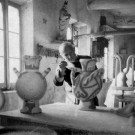
The term “Picasso Ceramics” generally refers to the pitchers, plates, vases and plaques that were recreated by the artisans at the Madoura pottery in the South of France after ceramics personally decorated by Pablo Picasso. These “authentic replicas” and “original prints” were done in editions of from 25 to 500 and were sold inexpensively to tourists until Japanese demand in the 1980s caused a price explosion. For the past thirty years EDITION PICASSO CERAMICS that might originally have been purchased for under a hundred dollars have sold for tens of thousands.
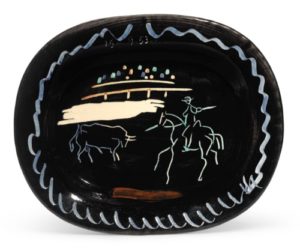
EDITION PICASSO CERAMIC AR 198 – one of 500 copies – sold at Sotheby’s London 4-10-2017 for $13,194
Because this is the age of “art as investment” people talk about the “Picasso ceramic market.” In order really to have a market for something you need a sufficient supply, a minimum trading volume and reliable information. The New York Stock Exchange for instance, requires member companies to fulfill various reporting requirements, have 1.1 million public shares outstanding and a monthly volume of 100,000. If you add up all the EDITION PICASSO CERAMICS (I once did), the total comes to almost 120,000 pieces. There’s a reliable catalogue raisonné and, while public sales of even the larger editions rarely exceed half a dozen per year, there are enough auction records over the past three decades to give the illusion of a market, albeit a thinly traded and highly inefficient one.
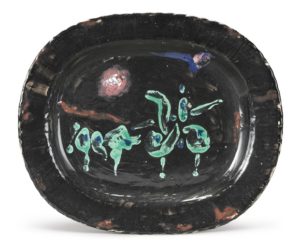
PICASSO CERAMIC ORIGINAL – personally decorated by Picasso sold at Sotheby’s in May 2017 for $32,500
But what about ceramics that Picasso personally painted? There were over 4,000 of these, including the prototypes after which the EDITION PICASSO CERAMICS were replicated. The vast majority of such PICASSO CERAMIC ORIGINALS were never offered for sale and are now in museums. Though dealers occasionally get hold of one and a few have made their way to auction, there have been years when it would have been difficult to find a ceramic hand-painted by Picasso for sale anywhere in the world. Nor is there anything approaching a definitive reference, though PICASSO CERAMIC ORIGINALS are discussed in a few books including the catalogue for the 1999 exhibition at the Met, “Picasso – Painter and Sculptor in Clay.” Dealers and auction houses like to call such ceramics “Unique,” perhaps not using the word “Original” so as not to draw attention to the fact that the EDITION PICASSO pieces are what some might call reproductions. However, the term “unique” can be misleading, as we shall shortly see.
In June 2015 Picasso’s granddaughter, Marina, put more than two hundred PICASSO CERAMIC ORIGINALS that she had inherited up for auction at Sotheby’s London. Coincidentally there was a sale of EDITION PICASSO CERAMICS the same day across town at Christies, giving a rare opportunity to compare prices of Picasso’s ORIGINALS versus EDITIONS. But adding a couple hundred of Marina’s ORIGINALS to the few already in circulation didn’t suddenly make this a reliable market. This can be seen from the spread between the sale prices and the estimates, which varied by tens of thousands of dollars. In an efficient market (like the NYSE) the difference between the bid and ask can be a penny.
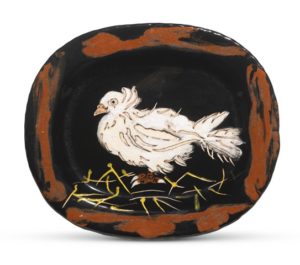
EDITION PICASSO AR 79, one of 300 copies. Between 2014 and 2017 there were more than a dozen sales of this ceramic between about $7,500 and $18,000.
In May 2017 Marina Picasso put more of her inherited pieces up for auction, this time at Sotheby’s in New York. Sotheby’s marketed this batch not as “Picasso ceramics,” but as “Works from the Collection of Marina Picasso.” In fact more than half the sale was comprised of drawings, which also made the three highest prices, but there were also PICASSO CERAMIC ORIGINALS, EDITION PICASSO CERAMICS, as well as another category that most collectors and many dealers are totally unaware of – EDITION PICASSO VARIANTS.
EDITION PICASSO VARIANTS are basically EDITION pieces apart from the official count that were for some reason decorated differently than the ceramics described in Alain Ramié’s definitive “Picasso – Catalogue of the Edited Ceramics.” There is virtually no information available about why such variations were created or how many exist.
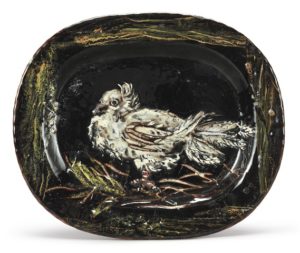
PICASSO CERAMIC VARIANT from Marina Picasso Collection brought $30,000 at Sotheby’s NY 18 May 2017
Picasso’s ideas evolved, and he often executed several slightly different versions of a ceramic. Perhaps the VARIANTS were tests, and ultimately a different version was selected for the EDITION PICASSO piece. Another possible explanation is that the artisans at the pottery were just fooling around. Madoura didn’t fire all the pieces of an EDITION at once. A small number were created at a time and another batch was fired only when the existing ones were sold. Maybe there was an extra blank, and someone couldn’t bear to just throw it away. Or maybe Picasso wanted to give a particular ceramic to a friend but the EDITION was closed out, so he just instructed Madoura to make a different, undocumented proof.
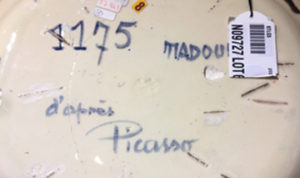
Picasso Dove Variant – reverse.
Whatever the reason for their existence, it’s generally been assumed that EDITION PICASSO VARIANTS were not created by Picasso personally. In the 1950s and 1960s EDITION PICASSO CERAMICS were inexpensive souvenirs; anything that Picasso personally decorated was in a different category entirely and scrupulously documented for the valuable object it was. Thus the VARIANTS that have made their way to auction have been considered mere curiosities and usually sell for prices comparable to the EDITION pieces.
The May 2017 sale of Marina Picasso’s odds and ends, however, has presented a new wrinkle in the status of EDITION PICASSO VARIANTS. The day I went to a viewing only junior people were available at Sotheby’s but I was told that every piece in the sale would come with a certificate from Claude Picasso saying that it was “unique.” Unique in the sense that it was painted personally by Picasso or unique in that it was an undocumented version of the EDITION PICASSO CERAMIC? The junior people weren’t clear, but what’s indisputable is that these ceramics had once belonged to Picasso and were part of the collection that Marina Picasso inherited from her grandfather.
Take a look at the EDITION PICASSO CERAMIC Dove above, AR 79, and the VARIANT from Marina Picasso’s collection. In the auction catalogue Marina Picasso’s Dove is one of the few ceramics in the sale not identified as unique, only as “Painted, glazed and incised ceramic.” It is marked on the reverse “d’apres Picasso” – “d’apres” means “after” in French. The logical conclusion is that it is not from Picasso’s hand; it is simply an EDITION PICASSO VARIANT.
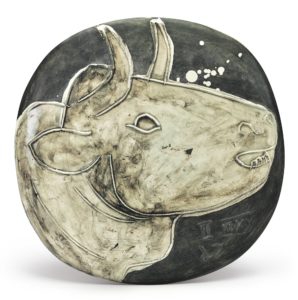
Marina Picasso’s EDITION PICASSO VARIANT Bull’s Profile sold for $62,500
It’s always a good idea to personally inspect an item you wish to buy at auction and to read carefully its catalogue description. Consider Marina Picasso’s Tête de Taureau for example. As with the Dove platter above, the catalogue entry for this Bull’s Profile plaque says nothing about its being unique, just that it’s in reverse in the EDITION piece.
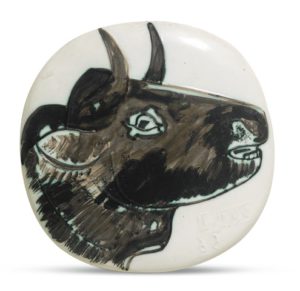
EDITION PICASSO Bull’s Profiles rarely sell for more than $6000.
Yet the ceramic brought $62,500 in the sale, which is curious because there are three different EDITION PICASSO versions of this same Bull’s Profile, adding up to a total of 1000 ceramics, and they generally bring under $6,000 at auction.
Are there other copies of this Bull’s Profile in reverse VARIANT? I have no idea, and as I said before, there is no way to find out. Certainly provenance can add value, but does the fact that Picasso had this VARIANT in his house (over the mantel? in the closet?) make it worth a 1000% premium? If so, why didn’t Marina Picasso’s Dove platter bring ten times the price for that EDITION piece?
Though no claim was made that Picasso personally decorated Marina Picasso’s Dove platter or her Bull’s Profile plaque, the Sotheby’s auction catalogue does give us some new information about VARIANTS, unequivocally stating: “Sometimes the decoration [of empreintes] would be replicated for the editions, but all the examples in the Marina Picasso collection were painted or otherwise decorated by the artist himself.”
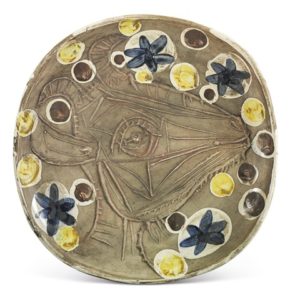
Marina Picasso’s Unique Version of an Empreinte Picasso brought $137,000.
“Empreinte originale” – also called “Original Print (or O.P.)”- was a technique whereby a mold reproduced Picasso’s raised structures in the wet clay. The catalogue description of each of such VARIANTS in the Marina Picasso collection calls it “a unique version of the empreinte.” So now we know that Picasso did personally create some VARIANTS, including a “unique version of the empreinte” Tête de Chevre (Goat’s Head), which sold for $137,000. (There are five different EDITION PICASSO versions of similar Goat’s Head empreintes in the catalogue raisonne (Ramié 151 – 155). Marina Picasso’s piece is a VARIANT of AR 154, the only EDITION Goat’s Head that has four Xs.)
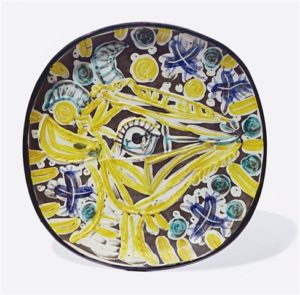
EDITION PICASSO CERAMIC AR 154. Goats Heads of the five different types generally bring between about $10,000 and $30,000 at auction
So are there any other “unique” copies of this same Goat’s Head VARIANT? The answer is yes – sort of. Another ceramic much like the one illustrated above came to auction on April 25, 2012, at Phillips de Pury & Co. in New York, where it was even described in the auction catalogue as “a unique variant” and sold for $21,250. The Phillips catalogue reported “There is an extremely similar image of a unique piece in the Marina Picasso Collection (Picasso Keramiek 1985 Museum Het Hruithuis).” Why was the Phillips “unique variant” created? Who decorated it and had the audacity to include nine yellow balls instead of the ten Picasso used in Marina’s ceramic?
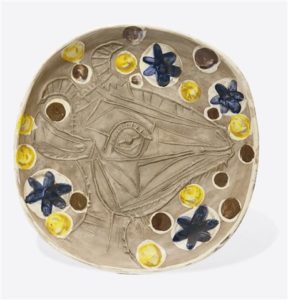
EDITION PICASSO VARIANT Goat’s Head brought just $21,250 in a 2012 auction at Phillips
Because different artisans replicated the EDITION PICASSO CERAMICS by hand after Picasso’s ORIGINALS, every EDITION piece is “unique” in that sense. Of necessity all VARIANTS were individually painted, too, and subtle differences in shapes and lines can always be found between two hand-painted recreations. You can see these for yourself if you examine this third VARIANT Goat’s Head that I found advertised on a dealer’s website as a “unique color variant.”
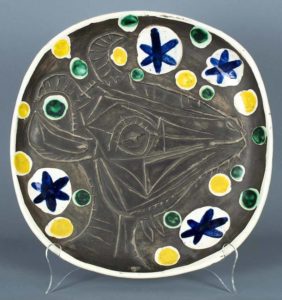
Another Picasso Goat’s Head “unique” variant
If “unique” VARIANTS aren’t enough to drive you crazy, there was actually a fourth category of Picasso Ceramics that were included in the Marina Picasso Sotheby’s May 2017 sale: damaged pieces. Remember that “d’apres Picasso” Dove platter EDITION PICASSO VARIANT? It had a great big crack right down the middle. Was this reason why it didn’t fetch more than about twice the price of the EDITION piece?
Picasso didn’t consider any ceramic a mistake that should be discarded; he believed something could be always be learned and even designated one of the Madoura artisans as his “mechanic” who would repair pieces that had been damaged in the firing. Several PICASSO CERAMIC ORIGINALS in this sale in fact had staples visible on the back to hold cracked pieces together.
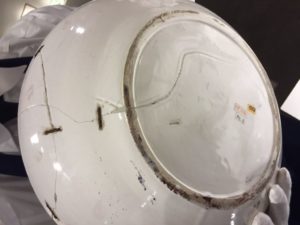
A cracked Picasso ceramic showing staples holding it together
Perhaps the VARIANT Dove became part of the Marina Picasso Collection because, no matter who had painted it, Picasso liked it despite the damage and took it home. After all, Picasso was the man who took a little owl with an injured claw home to live with him and Francois Gilot when he first came to Antibes in 1946. It was this owl that in fact inspired a number of his ceramics.
Marina Picasso’s unique Goat’s Head empreinte (it might be clearer to call it a PICASSO CERAMIC ORIGINAL – EDITION VARIANT) also had damage clearly visible on the reverse.
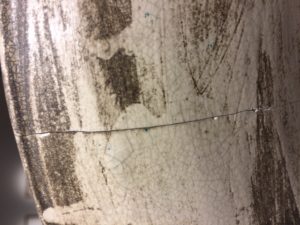
Marina Picasso Goat Head damage
So if Picasso didn’t care about damage, should potential buyers? Apparently the buyer of Ms. Picasso’s Goat’s Head VARIANT didn’t, if he or she was even aware that the plate had a crack. These days a lot of auction buyers don’t attend previews or even ask for condition reports, they just look at on-line pictures which rarely focus on a lot’s flaws. Certainly if there are three hundred copies of an EDITION PICASSO CERAMIC and one comes up for sale with a big chunk missing from the rim, people will likely want to wait for a better copy to their collection. However, earthenware ceramics can restored so expertly that even experienced dealers can’t detect any trace of damage by eye, and how many people really demand condition reports on pieces that look perfect? (For a discussion of how restoration can affect value of EDITION pieces, click here.)
With Picasso ORIGINALS, damage may not affect value at all. When casino magnate Steve Wynn put his elbow through Picasso’s painting La Rêve, which hedge fund honcho Steve Cohen had agreed to purchase for $139 million, Wynn sued his insurance company for $54 million in lost value. The suit was settled for an undisclosed amount, but a few years later Cohen turned around and bought the restored La Rêve anyway for $155 million, $16 million more than he was going to pay originally. After all, La Rêve was still a great Picasso, and it wasn’t like Cohen could go out an buy an undamaged version.
Because of paucity of supply and lack of information, the market for PICASSO CERAMIC ORIGINALS is so thin as to be practically non-existent. Consequently damage to such items may in fact present unique opportunities. Consider the top ceramic lot in Sotheby’s May 2017 sale of works from the Collection of Marina Picasso, Vase-femme Avec Bras-Anse, (Woman Vase with Arm Handle)” which brought $250,000.
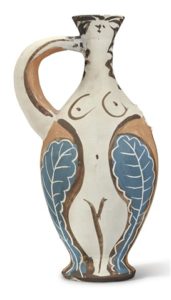
The catalogue visual of PICASSO CERAMIC ORIGINAL, Vase-femme avec un bras-anse
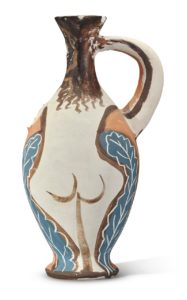
The vase’s rear end
Picasso’s son, Claude, in an essay in “Picasso, Painter and Sculptor in Clay” described how much of a challenge it was for his father to decorate a three dimensional object and how Picasso utilized the forms themselves in creative and whimsical ways – painting the picture of a vase on a vase, turning a handle into a flower, etc. Vase-femme Avec Bras-Anse is a perfect demonstration of how Picasso didn’t merely accept the limitations of shapes but used them to create something even better. However, many potential bidders may have seen only damage if they attended the preview. In the sale room it was evident that the “Arm Handle” had been restored and there had originally been another matching arm on the other side that was now missing entirely!
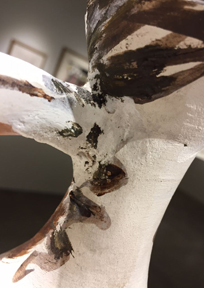
Picasso Original Repaired Arm
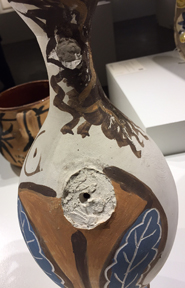
Picasso Original Missing Arm
Despite the damage the ceramic still soared above its $40,000 – $60,000 estimate. I think whoever snapped up this piece still got a tremendous bargain, even if he or she were one of those on-line buyers who had looked only at the pretty pictures in the auction catalogue and fainted when they opened the box. After all, $250,000 is a small price to pay for what is arguably a great PICASSO CERAMIC ORIGINAL. I mean we’re talking about just 1/1000th (all right, 0.00161290322%) of the $155,000,000 that Steve Cohen wound up paying for La Rêve! Who do you think got the better deal?
I think it’s extremely likely that the next time Vase-femme Avec Bras-Anse surfaces it will have both arms intact and no evidence that either of them had ever been anything other than perfect. Even if the new owner is a dealer who wants to make a big profit on the piece there would be no reason to conceal that it had been skillfully restored – a potential buyer will be hard-pressed to find a similar ceramic at any price.
Unique Picasso Ceramics vs. Madoura Editions
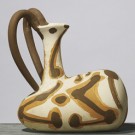
The market for Edition Picasso ceramics is hot. The auction prices of some pieces have soared 500% and more from one year (or one sale) to the next.
I’ve discussed the reasons for this explosion of interest before (the Runaway Bull, the Runaway Bull Returns, the High-Flying Owl), reminding people that the Edition Picasso Ceramics were not personally painted by Picasso. Though Picasso decorated over 4,000 ceramics, the Edition Picasso is comprised of some 600 “authentic replicas” recreated after Picasso’s unique prototypes by the artisans at the Madoura pottery in the South of France.
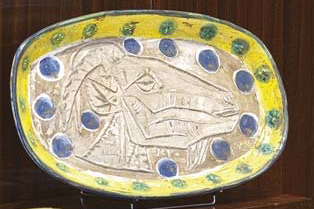
This Edition Picasso “Tête de chèvre de profil” AR 148 sold at Sotheby’s Paris on May 21, 2015, for $19,468.
When people hear about this distinction their initial reaction is often that they don’t want to buy “reproductions,” only originals. Unfortunately original Picasso paintings can cost as much as $179,365,000 at auction. A desirable Edition Picasso ceramic can sell for 1/10,000th of that (the Goat plate illustrated above brought only 1/9,213th of the record painting price, but you get the idea). No wonder these multiples quickly became collectable after their introduction in 1948 when they were sold as inexpensive souvenirs to vacationing tourists. That’s right, Edition Picasso ceramics purchased for fifty dollars in the 1950s are today worth tens of thousands.
So you would figure that the ceramics that Picasso personally decorated would be a lot more valuable than the ones that were replicated, right? Well, yes and no. Yes, they’re worth more. But no, they’re not worth 10,000 times more, or even 1000 times more. Or even 100 times more. Or, often, even 10 times more. And some of them have recently sold for less than Edition pieces.
One reason for this anomaly is the very rarity of Picasso’s “original” ceramics, most which were never commercially available. People equate rarity with value, but prices are determined in the marketplace. Picasso kept the vast majority of the unique pieces for himself and most ended up in museums or with members of the artist’s family. Consequently, the kind of competition that makes prices rise never developed for originals – they rarely came up for sale. However as early as the 1970s the approximately 120,000 ceramics in the Edition Picasso began appearing at auction. If a collector wanted an Edition Picasso ceramic there was a huge selection immediately available, but if he wanted a ceramic that Picasso himself had painted he might wait years before one appeared. The very term “Picasso ceramic” came to mean one of the multiples replicated by the artisans at Madoura.
It’s therefore doubly difficult to compare values for unique Picassos and Edition Picasso pieces, since not only do auction results swing wildly from place to place and year to year, there just isn’t much comparable sales data. Because of a rare coincidence, however, we now have a unique opportunity to make such price comparisons. In London on June 25, 2015, Sotheby’s sold a collection owned by Marina Picasso of over 100 ceramics personally painted by her grandfather (Marina is the daughter of Picasso’s son Paulo and his first wife, Olga Khokhlova). On the same day in another part of town there was a dedicated sale of Edition Picasso ceramics – at Christie’s South Kensington, the venue that has accounted for many of the recent record-breaking sale prices.
While comparing apples and oranges is still easier than comparing most of the ceramics in these two sales, some pieces are directly equatable. For instance, take a look at these two pieces:
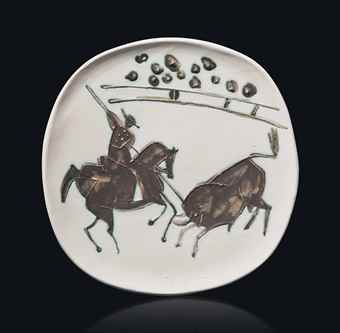
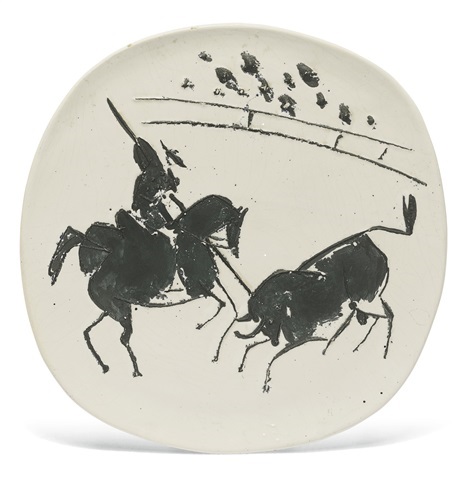
The one on the left is from the Edition Picasso, Picador et taureau, AR 194, from the edition of 200 (the “AR” number is from Alain Ramié’s definitive catalogue raisonné). The one on the right was entitled Tauromachie in Marina Picasso’s collection, a unique ceramic hand-painted by Picasso — almost certainly the prototype for the Edition piece.
The AR 194 Edition Picasso Picador et taureau plate brought the equivalent of about $10,780 at Christie’s South Kensington. At the Sotheby’s sale across town the comparable unique piece sold for the equivalent of $68,800. Granted that neither one of these ceramics is a great work of art. In fact if you had been at Madoura in 1953 the Edition piece was probably one of the Picasso tsotchkes priced at five or ten bucks. But if you use these two ceramics as a guide, a Picasso “original” is worth 6.38 times more than the Edition Picasso piece.
However, another pair of ceramics tell a different story:
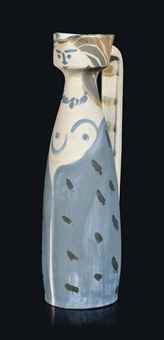
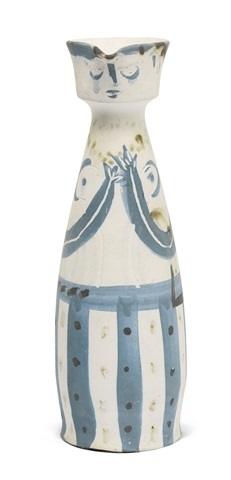 In the Christie’s sale, the AR 296 Edition Picasso ceramic, pictured on the left, sold for $27,440 (I’m using the auction houses’ conversions to translate all of these prices from pounds to dollars). The one of the right, one of Marina Picasso’s unique pieces, sold for $94,354 at Sotheby’s. The market — as well as your eyeballs — might suggest that these ceramics are “better” than the Picador plates. However, using these vases as a guide, a Picasso “original” is worth only 3.43 times more than the copy. Why does a “better” original bring a smaller multiple?
The most expensive piece in Sotheby’s sale of Marina Picasso’s ceramics, by far, was described as a vase but seems more of a sculpture than the usual shapes and plates in the Edition Picasso. It sold for $762,698 and is pictured at the top of this page. No Edition Picasso ceramic is even remotely comparable to this piece. The top lot in the Christie’s sale was Femme du Barbu (the Bearded Man’s Wife), AR 193, which sold for $163,856. Using these two ceramics as a guide you might conclude that the best Picasso original is worth 4.65 times more than the best Edition Picasso multiple.

Femme du Barbu (the Bearded Man’s Wife) AR 193, an edition of 500
Of course it is worth noting that Femme du Barbu is hardly among the “best” Edition Picasso ceramics. For starters it’s an edition of 500, the largest edition size made. I’ve found 16 other sales of this ceramic since 2013 with an average sale price of about $30,000 (until the Madoura sale in 2012 they brought much less). Femme du Barbu was estimated in the Christie’s catalogue for about $19,000 – $28,000. In short, it’s a fairly large, very common ceramic, and it’s whimsical and fun. But you can say the same about many, many other pieces.
So in the interest of fairness let’s look at what actually is considered to be the “best” Edition Picasso ceramic because of its scale, rarity, beauty and renown: the Grand Vase, AR 116. This ceramic is over ten inches larger than Femme du Barbu, it’s from an edition of just 25 (the smallest produced), it is pictured on the cover of the Alain Ramié’s catalogue raisonné and in a famous photograph of Picasso by Henri Cartier-Bresson. One of these pieces made the auction record for an Edition Picasso ceramic: $1,144,268 at the much hyped “Madoura” sale in 2012. Another brought $1,080,221 in 2014. Thus using the Grand Vase as a guide, the best “original” Picasso ceramic in Marina Picasso’s collection was worth less than the best Edition Picasso piece!
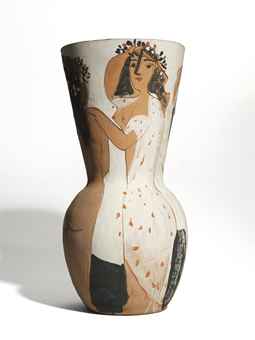
Prototype for Picasso “Grand Vase” AR 116 which brought a record $1.5 million. One of the 25 Madoura Edition Picasso copies brought $1.14 million.
If you want to get picky, at $762,698 Marina Picasso’s unique vase pictured above isn’t the “best” unique Picasso ceramic ever to sell at auction, at least in terms of price. Ironically that honor belongs to Picasso’s prototype for the same Grand Vase that set the record for most expensive Edition Picasso ceramic. This prototype sold in 2013 at Christie’s in London for $1,534,557. In other words, the original sold for only 1.5 times more than the copy.
Clearly something is screwy here. Either Edition Picasso ceramics are overpriced, unique Picasso ceramics are underpriced, or a combination of both. To say nothing of the possibility that the entire art market may presently be in the same kind of mania that precedes stock market crashes (and the fact that it’s silly to try to draw conclusions from individual sales in thinly traded, inefficient markets).
Regardless of whether an entire market is elevated or depressed, however, certain ratios should be constant unless there is a fundamental paradigm shift as there was in the 1970s and 1980s due to the influx of Japanese buyers. In Western culture, oil painting is the most important fine art; ceramics are less important. In Asia it’s just the opposite. When the Japanese entered the market, they were willing to pay vastly higher prices for ceramics than anyone ever had before. When they stopped buying at the beginning of the 1990s, prices crashed.
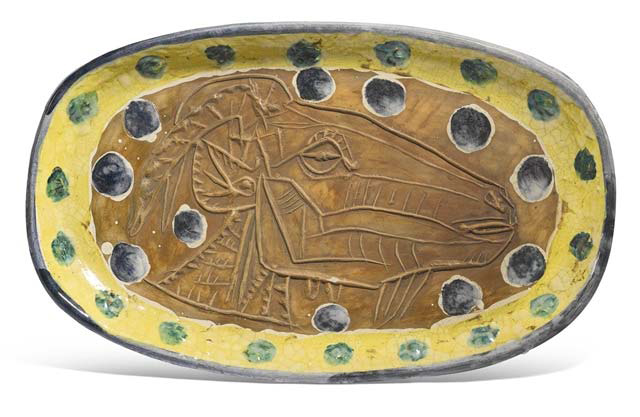
Unique Picasso Goat plate from Marina Picasso’s collection sold at Sotheby’s in June 2015 for $176,914
Let’s return for a moment to that $179 million record-price Picasso painting, and the fact that you can get a fine Edition Picasso ceramic for about 1/10,000th of that. The Tête de chèvre (AR 148) platter from the edition of 100 pictured at the top of this page is an example of such a bargain at a sale price of $19,468. If you believe in numerology (and the metric system) you’ll be interested to learn that Picasso’s probable prototype for Tête de chèvre sold for $176,914 in the Marina Picasso sale at Sotheby’s, about ten times more than its Edition Picasso equivalent but close to 1/1,000th of the record-price Picasso painting.
So, how much more should unique Picasso ceramics be worth than comparable Edition Picasso pieces? If the answer is 1000 times, then the Grand Vase prototype should have brought at least a BILLION dollars — 1,000 times the $1+ million that the two Edition Picasso Grand Vases have recently sold for. If the answer is 100 times, then the best originals should be somewhere between $50 and $100 million — 100 times the $500,000+ prices that many other Edition Picasso Grand Vases have brought at auction. If it’s a mere 10 times, as the the two  Goat plates would seem to suggest, then best original Picasso ceramics should sell in the $10,000,000 range. If the other examples compared above are better guides, then the best unique pieces should be $6,380,000 or $3,430,000, 0r $4,650,000 — in all cases significantly more than they have actually been selling for. To my mind the buyer of the beautiful Picasso at the top of the page got a steal.
Clearly Christie’s believed that the “best” Edition Picasso ceramic in their sale of June 25, 2015, was Personnages et Têtes AR 242. At 22 inches tall, not only was it the largest piece in the sale, it was one of only 25, the smallest edition size produced at Madoura. It was pictured on the cover of the catalogue and brought the second highest price in the sale (after the outlier Femme du Barbu ), selling for $145,040 — over twice its low estimate ($62 ,000 – $92,000). Yet more than half of the unique Picasso ceramics from Marina Picasso’s collection at Sotheby’s sold for less than the cost of this Edition Picasso multiple. Granted that the originals were smaller in size and arguably less interesting than Personnages et Têtes, but they were actually from the artist’s hand, not “authentic replicas.”
Which would you rather own?
Repent! The End (of the Art Bubble) is Nigh!
Laurence Fink, chairman of the world’s biggest asset management firm, Blackrock, said recently that contemporary art, along with apartments in places like New York and London, had supplanted gold as the world’s top store of value. This is an ominous signal for the art world.
The concept of “store of value” is one that acquires relevance in direct proportion to your wealth. That $1,000,000 you’ve put under your mattress will be worth only about $550,000 twenty years from now figuring 3% inflation. Buy a Manhattan apartment with the money (you can probably afford an okay studio), chances are you won’t take such a haircut. Invest in the next Apple and maybe you’ll do a lot better (invest in the next Enron, maybe you’ll end up with nada).
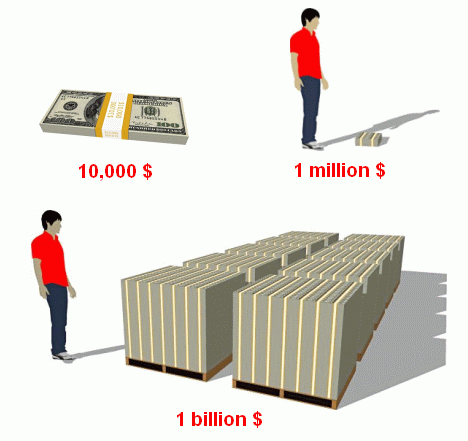 But let’s say you’re a billionaire. Forbes Magazine says that there are 1,826 such people in the world in 2015, and their problem is literally a thousand times worse than yours (a billion is a thousand million). How can you efficiently store immense wealth so that it remains safe and keeps its value? It won’t fit under the mattress. In fact it was this sort of dilemma that led to the invention of money, an abstraction that could be used to stand in for the actual wealth it represented, whether that wealth be land, goats or wives.
The only essential criterion for something to become money is that everyone agrees that it’s money. Over the centuries some abstractions that people have agreed can be money are shells, beads, axes, gigantic donut-shaped carved limestone wheels, woodpecker scalps, bitcoins and of course printed slips of paper bearing pictures of dead Presidents.
Gold is a particularly successful abstraction for money, though it has no real “intrinsic” value. You can get milk from a goat, you grow vegetables on land, and wives can demonstrate value in numerous ways, but gold just sits there, weighing a lot and not producing anything. But gold is a unique material that is easily worked into beautiful articles that don’t deteriorate over time. It is naturally rare. For millennia people have been willing to trade goats and wives for gold. You’d be betting against history if you thought that demand for it, whether rational or not, was suddenly going to evaporate.
Demand for other abstract stand-ins for wealth like woodpecker scalps (and paper money issued by profligate countries) is not so stable. Which brings us to art.
Art, like gold, doesn’t produce anything but can be beautiful to look at and its natural supply is limited. While many artists may toil at their craft the output of only a vanishingly small minority is ever transformed from mere decorations into a store of significant value.
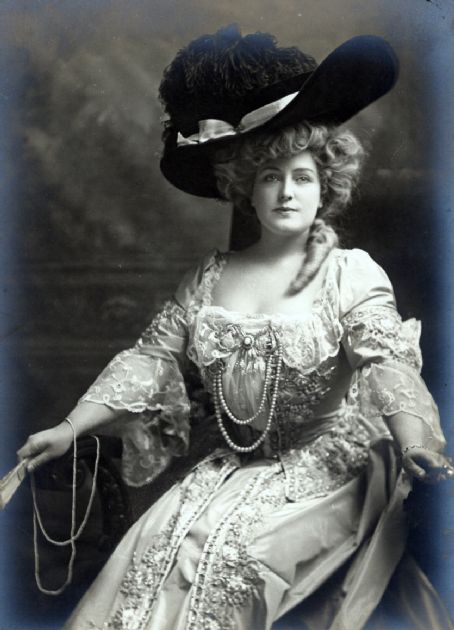 Exceptionally talented artists who worked for decades to hone their skills used to be the ones to whom cultures awarded fame and wealth. But starting in the late 19th century, artists began to achieve greatness because they broke the rules. Vincent Van Gogh never sold a painting in his entire life, but our culture came to consensus years ago that his work was revolutionary, a turning point in history. The Impressionists broke the rules, too. Though many of their contemporaries thought Impressionism was ridiculous, today we see paintings by Monet, Renoir and others as both valuable and beautiful. But both value and beauty are relative notions that change as societies change (Lillian Russell was considered one of the most beautiful women in the world in the 1890s; today she would be considered plus-sized). So do concepts of wealth.
Take one of the most famous artworks in the world: Picasso’s “La Reve.” Casino magnate Steve Wynn bought this painting at auction in 2001 for about $60 million — the previous owner had gotten it auction in 1997 for $48 million. Wynn reportedly had agreed to sell it to hedge fund giant Steven A. Cohen for $139 million five years later. The painting would have thus become the most expensive ever sold, only Mr. Wynn put his elbow through the canvas and the deal was called off. Wynn collected millions of dollars in insurance because of the damage, and then still sold it to Cohen for $155 million in 2013 — a good investment any way you look at it and worth “a fortune” every time it traded hands.
Yet when Victor and Sally Ganz originally purchased “La Reve” in 1941, the price was $7,000, which was considered to be a fortune to spend on art in those days. It is equivalent of about $112,000 in today’s money. Some would still consider $112,000 a fortune, but certainly not the 17,685 people in the United States who filed tax returns in 2012 showing annual income of over $10,000,000 according to the IRS. Approximately 128,200 individuals worldwide have a net worth in excess of $50 million according to Credit Suisse.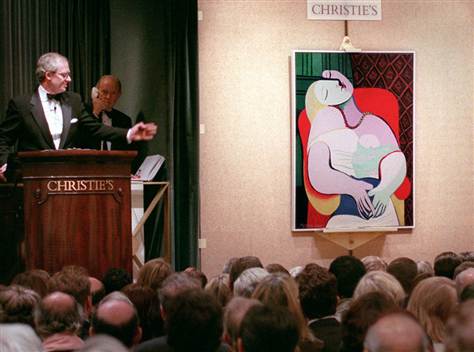
So where can all these people store all that kind of value? Real (literally) estate entails significant carrying costs. The 18th floor of the Sherry Netherlands Hotel, for instance, has been marked down $30 million to a more reasonable $95 million, but the monthly maintenance fee is $60,000. And real estate is not particularly portable, unlike paintings which you can just carry back to Russia or China on your private jet.
In a world where the top 1% of the world’s population control over 50% of the wealth, an abstraction like Art would seem like a wonderful solution. Certainly it was for the billionaire Qatari who just spent $179 million for the current record breaking Picasso. However, the merely rich, too, need something to decorate their humble seven-figure abodes and show people how rich and clever they are. This demand has resulted in an ever-increasing need for more art. Luckily Andy Warhol practically single-handedly created a new category called called Contemporary Art when he broke all the rules and put a frame around a can of soup. Suddenly, anything could be art, thus conveniently increasing its supply exponentially. Over the past decades other would-be revolutionaries have become rich and famous by putting frames around everything from chicken-scratch doodles (Cy Twombley) and comic strips (Roy Lichtenstein) to dead animals floating in tanks of formaldehyde (Damian Hirst) and West Highland white terriers (Jeff Koons).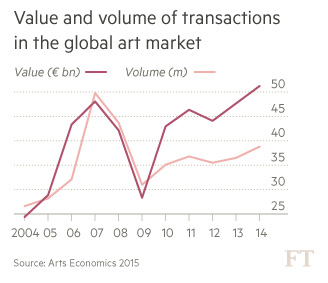
One of the lessons of history is that when governments go crazy printing money it often loses its value. Today it is not only governments who can print money, it is a small number of artists whom art dealers and the super rich have randomly anointed. Anything these artists produce magically becomes money: piles of candy, messy unmade beds, even pieces of shit. This Contemporary Art can be produced as fast as you can say “art asset investments.” However, even as supply increases, demand has begun to break down except at the highest level. Fewer and fewer people are exchanging more and more wealth for a dwindling number of these abstractions, as a graph compiled by the Financial Times clearly shows.
It is very dangerous when people lose sight of the difference between wealth and the abstractions that stand in for wealth. Natural pearls were once a formidable abstract stand-in for wealth. In 1917 the jeweler Cartier traded a double-stranded pearl necklace then worth over a million dollars for its landmark home, the Neo-Renaissance building at 53rd and Fifth Avenue. The Cartier building today is probably “worth” more than that record-breaking Picasso. The necklace was sold at auction in 1957 for $151,000.
 The present attitude toward art has evolved so slowly that it must seem like a totally reasonable stand-in for real wealth to the 1% (whom the other 99% believe don’t know the value of a dollar). It probably seemed just as reasonable that certain tulip bulbs were worth more than country estates in 17th Century Holland. Or that companies which never earned a nickel were “worth” more than General Electric during the Dot.com years. Art is no longer beautiful and/or meaningful creations by people with unique talent who have worked years honing their craft, it is now practically defined as rule breaking in an area that no longer has any rules. No one has put a frame around a pile of ping pong balls? Quick, call the Whitney!
“Appropriation artist” Richard Prince is a just one example of what I call “Emperor’s New Clothes Art” — as in Hans Christian Andersen’s classic story. The rule Price broke was the Eighth Commandment: Thou Shalt Not Steal. For one of his early successes Prince photographed and retouched other’s people photographs. Another triumph are “his” Nurse Paintings where Prince scanned book covers, transferred the images to canvas with an inkject printer, and then added some acrylic paint. Recently he was in the news for reproducing people’s Instagram posts without notice or permission and selling them for $90,000.
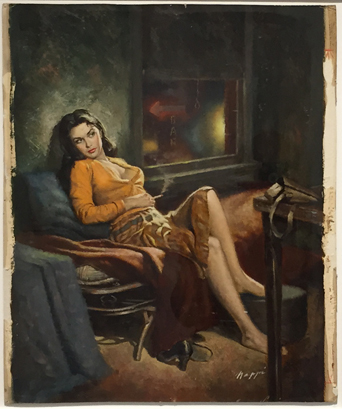 Prince is handled by the Gagosian Gallery, one of the important galleries in the world, where his oxymoronically entitled show “Original” can be seen until June 20, 2015. Over the years Prince purchased the original cover art for the pulp paperback books that he collects. Such paintings, many by unknown artists, often sell for less than $1000 and you can find vintage paperbacks on Ebay for a few bucks. For the Gagosian show Prince simply framed the paperback along with the original cover art. The result actually ends up looking pretty cool until you find out that the prices are in the $250,000 range. That’s right: people are spending $250,000 for a framing job. And I’m sure they’ll tell you that you’re an unsophisticated idiot if you don’t see how important and wonderful this latest fashion is.
I’m sorry, but the Emperor has no clothes.
Bubbles end when price and value diverge overwhelmingly, though it’s always been been difficult to call a top 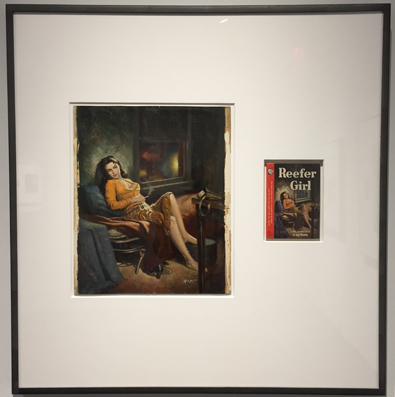 (economist John Maynard Keynes is said to have remarked that the market can remain irrational longer than you can remain solvent). There more than a few billionaires who have made their fortunes by betting on irrationality, but at some point the music stops. Today’s art market is fueled by huge amounts of international money from people who are speculating in a rigged market that what they buy today will garner them the same status (and profits) as others of their financial station have enjoyed for years.
It will end badly.
All Calder Tapestries Are Not Created Equal

Alexander Calder (American, 1898 – 1976) may be best known for his stabliles and hanging mobiles but he also worked in almost every medium imaginable — paintings, prints, jewelry, stage sets and wire sculpture — he even decorated airplanes.
Beginning in the 1960s Calder aligned himself with important French weavers, most notably Pinton, which recreated his designs in fine art tapestry. Calder’s work was graphic, simple and perfectly suited to the medium, which made it both highly desirable to art buyers and profitable for the tapestry ateliers. Ultimately there were more tapestries by Calder than by nearly any other well-known artist.
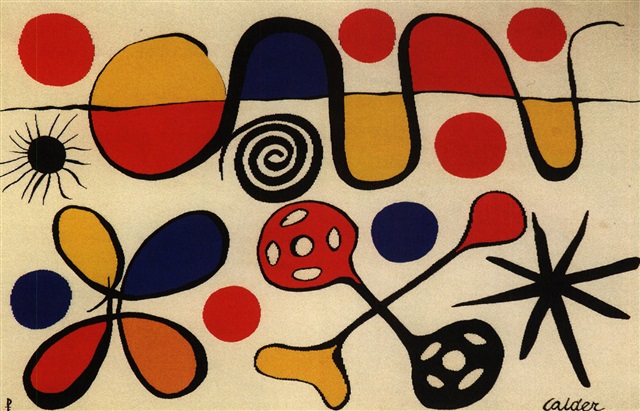
“Les Passoires,” the most expensive Calder recorded at auction sold in 2007 for the equivalent of $77,810 without premium. Six years later in 2013 another copy from the edition sold for $5,000 less — premium included.
Some dealers now are asking over a hundred thousand dollars for Calder Aubusson tapestries, though they certainly can be found for less — not just because of the number available (there were over 60 different Calder designs made into small-edition Aubussons), but because there is a lot of confusion in the market place about this lesser-known medium. These days people use the word “tapestry” to refer to any textile that can be hung on a wall for decoration. You can take a blanket off your bed, tack it up over the window and call it a tapestry — no Vocabulary Police will arrive to arrest you. Consequently some types of Calder “tapestries” are worth a lot more than others.
There are basically five types of what people call “Calder tapestries”: 1) Aubussons; 2) Bicentennial Aubussons; 3) Natural Fiber Wall Hangings; 4) Pile rugs and carpets (tapis); and 5) Problematic Items
CALDER AUBUSSON TAPESTRIES
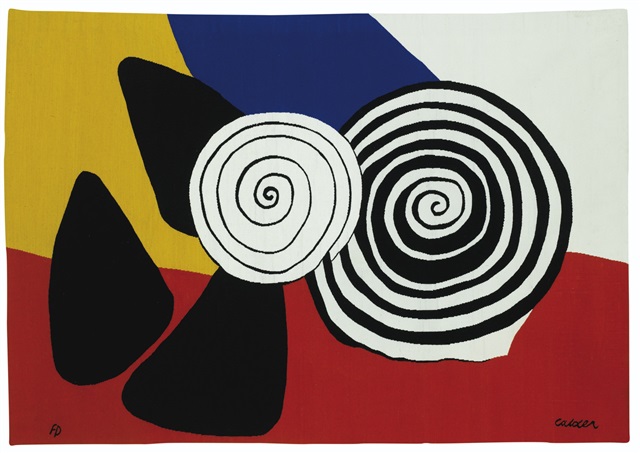
This large Calder Aubusson (91 x 63 inches) sold at Sotheby’s Paris in November 2014 for $54,252
The tradition of weaving textiles goes back to ancient times. Horizontal stands of wool (or other material) called weft threads are passed between vertical warp strands that are affixed to a wooden frame called a “loom.” Colors are changed to create patterns or images. The resulting textile are called tapestries. The “Sun King” of France, Louis XIV, set up Manufactures Royales like the Gobelins to weave tapestries in this tradition for his palace at Versailles, and French tapestries woven in this manner are generically called “Aubussons.” Aubusson is actually a town in central France, which Louis declared a “Manufacture Royale” in 1665. Its output, and the output of ateliers in its sister city of Felletin (declared a Manufacture Royale in 1689) has always been commercially available and tightly controlled for quality.

A smaller ( 66 x 49 inches) and less colorful Calder Aubusson sold in November 2013 at a more obscure French auction for a hammer price of about $4,000.
It can take a skilled weaver a month to create a square meter of a fine Aubusson, so these French textiles — handwoven in the most famous tapestry ateliers in the world — have always had intrinsic value. Supply and demand has resulted in people willing to a premium above the weaving costs for images by important artists.
Some of the differences in pricing of Calder Aubussons has to do with basic considerations such as size. Large tapestries tend to cost more than small ones since their original retail cost was higher because they took longer to weave. Sometimes, however, very large tapestries can be difficult to resell because there are fewer potential buyers with giant walls. This is one factor that makes auction prices for tapestries so deceptive. There is very definitely a “sweet spot” in terms of size — if it’s too big or too small fewer people will bid.
Quality is also a factor. Buyers are sometimes more attracted to busier, more colorful images, but sometimes art can be too busy and too colorful. Or too quiet and not colorful enough. It’s a matter of taste and trends. Calder is much more popular now than he was twenty five years ago and Calder Aubussons are very much in demand.
CALDER BICENTENNIAL AUBUSSONS
1976 was the two hundredth anniversary of the Declaration of Independence, the Bi-Centennial. As part of the celebration a special series of 6 different Calder Aubussons was commissioned. Aubusson tapestries are limited in France to editions of no more than 6 with two authorized proofs — a maximum total of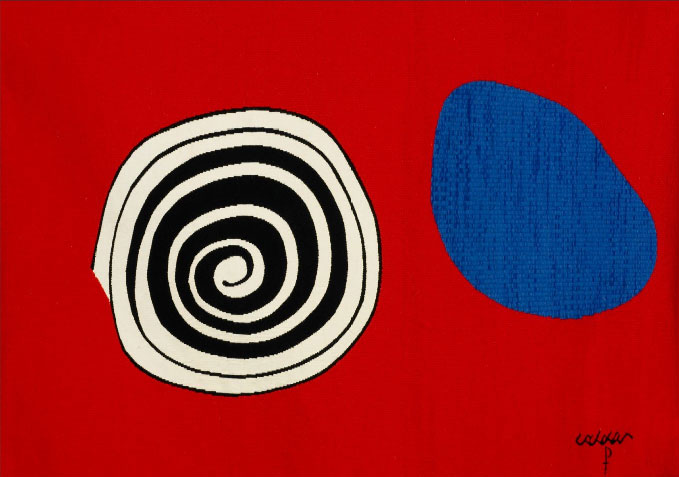 eight pieces. What made the Calder Bicentennial tapestries special is that the French government in the spirit of celebration allowed 200 sets to be woven. It was a magnanimous gesture — and an optimistic one.
Only about 45 sets were actually ever made, which leads to confusion about supply in both directions. People have assumed that since the Bicentennial tapestries are Aubussons they must be editions of only six. Others assume that there were actually 200 tapestries made of each design. Whether 8, 45 or 200 were made, demand is actually more important in the pricing of tapestries (and most art) than supply. The Bi-Centennial Calder Aubussons are physically smaller and the designs generally less complex and graphically interesting than the most desirable Aubussons, so there is less demand and prices usually are significantly lower.
Bottom line: Depending upon the asking price, Calder Bicentennial tapestries may or may not be the bargains they seem to be.
CALDER JUTE/MAGUEY FIBER WALL HANGINGS
 Perhaps the most confusion when people talk about Calder tapestries comes from the series of mats that were created as part of a charitable relief program to help victims of a devastating 1972 earthquake in Nicaragua. Kitty Meyer, a New York socialite, had brought Calder a thank you gift of a hammock braided by the artisans in the village of Masaya employing a centuries-old technique. The material used was not the fine wool employed by the ateliers of Aubusson and other famous tapestry centers, but natural vegetable fibers that could be spun into strong, coarse threads. The material may be identified as being Jute, Hemp, Maguey, Raffia or even rope. Calder was intrigued by the process. After collaborating on some hammocks, he ultimately agreed to let artisans in Nicaragua and Guatemala similarly execute 14 of his designs as mats in editions of 100 (the craftsmen were paid four times their usual wage plus given the materials gratis).
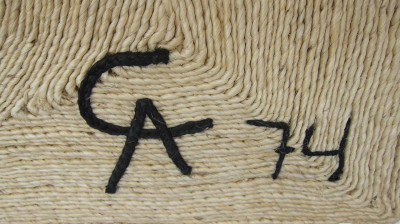 Part of the problem with these mats (originally people put them on the floors of their rec rooms and porches) is that some of the designs were the same ones that had been used for Aubusson tapestries. If you looked at one of these mats next to an Aubusson tapestry and felt the materials, the difference in quality would be immediately apparent. However, if you had no familiarity with tapestries and wanted to get an idea of what your Calder maguey fiber mat might be worth, you might turn up a picture (and a price tag) of the Calder Aubusson with the same image and think you had hit the jackpot. And once prices for these mats escalated into the thousands, galleries bought them from people who had them on their floors and sold them as tapestries to people who put them up on their walls.
Perhaps a bigger problem is that the Calder Foundation pictures several of these fibre hammocks and mats in the “Misattributed” section of their website, maintaining that Kitty Meyer was not authorized to make editions and that duplicate numbered pieces have been brought to their attention.
It’s comforting to think that every art professional is an expert who knows everything about everything, but misinformation percolates into world through innocence more often than deception. Though it has become rarer in recent years, you can still find these Calder fiber mats misidentified in both galleries and auction houses. This becomes an even more difficult problem with online auctions. It can be very hard to tell whether a “tapestry” is a maguey fiber mat or an Aubusson from a little tiny picture. Also, more and more retail sellers are turning to auction format because of the public perception that they will invariable get things cheaper at auction. Even if a Calder “tapestry” has been identified as one of these wall-hanging and not an Aubusson, the estimate from some online auctions may in fact reflect a retail price range, not an auction value.
Take a look at the images below. The top piece is the Calder Aubusson tapestry Sillons Noirs from the edition of 6. The visual beneath is a maguey fiber mat sometimes identified as Zebra, an edition of 100.
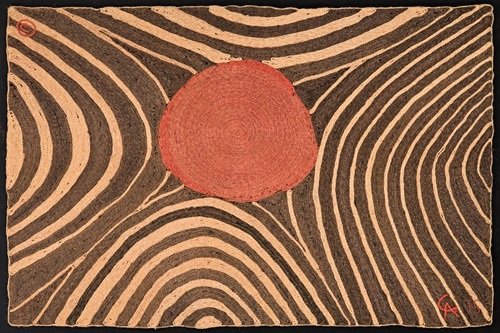
This is a case where the confusion could have benefited a knowledgeable buyer. Over the past five years one Sillons Noirs Aubusson sold for about $12,000 and another passed at about $13,000, albeit in obscure French sales. The apparently faded maguey fiber wall hanging at the bottom — sold (albeit in Australia) for over $15,000. Another copy of this very same hanging sold at Phillips in London January 22, 2015, for about $3,000.
CALDER RUGS AND CARPETS (TAPIS)
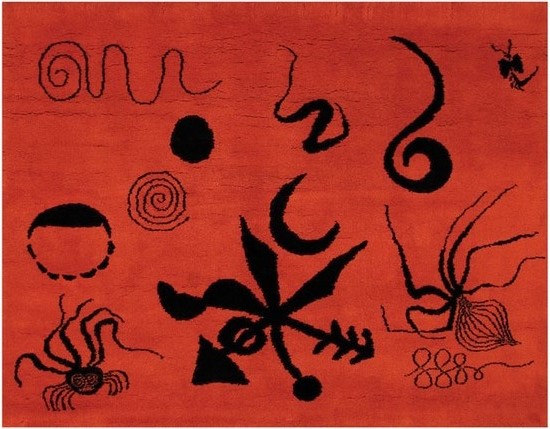 The second biggest source of confusion when it comes to Calder tapestries are pile carpets and rugs, which the French call “tapis.” These are very graphic and people (including Calder himself) hang them on walls, so inevitably they are called tapestries.
In the book, Calder’s Universe, which was published in conjunction with the Whitney Museum’s 1976 Calder Retrospective, several rugs are pictured, some hooked and knotted by Louisa Calder, the artist’s wife, others by apparent friends of the family. These are identified as never being available for sale, only for personal use. In that anyone who knows how to make a rug (including commercial manufacturers who haven’t heard about artist’s rights) could conceivably make one after a Calder design, provenance can play an important part in determining whether a Calder rug is even legal.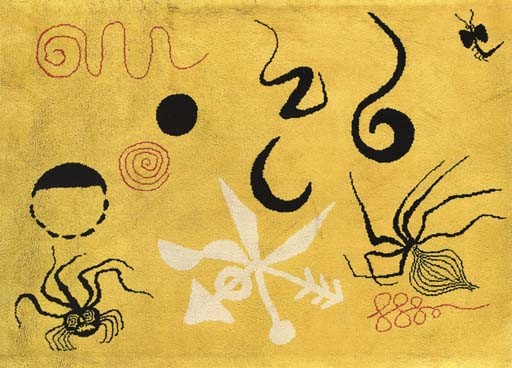
There were two or three Calder tapis that were legitimately created by Marie Cuttoli, a friend of many artists including Picasso. Cuttoli had rugs made after Calder paintings she owned. Hand-knotted in India, these were originally sold in galleries both in Europe and the United States, but always for prices much less than Aubussons. While people generally assume that these were limited editions there were probably dozens created. And, as can be seen from the visuals, color seems to have been a matter of debate.
PROBLEMATIC CALDER TAPESTRIES
Problematic doesn’t necessarily mean illegitimate, it simply means there are problems. One such problem is how to figure out whether a price is a bargain or an outrage without comparable sales data. The less known a work is, the bigger the problem. A legitimate Calder tapestry was actually woven of goat hair in the African country of Lesotho. Good luck in figuring out what is a fair price for one (and such an item might be hard to r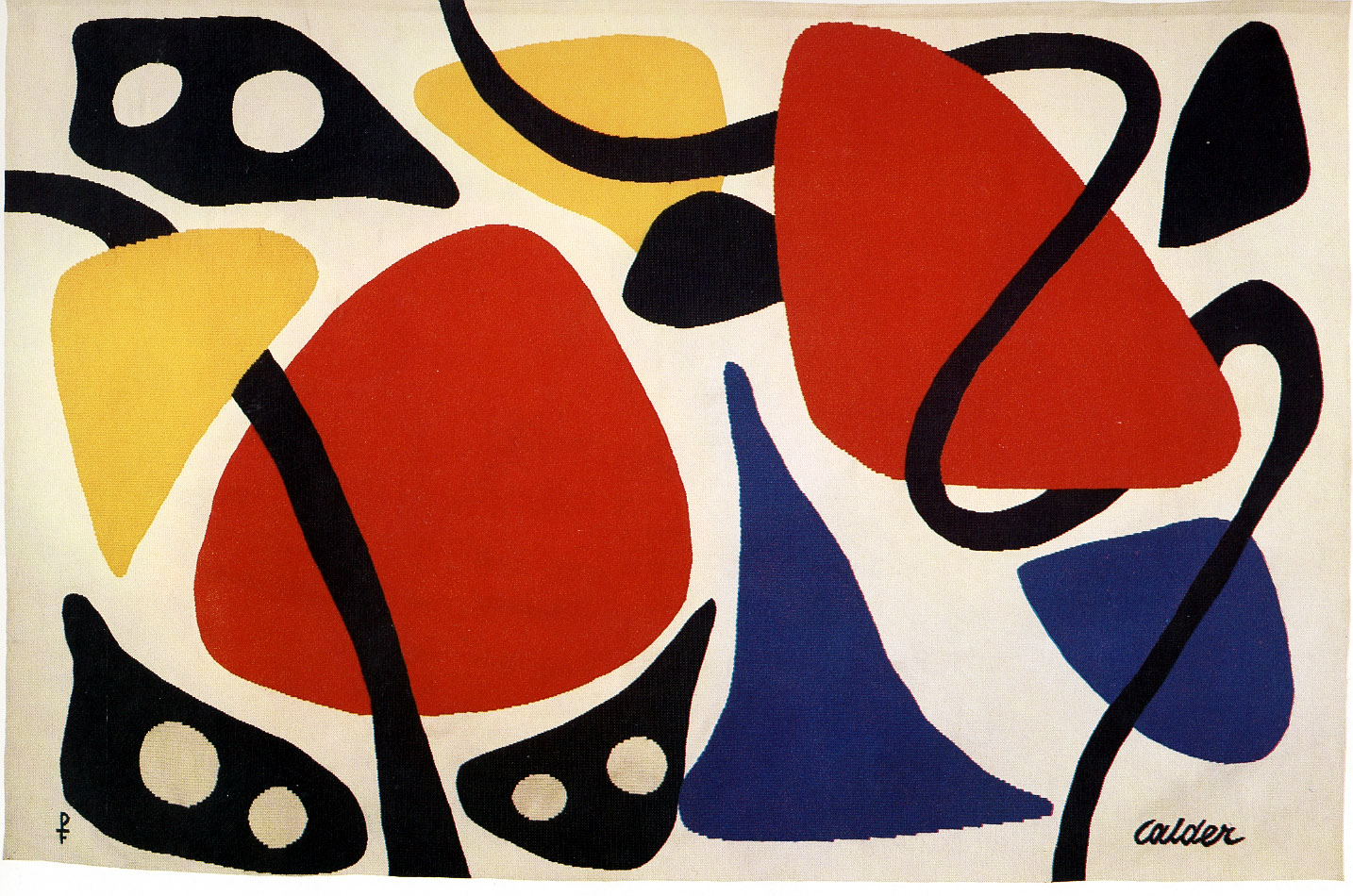 esell if you are thinking of buying it as an investment).
As explained above, Calder rugs and carpets can be problematic because, with the exception of the Marie Cuttoli pieces, there is scant information about who created Calder tapis, when they were made and whether they were authorized.
The biggest problems come from items that were created without permission whether innocently (a lot of little old ladies who admire Calder know how to hook rugs) or perhaps deliberately created to deceive. Take a look at the tapestry above. It appears to be a weaving of “Les Masques” a very good Calder Aubusson, one of which is owned by the Whitney Museum and is illustrated in Calder’s Universe.
If you saw this image in a catalogue or on a gallery’s website and were in the market for a Calder tapestry, this would seem to be a good choice, even at a high price. But you might be in for a surprise. Only when you received the tapestry will you notice that it is not a tapestry at all, it is a pile carpet. 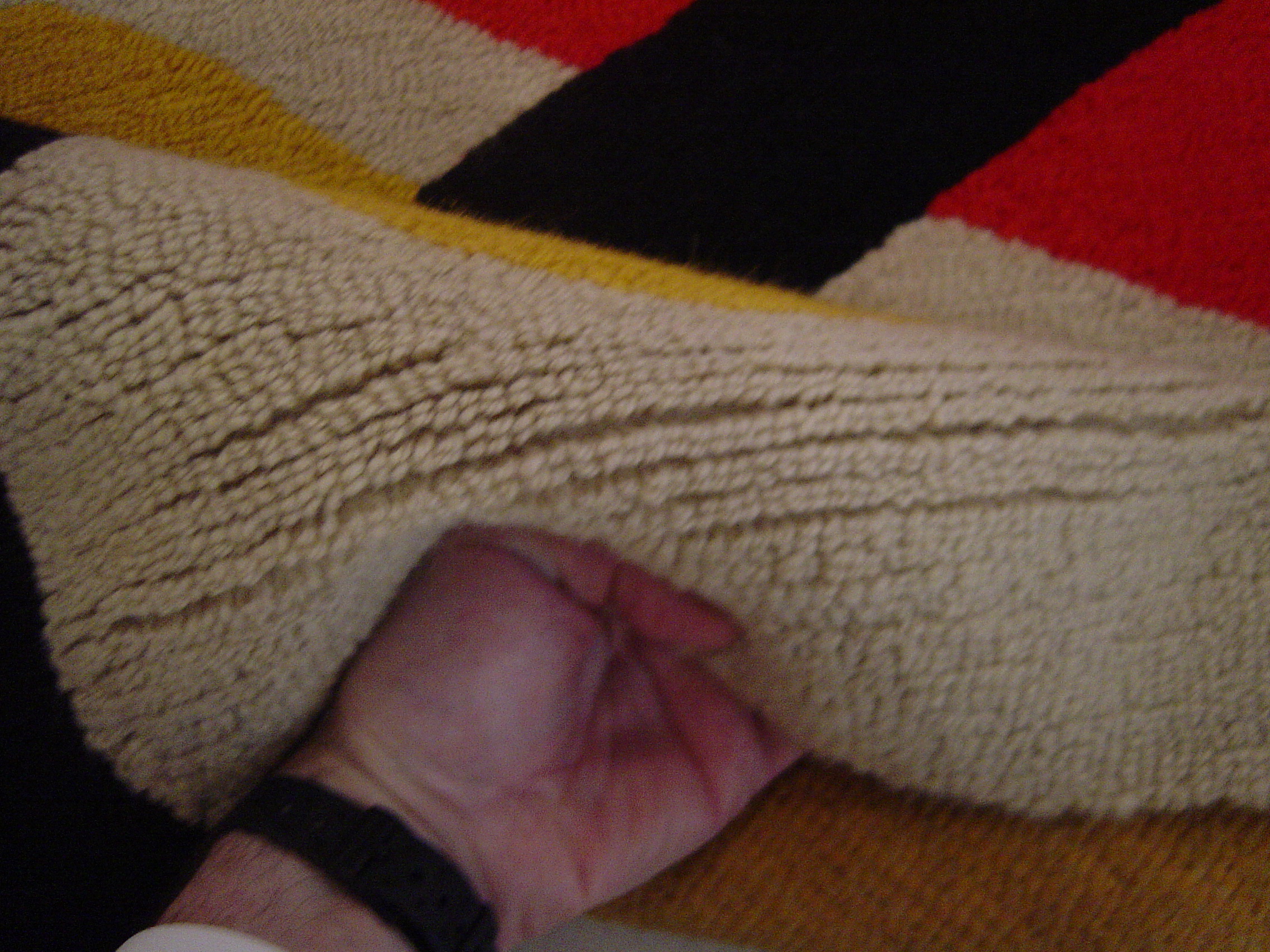
I have no idea how this pile rug after the Calder Aubusson came to be made or who created it. And this isn’t the only Calder rug pretending to be an Aubusson that I’ve seen. Perhaps they might even have been authorized in some way, but I wouldn’t want to be the one who shelled out a lot of money with the hope that the Calder Foundation knew all about it.
The bottom line is that buying tapestries can be just as confusing and potentially treacherous as buying any kind of art. It’s important to understand what you’re doing or to be dealing with someone who does. And it may not be wise to rely on a seller’s expertise alone: someone who has something to sell always has a built-in conflict of interest when it comes to what’s best for the buyer.
Value Mysteries: Picasso Ceramic Owls

In 1946 Picasso was staying near Antibes in the South of France and decorating the walls of what would become the Musée Picasso. A small owl with an injured claw that had been found in a corner ended up living with him and his lover, Francois Gilot. According to Gilot in her book “Life With Picasso” the owl was an ill-tempered creature who smelled awful and ate only mice. The owl would snort at Picasso and bite his fingers; Picasso would reply with a string of obscenities just to show the bird who was the most ill-tempered. Clearly bad manners were the way to Picasso’s heart for not only did he do a number of paintings, drawings and prints of owls, he created numerous ceramics.
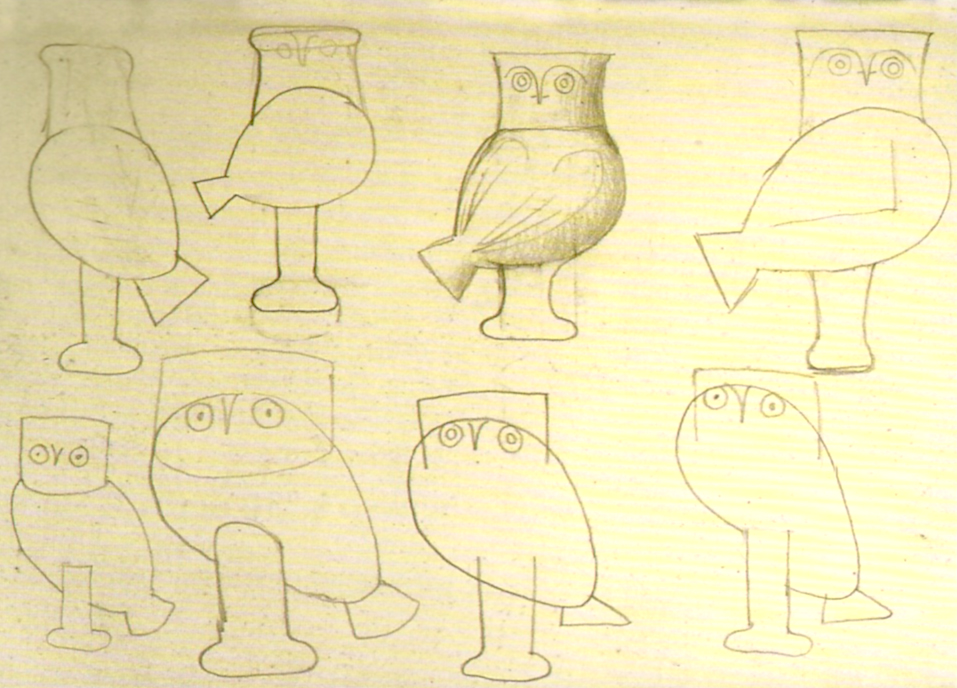 While it is true that Picasso didn’t create most of the ceramic shapes that he decorated at the Madoura Pottery in Vallauris (though he did manipulate many of the forms — bent them to his will, if you will), it was not until after the artist’s death did sketches come to light that proved Picasso had in fact executed designs for ceramics around the time the little owl was regurgitating hairballs around the house.
Take a look at five ceramics below that were created at Madoura in 1951. One of them was painted personally by Picasso. The others were painted by the artisans at the pottery after Picasso’s original, what are called “authentic replicas” in the Ramié catalogue raisonne and what are commonly known as Edition Picasso Ceramics. Can you tell which is the one painted by the artist?
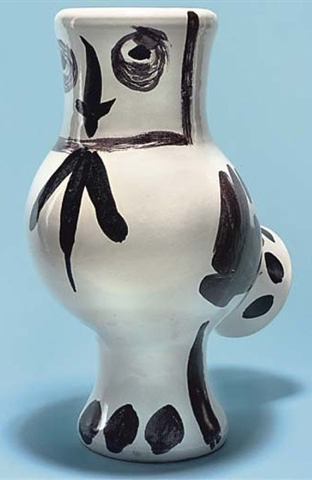
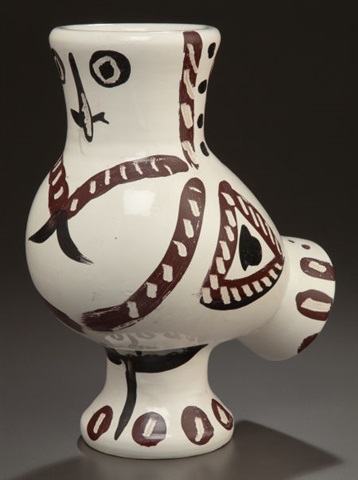
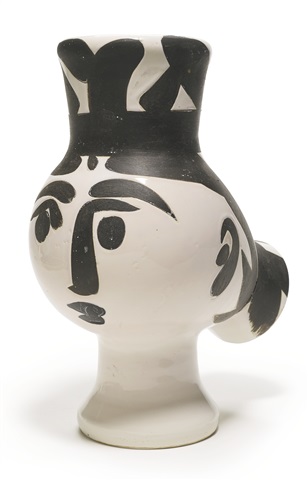
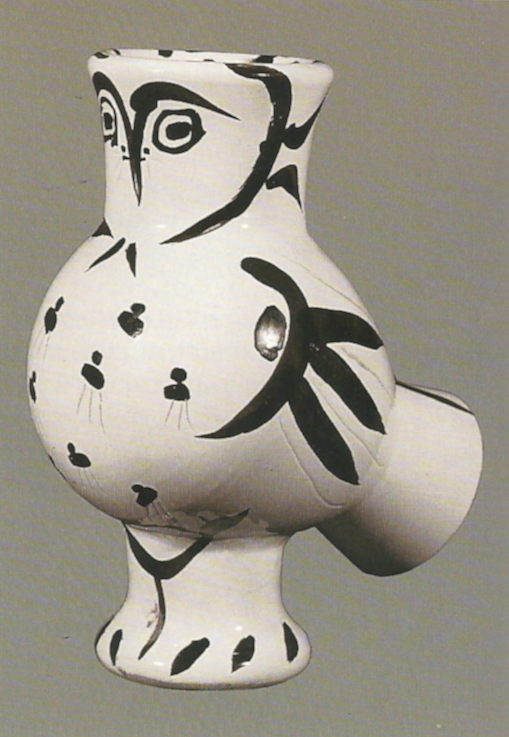
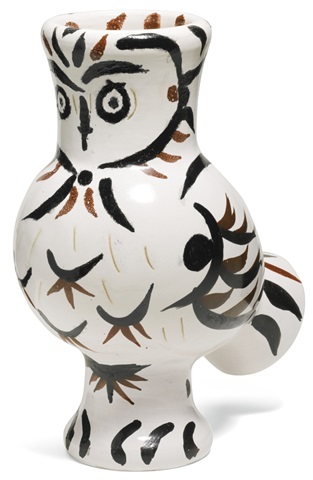 This isn’t the value mystery by the way, although Picasso’s unique prototypes usually command prices at least ten times higher than the editions. We’ll get to the value mystery shortly. First, however, it will be useful to understand how relatively common this owl shape was in the entire set of 633 Picasso ceramics that were made into editions.
Of the edition owls above one was of 500 (Picasso ceramics were made in editions of between 25 and 500), so it is not particular rare. The other three were from editions of 300, so already in 1951 there were 1400 owls of this shape flying out of Madoura. You might think that there were really 1401 counting the one that is Picasso’s unique piece, but you would be wrong. In addition to the unique piece (the fourth in the lineup above) which was not made into an edition, there were prototypes for the four other owls that were replicated plus, undoubtedly, other paintings by the artist of this shape. The essence of Picasso’s genius was his being able to tap into a virtually inexhaustible creativity. Once the artisans at the Madoura pottery had created Picasso’s owl shape in ceramic they would have given him some fired pieces which he would have begun decorating. It was not unusual for Picasso to paint a dozen ceramics in a day or more. Altogether he painted over 4000 pieces at Madoura, only 633 of which were made into editions.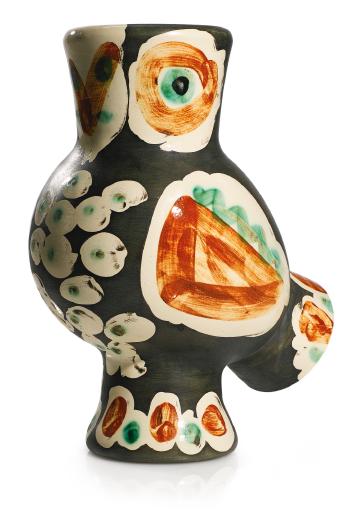
There were other owl shapes decorated by Picasso but this, his own, clearly remained one of Picasso’s favorites. A new edition of 300 differently painted owls of this same shape were produced in 1952. In 1958 another edition was created, this one of 200 pieces (the smallest edition of this particular form), not with a white glaze but just the terracotta clay as the mat finish. Ten years later, in 1968, Picasso decorated two more owls in his most complex and colorful design, each editions of 500. A year later, in 1969 just a few years before his death Picasso returned to the shape again with six new pieces — some of his last ceramics, also in large editions. If you add up all the edition owls of this particular shape the total comes to 5,250. Since some shapes were painted just once by Picasso in editions as small as 25, it is safe to say that these owls not only are not rare, they are actually among the most common of the three-dimensional Edition Picasso ceramics.
Now consider these four different versions of the form — all from 1969 — and therein lies the mystery:
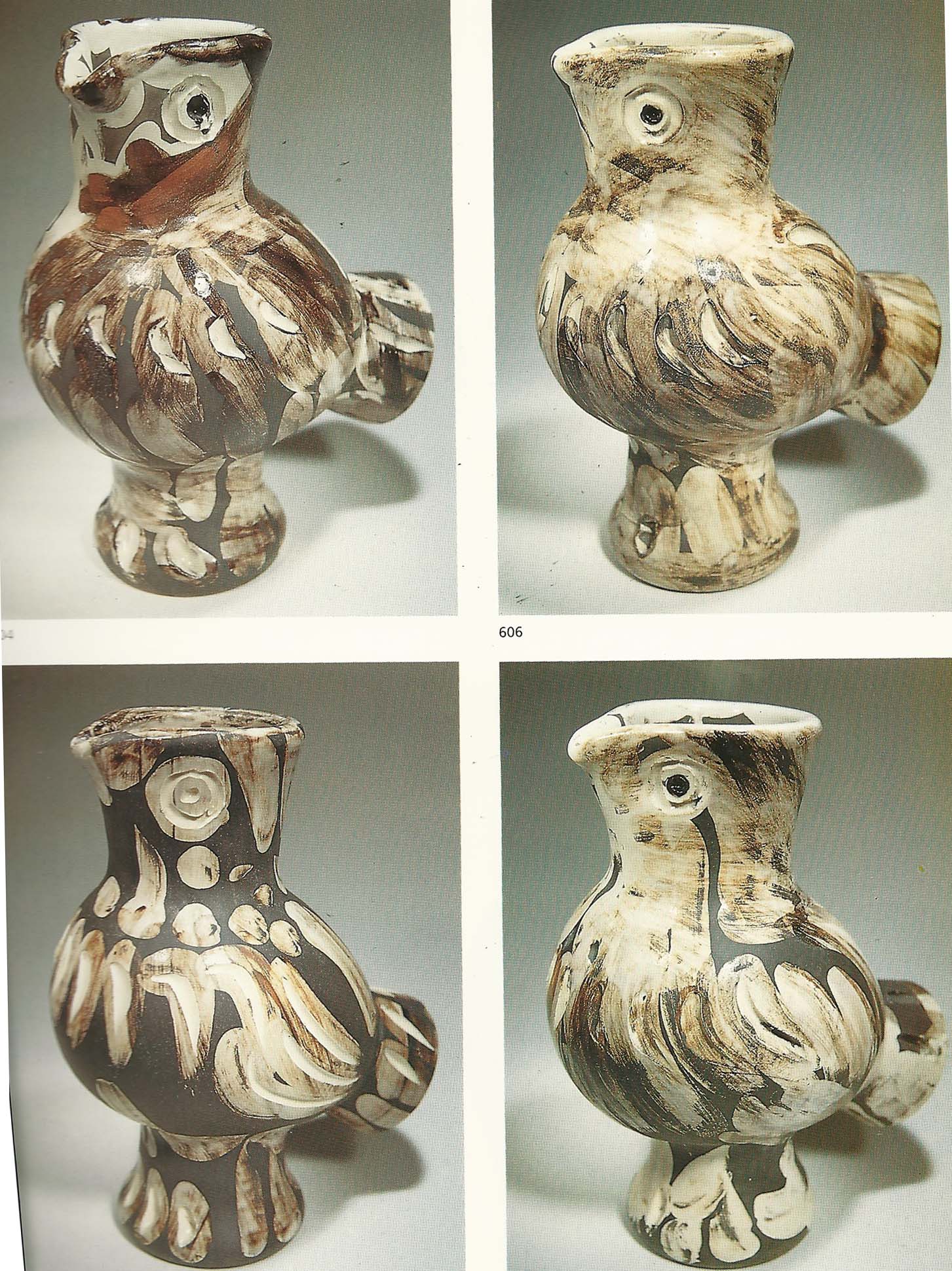 These owls are regularly estimated at about $6000 – 8000 at auction. However, one of them — or I should say a piece from one of these editions — sold at Sotheby’s London on March 19, 2013, for the equivalent of $75,590.
Was that particular version some kind of weird rarity? No, it was simply one of the 500 copies in the edition, which are all supposed to be virtually identical replicas of Picasso’s prototype. Is one of these versions somehow “better” than the others from 1969 (or all the other 5,249 Edition Picasso owls of this shape)? No. In fact these four ceramics are often miscatalogued because they resemble one another so closely and because of their muddy palette they have historically sold for less than some of the more colorful pieces of the same form.
So what gives?
I have spoken about the wild price fluxuations in Picasso Ceramics before, which started with the “Madoura” sale at Christie’s London in June 2012. A lot of it boils down to a thinly traded market, lack of information and clever people trying to exploit one another. The $75,590 owl was Ramié 605, the first owl in the second row, but the huge price wasn’t made at the 2012 Madoura sale. While a copy of Ramié 605 did soar in that sale above its 3000 – 5000 British Pound estimate to achieve 10,625 pounds ($16,554), which was in fact a record high for the ceramic, that price was bested at the Sotheby’s London 2013 sale by almost 400%.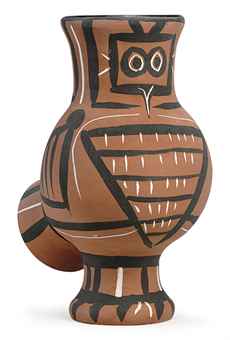
At Sotheby’s 2013 sale several other Picasso ceramics achieved prices higher than pieces from the same editions had at Christie’s historic Madoura sale the previous year. Perhaps the reason was that Sotheby’s, taking a cue from its competitor, had started to specifically target Chinese and Russian buyers. These collectors were already spending big money at the evening sales of Picasso paintings and drawings, the estimates of most of which started at over a million bucks. It was — for them — a new notion that they could pick up Picassos for less than $100,000. So you paid two or three times the estimates – the auction houses often kept estimates low just to get the action going. What bargains!
Of course when you are dealing with a lot of clever people all of whom are trying to outsmart one another reversals aren’t uncommon. There’s probably even Chinese and Russian words equivalent to the one we use in English when there’s a second reversal after the first: the double cross. Lately it’s come to light that some Chinese buyers haven’t paid for items they’ve won at auction. So perhaps once the buyer had a chance to consider things, the record price was something that existed only on paper (and in auction records), not in fact. And maybe underbidders researched the market a bit more thoroughly after the $75,590 record. Six copies of Ramié 605 have traded at auction since 2013 at prices ranging from $15,000 – 20,000 (Ramié 604, 606 and 607 have performed similarly).
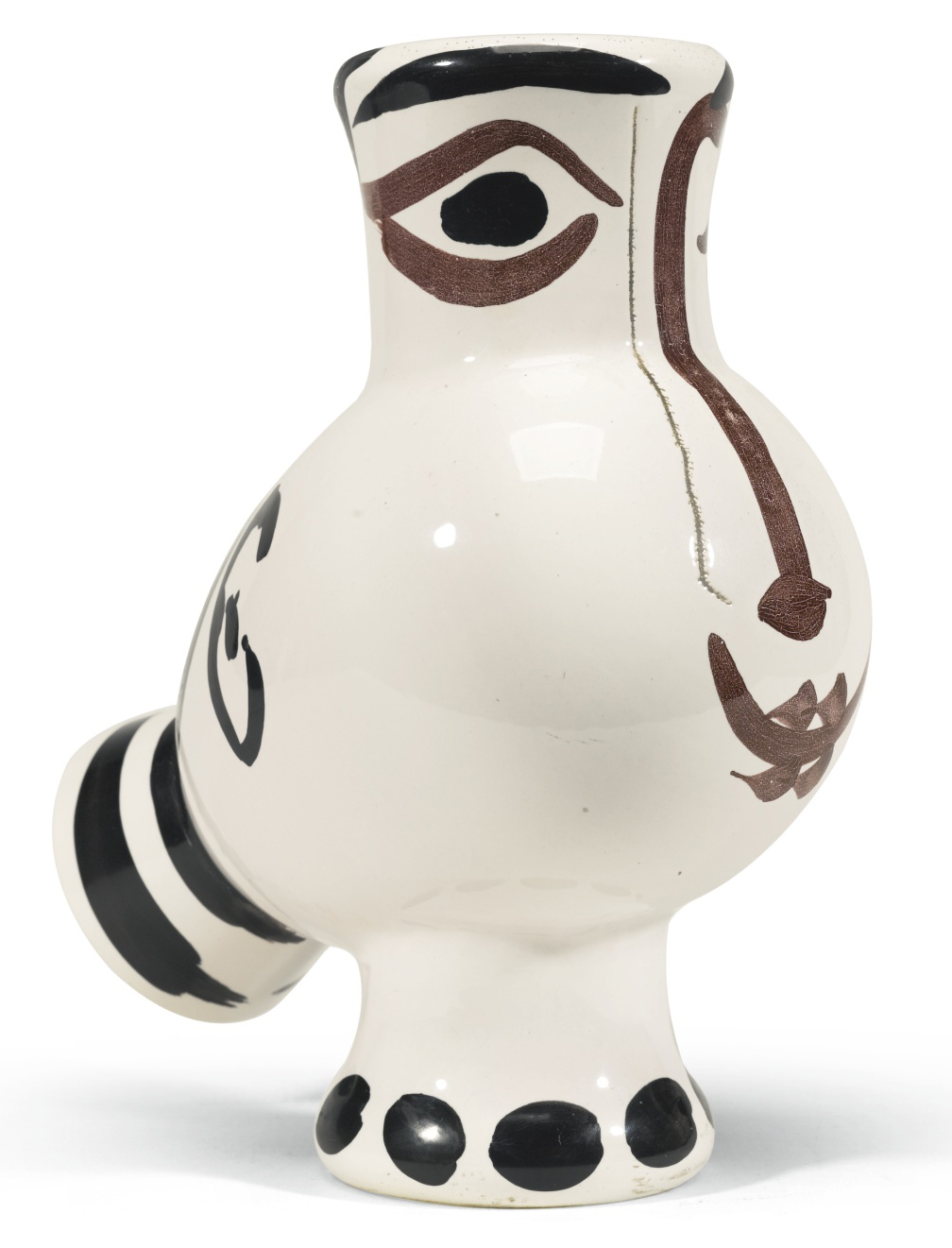
Every sale is different, and when you are dealing with thinly traded items anything is possible. You only need two bidders to make an auction. If they both have a lot of money and perhaps not enough information then the sky’s the limit. The owl below, one from an edition of 300, just sold (18 March 2015) at Sotheby’s in London for 37,500 pounds ($55,343) against an estimate of about $4,400 – 7,300. At the same sale four other versions of owls of this shape sold for between $13,000 and $24,000.
 There’s one more wrinkle to this story. After the $75,590 record, knowledgeable collectors who had copies of Ramié 605 (or Ramié 604, 606 and 607) decided that their ceramics, too, were suddenly worth $75,000. Not surprisingly they haven’t been overanxious to consign the pieces to auction where they are still estimated $6,000 – $8,000, and it’s hard to find a dealer with one of these pieces whose asking price starts at lower than $75,000. Thus while demand remains strong the supply actually available for sale is far less than the real supply. Just a few birds fly out periodically, which may be why they still bring Madoura Sale prices.
But if everyone gets nervous that the market won’t sustain these prices and a few dozen or hundred (or thousand) owls were to fly out at the same time, look out below.
Chagall (and other) Tapestries by Yvette Cauquil-Prince

The name Yvette Cauquil-Prince is virtually synonymous with the term “Marc Chagall tapestry.”
After all, Chagall didn’t spend years mastering the ancient craft of weaving and then sit working at a loom, day after day, for months at a time. Someone else had to do that, and for Chagall — as with artists and their estates including Picasso, Leger, Calder, Kandinsky, Klee, Ernst, de St. Phalle, Brassai and Matta — it was Yvette Cauquil-Prince.
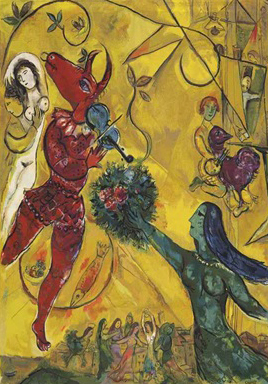
This Cauquil-Prince Chagall tapestry measures 105.5 x 74.3 inches and was woven in 1997.
The Belgian-born Cauquil-Prince was Chagall’s best option to continue to explore the medium of tapestry which he had become enamored with after completing a series of tapestries commissioned by the state of Israel. The Chagall tapestries that still decorate the state reception hall of the Knesset had been woven by the Gobelins, the famous French “Manufacture Royale” which was set up by Louis XIV but to this day only takes on gifts of state. Happily Madeline Malraux, the wife of the France’s Cultural Minister Andre Malraux, was acquainted with Yvette Cauquil-Prince and made the introductions.
Chagall was wary at first, demanding that their first effort be destroyed if he didn’t like it. Yvette had a condition of her own — that it be destroyed if SHE found it wanting. Happily both were delighted, and they embarked on a long collaboration and friendship so close that Chagall referred to Yvette as his spiritual daughter. As had Picasso, the artist allowed Yvette to choose the images to be translated into tapestry and didn’t interfere with her interpretive cartooning or weaving as it progressed. After Chagall’s death Yvette remained close to the artist’s family and with their approval continued to create Chagall tapestries, something that Chagall himself had said he wanted. “When I am no longer here, you must continue the work,” he told her. “There will never be a tapestry by Chagall without you.”

Woven ca. 2000, Cauquil-Prince’s weaving of Chagall’s “Liberation” measures 109.8 x 51.9 inches
Altogether there were only about forty Chagall tapestries by Yvette Cauquil-Prince, some of them monumental in size, all of them very small editions or unique (though “editions of one” often provided for an artist proof reserved for the Chagall family). She didn’t actually weave most of these pieces herself. Early in her career Yvette had developed a complex shorthand code by which other weavers in her employ could execute her complex Coptic-influenced interpretative designs — the blueprints that made a Chagall tapestry a Chagall tapestry. By the end of her life in 2005 it could take Yvette up to a year to complete one of these “cartoons” for tapestry.
Cauquil-Prince was recognized by the Louvre as a great artist in her own right, and her Chagall tapestries are widely honored in important private and public collections throughout the world. Because such tapestries are much rarer than Chagall paintings the temptation is to call them “priceless” since they rarely come up for public sale. However, everything has its price and during her lifetime most of Cauquil-Prince’s tapestries were for sale (this was how she made her living). They come back onto the market from time to time.
Two of arguably the most beautiful small Chagall tapestries recently appeared at auction. “Liberation” was withdrawn from Sotheby’s New York sale of November 7, 2013. Perhaps the consignor was nervous about it making the presale estimate of $200,000 – $300,000 and sold it privately before the auction. If so, he may have acted too quickly, judging by the very comparable “La Danse” tapestry, which sold at Christie’s London on February 5, 2015, for the equivalent of $306,621 USD. The presale estimate for La Danse was $152,928 – 229,392 USD, reflecting the lower prices that tapestries by other important artists have recently achieved. All tapestries are not created equal, of course. In the last ten years three other small Chagall tapestries by Yvette Cauquil-Prince have sold at auction at prices between about $30,000 – $80,000, and one monumental masterpiece brought $385,000 – still the auction record for a Chagall tapestry.
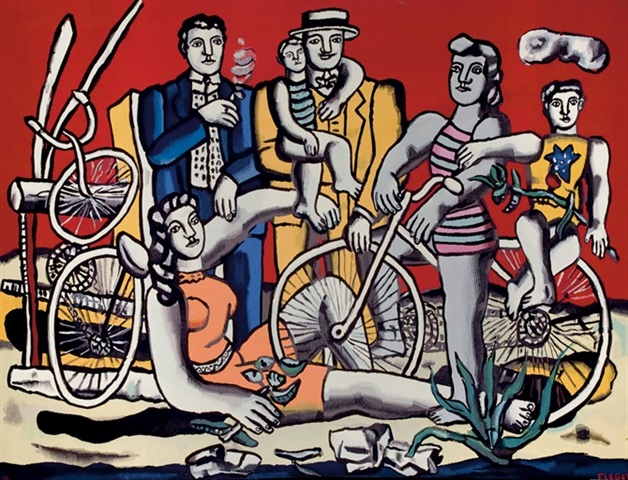
Cauquil-Prince’s 1990 weaving of Leger’s “Les loisirs sur fond rouge” measures 127 x 169 5/8 inches
Cauquil-Prince and Chagall were so attuned that Chagall himself declared upon seeing one of her efforts, “This is a real Chagall. It is my hands that did all this.” Perhaps this is one of the reasons why Yvette’s Chagall tapestries sell for higher prices than her interpretations of the works of other artists. However, it would be hard to make a case that Cauquil-Prince’s weaving of Leger’s “Les loisirs sur fond rouge” isn’t a spectacular tapestry. Why, then, did it sell at auction for 45% less than the top Chagall? It’s not like Leger is somehow a less important or desirable artist, at least in terms of public sales of paintings. The highest price for a Chagall painting at auction was $14,850,000 versus $39,241,000 for the top Leger lot. If you add up the top ten auction sales for each artist Leger still wins hands down — his top ten sales add up to nearly $176,000,000 versus just $100,000,000 for Chagall.
I often write about value mysteries and in many ways every sale of a work of art qualifies as a mystery. It’s no more strange that Yvette’s Chagall tapestries bring more at auction and than her Legers than the fact that Chagall tapestries are sometimes priced 1000% higher in galleries than they likely can be resold for at auction. However, the real mystery has to do with the tapestries that Yvette Cauquil-Prince created with Max Ernst.
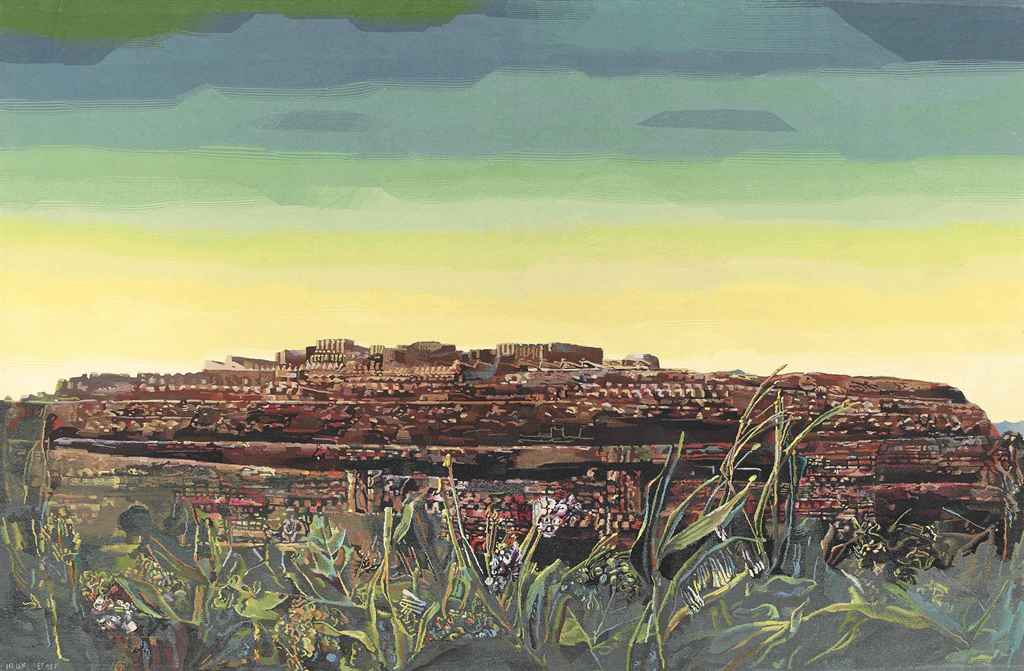
Monumental Max Ernst tapestry by Yvette Cauquil-Prince: “La ville entière” – 111 7/8 x 169 1/2 inches
Ernst (2 April 1891 – 1 April 1976), was a German born Dadaist/Surrealist. His work can be seen numerous important museums including the Metropolitan Museum of Art, the Museum of Modern Art, the Guggenheim, the Hirshhorn, Art Institute of Chicago, the Philadelphia Museum of Art, the St. Louis Art Museum, the Cleveland Museum of Art and on and on. He sells well at auction. Ernst’s top sale was $16,322,500 vs, $14,850,000 for Chagall, though if you look at the top ten auction prices Chagall thrashes Ernst two to one (why auction prices can be hugely deceptive indicators will be to subject of a future post).
Yvette Cauquil-Prince’s collaboration with Max Ernst actually came about smack in the middle of her triumphant work with Chagall. Chagall called Yvette “my little girl” once too often in front of his jealous wife, Vava, and she banished Cauquil-Prince from working with her husband for a decade. In 1978 Yvette came back to Milwaukee where she had been greeted so warmly upon completion of the Jewish Museum’s Chagall, to present her ten Max Ernst masterpieces,which then toured to Los Angeles and Philadelphia.
Like her Chagall tapestries, Cauquil-Prince’s Max Ernst masterpieces were beautifully interpreted, monumental in scale and woven in very small editions, some of them unique. Because of the difficulty and time-consuming nature of the cartooning and because Cauquil-Prince had to maintain an entire atelier of artisans to weave her pieces on Corsica, it’s likely that the prices for the finished tapestries were comparable to what she had asked for her Chagalls.
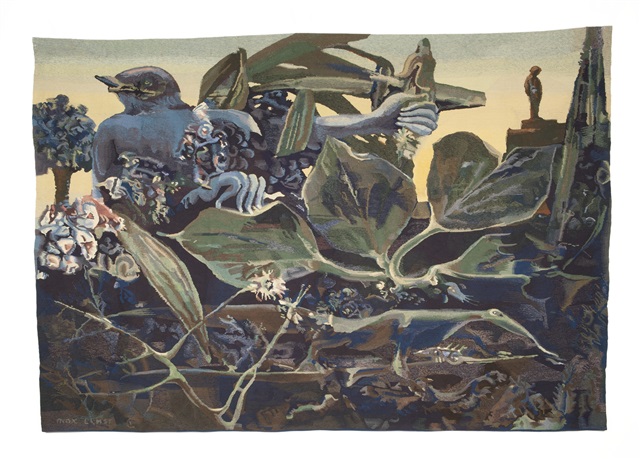
Ernst’s “La nature à l’aurore” tapestry (76.4 x 106.2 inches) woven by Cauquil-Prince did not fare well at auction
What makes an artist “important” and “desirable” doesn’t necessarily equate to demand across different markets. For collectors of Surrealism, important paintings by Ernst are very desirable. For an American living in the mid-West who is decorating his home, a beautiful tapestry by the famous Chagall is a lot more desirable than some beautifully weird and disturbing tapestry by Max Ernst, who is not exactly a household name in the USA. Still, you’d think that an Yvette Cauquil-Prince Ernst tapestry would be worth at least half as much as a Chagall or even a Leger, wouldn’t you?
But you’d be wrong. Not to be cynical, but value doesn’t necessarily have much to do with price, whether at auction or in galleries (it was Oscar Wilde who wrote that “a cynic is a man who knows the price of everything but the value of nothing”). The day after the small Chagall “La danse” sold in London for the equivalent of $308,000 against an estimate of 100,000 – 150,000 GBP, a monumental (111 7/8 x 169 1/2 inches) Cauquil-Prince Max Ernst tapestry, “La ville entière” was passed a few miles away at Christie’s South Kensington against an estimate of just 10,000 – 15,000 GBP — about $16,000 to $24,000!
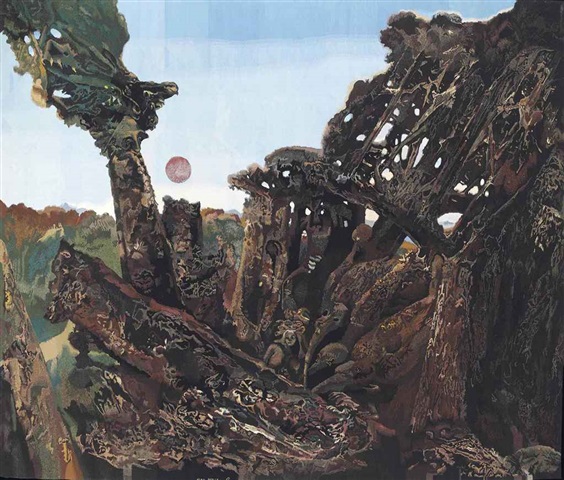
“Totem et Tabou” – Max Ernst tapestry by Yvette Cauquil-Prince measuring a gigantic 163.4 x 194.9 inches
It’s tempting to think that this was some kind of bizarre fluke, but in fact Cauquil-Prince tapestries by Max Ernst have a history of making prices vastly lower than what it would cost to weave them. Christie’s didn’t just pull their estimate out of a hat, it was probably based on Cauquil-Prince’s weaving of Ernst’s “La nature à l’aurore” which sold at Sotheby’s New York on December 15, 2014 for just $22,500. And it’s not like Sotheby’s was throwing their piece away — they had offered it at an estimate of $25,000 – $35,000 on May 8, 2013 and it had failed to sell (it had brought $36,000 at a 2006 Christie’s sale). “Totem et Tabou,” which is the largest and arguably the most important of Cauquil-Prince Ernst tapestries, was passed at Christie’s London on February 7, 2013 with a much more aggressive estimate — 50,000 – 70,000 GBP (78,480 – 109,872 USD).
Bottom line, there just isn’t much demand for Max Ernst tapestries, Yvette’s talent notwithstanding, which to my mind makes them fantastic bargains (provided you like the work of Max Ernst). But auction results can be extremely deceptive indications of prices in the real world. Unless you have a time machine, knowing what was available last year (or yesterday) isn’t worth much. For thinly traded items like tapestries, the “spread” between bid and ask prices can vary wildly. Yes, “La ville entière” may have failed to get a $16,000 bid at Christie’s but it was snapped up within days after the sale. It may very well show up in some dealer’s possession tomorrow with an asking price of hundreds of thousands of dollars, which may be what it really is “worth” but would make it no bargain at all.
Art Consultants and the Agency Problem
When I was Director of a New York City gallery people often came in, saw an artwork they liked and then sent someone whom they called “my friend,” or “my dealer,” “my adviser,” or “my expert” to look over the piece and negotiate for them. Today more and more collectors are buying art through this kind of of representative. In fact there’s a whole profession of people calling themselves “art consultants.” I’m now one of them.
Such representatives theoretically are a great thing for collectors. There’s a widespread perception that dealers are used-car-salesmen-type hucksters eager to take advantage of honest folks. Sadly this perception is sometimes true. Many dealers will tell you that whatever they happen to have in their gallery is absolutely the best thing you can possibly buy and the price is a fantastic bargain. They’ll routinely badmouth anything you may like from their competitors out of sour grapes or just for sport, unless they can somehow cut themselves in.
So what could be wrong with getting an experienced professional to help you make sure you’re getting a good piece of art at the best price?
Well, what’s wrong is a well-known business dilemma called the Agency Problem, which Investopedia defines as follows: “A conflict of interest inherent in any relationship where one party is expected to act in another’s best interests. The problem is that the agent who is supposed to make the decisions that would best serve the principal is naturally motivated by self-interest, and the agent’s own best interests may differ from the principal’s best interests.”
Thus at my old gallery the first thing out of the mouths of some clients’ “friends” was sometimes: “So what’s my cut?” or words to that effect.
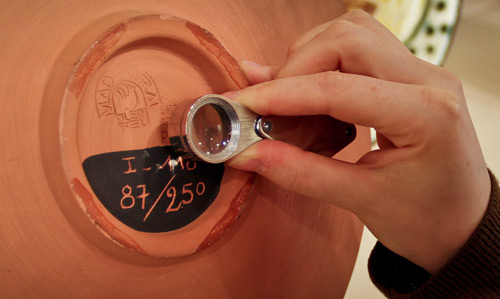 When faced with a choice among several works that the client liked, a lot of “friends”made their recommendation based on the highest rebate to them, or kickback, or whatever you want to call it. Dealers like to call it a “commission.” Such commissions are so common that many people in the art world think of them as simply the way business is done. Not everyone necessarily agrees, including a judge in the U.K. who recently ruled against a dealer who sold a painting for a million dollars more than it was consigned for and then pocketed the difference as his commission (this case and others are related in an eye-opening article by Adil Essajee entitled “Commissions – the best kept secret?”).
To avoid these kinds of conflicts of interest, many art consultants charge on a fee basis or by some complex percentage arrangement. However, this often requires fat legal contracts specifying every possible contingency and can still result in misunderstandings. Consultant A might need only a single conversation to stop a client from making a million dollar mistake and instead show him how to double his investment while giving him years of pleasure. But he’ll end up with a few hundred dollars if he charges by the hour, as opposed to Consultant B who stands to make a hundred thousand by taking a 10% commission on the million dollar mistake. And Consultant C, who charges a commission to both the buyer and the seller for putting deals together (hey, it works for Sotheby’s and Christie’s…), will end up being the most successful consultant in town — or at least the richest.
If it sounds like some art consultants may just be dealers dressed in sheep’s clothing, it’s probably because it’s true — though there certainly many consultants who are e xactly what you would want them to be — honest, experienced professionals who want to help you navigate treacherous waters. And to make a living through their knowledge and love of art.
It’s helpful to remember that there are only two parties really necessary to the sale of art: a seller and a buyer. Everyone else — dealers, auction houses, consultants and friends (or whatever you want to call them) — are middlemen subject to the Agency Problem, some more than others. So if you’re a person who wants to buy or sell art, how do you get around these people?
The answer is that you usually can’t — unless you want to start a gallery or auction house of your own. And this is the wrong question to be asking anyway. The right question is: how can we both get what we want by working together? The answer will involve communication, transparency, trust, realism, mutual respect and a sincere desire on the part of both parties to look out for one another’s interests, not just your own.
Value Mysteries: Jean Lurçat Tapestry Screen
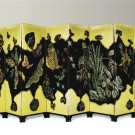
Most dealers and auction houses don’t have a lot of knowledge about tapestries by 20th centuries artists. This makes for a very inefficient, thinly traded market — exactly the type of environment in which smart people can make big profits. Aubussons by Alexander Calder are sometimes still estimated for $2,000 – $3,000 as they were twenty years ago. Though the final hammer prices generally are much higher if word gets out, sometimes no one recognizes what bargains can be had.

This Calder Aubusson sold at a French auction in 2013 for a mere $4,000
Calder didn’t sit down at a loom for months weaving those “Calder” tapestries, of course. He didn’t even see most of them — tapestries are multiples, and Aubussons were generally woven in editions of six with two authorized artist proofs. Long after Calder died, the ateliers were still completing these editions.
It wouldn’t be correct to call tapestry ateliers “factories,” but since they were established by Louis XIV in the 17th Century the “Manufactures Royales” of Aubusson have been businesses that must charge a certain amount per square foot in order to cover salaries, cost of materials, administrative overhead, payment to the artist and profit. Sometimes the marketplace bestows a premium above and beyond what it would cost to replace a tapestry from the weaver. This is especially true for tapestries by Brand Name artists like Picasso, Chagall, Miro, Leger that were woven years ago and the editions are closed out. Here, the line between decorative art and fine art begins to blur and tapestries become rare and collectible artifacts, like first editions by important authors. Tapestries by lesser-knowns, on the other hand, can sometimes be purchased for a fraction of their replacement cost — like used books by forgotten writers.
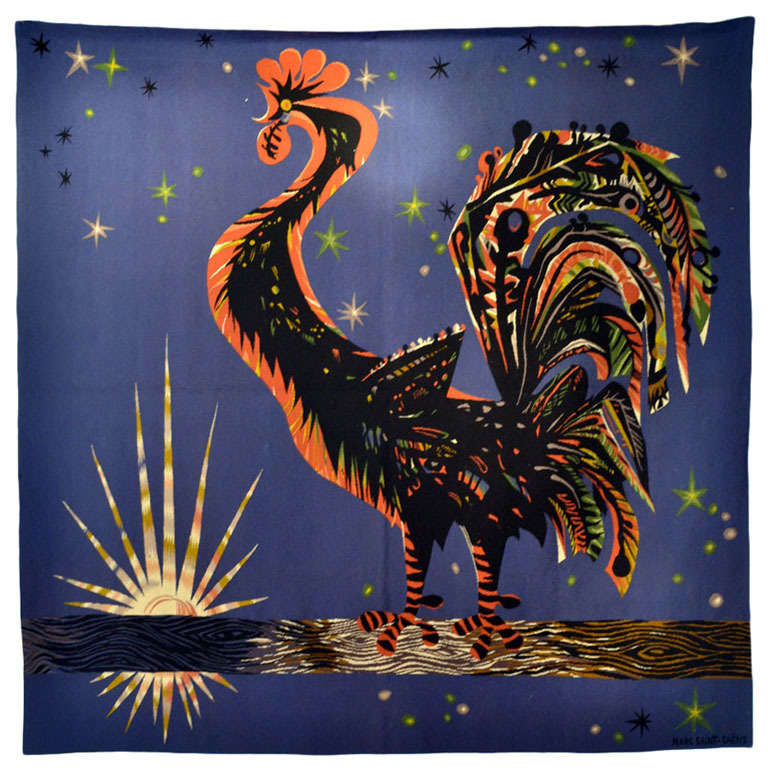
This tapestry by Saint Saens, an artist influenced by Lurcat, was recently on sale in a retail gallery for less than $10,000
One of the most important names in the tapestry world of the mid-20th century was French artist Jean Lurçat. Lurçat was not a weaver himself but he became a master of the medium and inspired scores of important French artists of the period to work in tapestry, which had been a dying art form.
Between 1900 and 1910 the average annual output of the world-famous Beauvais tapestry workshops was a mere 20 square metres because the weaving costs had risen as high as 38,000 francs per square metre, roughly $60,000 in today’s dollars! Lurçat rescued the Aubusson tapestry ateliers practically single-handedly by simplifying design and production requirements. His innovations brought costs back down to earth and the Aubusson ateliers sprang to life in the 1940s once weaving became profitable again.
Lurçat, however, is not a name known to most Americans. His tapestries and those by important artists who followed his lead are usually sold as decorative pieces with none of the fine art premium that attaches to Calders, Sonia Delaunays and the like. Thus beautiful tapestries by René Perrot, Jean Picart le Doux, Mario Prassinos and Jean Lurçat himself can be found in retail galleries for prices in four figures – far less than the cost of weaving, which it could be argued is their intrinsic value.
Fine art tapestries like other works of art are not commodities. One Miro tapestry is not the same as any other any more than all Picasso paintings are interchangeable in value like pork bellies or ounces of silver. Nor are auction prices reliable indicators of value, though they can provide useful insights.
Take this Lurçat tapestry for instance.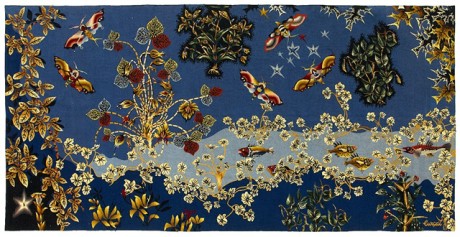 “Papillons de Nuits” is a large, fairly typical Lurçat measuring 68.1 x 135.8 inches. It sold under estimate at the Van Ham Kunstauktionen auction in Germany on 1 December 2011 for the equivalent of about $6,000.
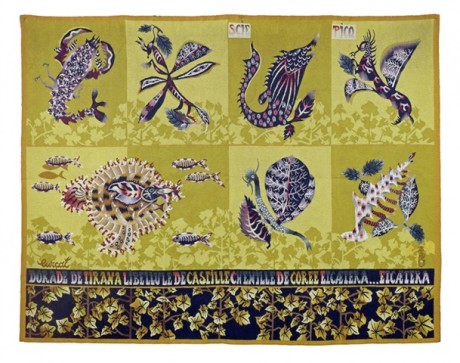 Here’s another, arguably a “better” Lurçat tapestry. Auction records show that “Scie Pick,” 60.2 x 120.5 inches, was passed at Éric Pillon Enchères auction in France of October 26, 2014 against an estimate of 7 – 8,000 Euros (8,868 – 10,135 USD). Another tapestry that looks just like this one but measured only 60.2 x 78.7 inches sold at Drouot-Estimations in Paris on June 13, 2014, for 4,100 EUR (5,544 USD) Hammer. While modern Aubussons are generally limited to a total of eight pieces as indicated above, select tapestries were sometimes “re-editioned” in different sizes — a way of capitalizing on the more successful images (and making them not quite as “rare” as edition sizes would seem to indicate).
Auction prices can be greatly misleading, and it would be foolish to believe that somehow $5,000 or $6,000 “should” be the price of a Lurçat tapestry. In fact they have sold at much higher prices both at auction and in galleries.
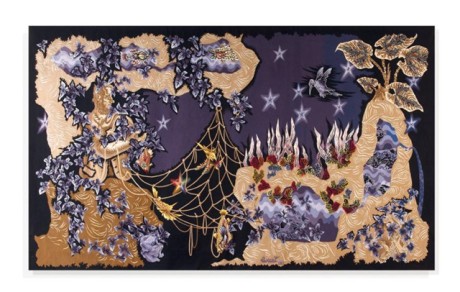
Jean Lurçat’s
“Chasse et pêche” measuring 81 x 140 inches sold at a French auction in 2011 for the equivalent of $44,000 – probably less than it would cost to have a similar piece woven today. In a retail gallery it would be priced much higher.
It’s not likely that most people looking for a large artwork to place on a wall in their home would have been considering tapestries when the above pieces sold inexpensively at auction, nor is it likely that Americans would have even found these particularly obscure sales. Even if you have a time machine, it’s not like you can actually buy these tapestries for the recorded auction prices — you will simply be able to make the next bid. Unless the actual buyer then just gives up, the price could go much higher. In fact many Lurçats have sold for much more at auction and in galleries, which is where most tapestries are sold to end users. Retail buyers generally need someone to explain why a tapestry might be better for them than a painting and time to consider the type of image and the size that might work in their home.
But the fact is that Lurçat is not a “hot” artist. There is not much demand for tapestries in general, let alone for tapestries by Lurçat. This is why most sell — even in retail galleries — for less than it would cost to weave them. To some people that would indicate “value” and “bargain.” Others would probably be thinking “White Elephant.”
So what would you call this Lurçat tapestry screen that I saw recently in the booth of a fashionable French gallery at a high end art and antiques fair in New York?
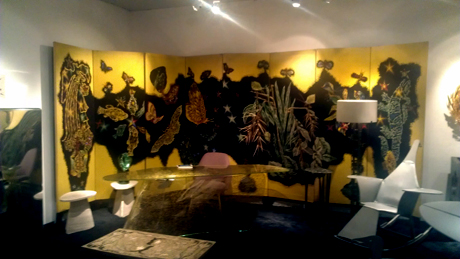 While it appears at first to be an eight panel screen, closer examination reveals that it is actual four two-piece panels, making it much easier to transport and set up. Actually it’s a pretty ingenious thing to do with very large horizontal tapestries like the ones illustrated above, which generally are harder to sell than smaller pieces which can be more easily placed. In fact this screen is 90.5 x 220.5 inches — over 18 feet across!
Such a huge tapestry was probably commissioned for a specific space — this is not the type of thing you weave on spec and then hope to find someone with a gigantic room they want to hang a tapestry in. Perhaps when the original owner died somebody needed to be creative in order to sell this gigantic thing and had it mounted. However, the woman in the booth at the fair explained imperious tone that this was designed by Lurçat specifically to be a screen, in fact it was the only such screen he ever created.
When I asked if there was some documentation for this claim I was given the look that dealers reserve for Martians and other ignoramuses. Obviously if I were one of those crazy Americans obsessed with minutia, I wasn’t a likely prospect to buy anything. Especially a rare tapestry screen like this one priced at $160,000!
Well, maybe the story was true, maybe it wasn’t. However, the bottom line of value is always determined by supply and demand. There were hundreds, possibly thousands of Lurçat tapestries woven; few people are looking specifically for this type of thing, hence prices are often below intrinsic cost. However, this smart French dealer is trying to change the equation. He’s saying that the supply is not thousands but — if you believe the story — only one. And while demand by knowledgeable buyers of tapestries for an impossibly large Lurçat is minimal, a lot of rich people on Park Avenue with big walls and collectors of trendy Mid-Century Modernism shop at prestigious art and design fairs. They’ve probably never seen anything like this (partly because they don’t shop in those places where Lurçat tapestries can be purchased for less than $10,000).
Whether the screen sold for anywhere near the asking price or at all, I do not know. What I do know is that somebody bought this very same Lurçat at Sotheby’s Paris on November 26, 2013 for a little more than $20,000. The Value Mystery is whether the French dealer will be able to sell it, how long will it take, and how much will it finally bring? At full price somebody stands to make a 700% profit in a year, but that $160,000 probably is not a great deal higher than it would cost to weave such a tapestry today.
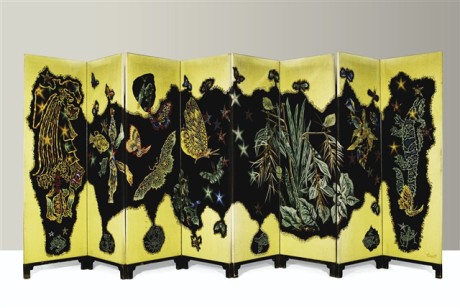 So what about this other Lurçat tapestry screen measuring a much more practical 89 x 32 inches that sold at the Leland Little Auction & Estate Sale of March 17, 2012, for a total price of $2,000? What kind of value should be placed on it?
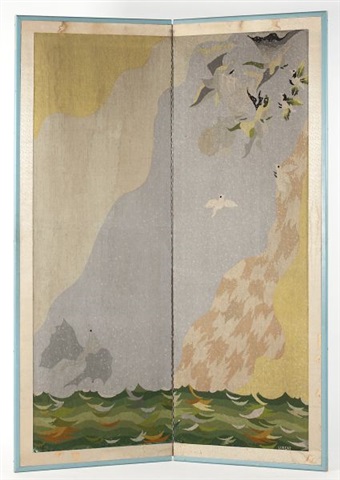
Art as a Form of Money
Money today isn’t what it used to be.
In previous centuries the standard medium of exchange was gold or other precious metals. These commodities had certain attributes that made them ideal: they were rare in nature and hard to refine, thus limiting their supply. They were also physically handsome to look at and could be fashioned into beautiful things. They were easier to carry around than more primitive stores of value, such as cows and wives.
Back then if you wanted a piece of paper to be perceived to have value it had to be exchangeable for the physical commodity it represented. Today the value of “fiat” currencies — i.e., money that is based on governments declaring it to be money rather than making it exchangeable for commodities — is taken for granted. A new twist is that if enough people agree that something is money (like Bitcoins), then it becomes money — though the rate at which such things can be exchanged for goods and services can be wildly erratic.
Which leads us to Art. A few hundred years ago anybody could glance at a painting by Leonard da Vinci or Raphael and know that it was art. In the old days art was like pornography; maybe people couldn’t define it but they knew it when they saw it. Today, nobody knows it when they see it. Art no longer has to be beautiful or require a lot of skill to produce like it used to. Part of the reason that the Impressionists were initially ridiculed was the perception among older artists who had labored for decades perfecting their craft that any idiot could dab some paint on a canvas and create this “new” stuff. But all that has changed now.
Take a look at this work:
City Within the City
Let’s say I’m an artist, and I say this is art. Is it? Or suppose I am an art critic. I, too, say it is art. Is it? Or I am an art dealer who agrees that this is art. Is it?
While all of these folks are influential in determining what art is, I submit that none of their opinions ultimately matter unless the item can be exchanged for money. Perhaps I am making a distinction between “art” and “the value of art” but if something has no value, wouldn’t it be more correct just to call it “trash”? What’s the point of a word if nobody knows what it means? In our culture art means money.
Consider three virtually identical 30 x 30″ canvases, all covered with red paint. The first was done by a professional house painter, who did it to give you an idea of the color he can paint your bathroom. He won’t charge you for it if he gets the job, otherwise he’ll bill you for the cost of the materials. The second was produced in a factory by an industrial robot — it is on sale at Walmart for $49.99. The third was painted by a “name” artist whose work has been exhibited in numerous important galleries over decades. It is identified in the Sotheby’s catalogue as a masterpiece and estimated at $360,000 – $400,000. Isn’t the one at Sotheby’s the only one that’s “art?” And if there were a fourth identical red canvas, but one done by a young artist on sale at a local frame shop for $1000, most people would probably say that though it might be art it’s not as good as the one at Sotheby’s. In our culture the price of something pretty much determines its quality, not the other way around.
Now forget about semantics, and about philosophical questions like “What is Art?” Take a look at the two items below. One is a form of money and one is a form of trash. Can you tell which one is which?
Mirrored Armadillo
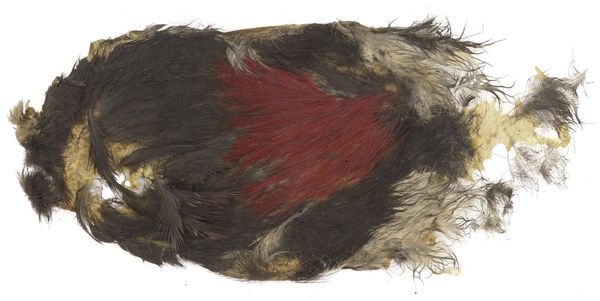
Woody Memories
It doesn’t matter what your level of taste or education is, there’s no real way to determine which one is garbage. But what if I told you that “Mirrored Armadillo” was exhibited by the Gagosian Gallery? And “Woody Memories” is in fact a natural item — the scalp of a woodpecker.
However, you still may be jumping to the wrong conclusion.
“Mirrored Armadillo” was exhibited (i.e. displayed publicly) by (i.e. in proximity to) the Gagosian Gallery. I found it in the street about a block up from Larry’s Madison Avenue place. I believe it is a side mirror that was knocked off a car and run over a few times. Woodpecker scalps on the other hand were used as money by the Karok people of the Klamath River region, in northernmost California and adjacent parts of Oregon. The example above comes from the collection of the American Numismatic Society.
Either one plus $2.50 will buy you a cup of coffee in New York City.
And what about contemporary artist Tracey Emin’s bed? 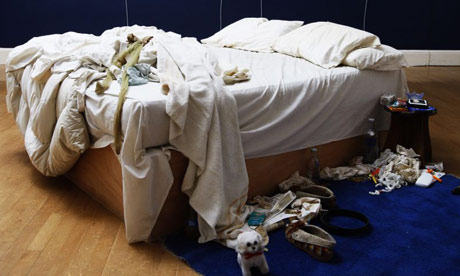 If you aren’t already familiar with this, you might not consider it Art-with-a-capital-A, what with the used condoms, empty bottles of vodka, dirty laundry and the like. But the Tate Gallery in London exhibited it in 1999 and it was shortlisted for the prestigious Turner Prize, causing great indignation among the hoi polloi who thought it was garbage. Whether it is art or not was settled by Charles Saatchi who bought it for £150,000. But is it good art? This question was settled the way we in our culture now settle such matters — namely at auction. It brought £2.2 million at Christie’s this past June.
As for “City Within the City,” it looks as much like art as anything else. If I could make a hundred somewhat like it each year and get an important dealer to show them at Art Basel, put a few pieces at auction and bid up the prices (rather illegal, of course, but do you really think it isn’t being done?), then I will have created some real value. But I’m just interested in art and was happy to have seen it when it was exhibited on 57th Street.
The emperor may not be wearing clothes, but they look like a million bucks!
Value Mysteries: Picasso’s Runaway Bull Returns
In my previous post I discussed the Case of the Picasso Ceramic Bull, “Taureau” as he is called in Alain Ramié’s definitive ““Picasso – Catalogue of the Edited Ceramic Works, 1947 – 1971.” Alain Ramié is the son of the Georges and Suzanne Ramié who created Picasso’s edition ceramics at the Madoura pottery.
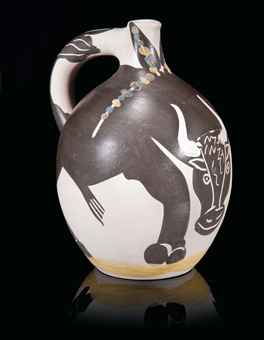 The first of these Taureaus (AR 255 as it is identified in the catalogue raisonne) to sell at auction brought $87,000 in 1990. For the next two decades, however, at least eighteen other bulls from the edition of 100 sold (or were passed) at auction for prices averaging in the $20,000s. As late as April 2010 one sold at Christie’s in New York for $27,500. In October that same year another brought $25,000 at Sotheby’s New York. But something very strange happened at the next sale of AR 255, which took place at Christie’s South Kensington on June 25, 2012. The price was 97,250 British pounds — $151,263!
What the hell happened in the intervening year and half that drove the price of Picasso’s ceramic Taureau up 500%?
To answer that question it is helpful to go back to last post where I discussed the factors that drove the price of the first Bull into record territory:
“Market inefficiency drives price volatility and, as with many markets, there are three factors that create inefficiency for Picasso ceramics: lack of knowledge, thin trading and what some people might call manipulation but which in reality is simply the interaction of small groups of people who think they are smarter than everyone else seeking to make money by exploiting the first two factors.”
 Did any of these three factors exist after twenty years of stable prices for this ceramic? You’d think all the angles had been covered by now, and everybody knew all there was to be known, wouldn’t you?
But in fact all of these conditions still existed on June 25, 2012 when “The Madoura Collection” went up for sale in South Kensington. Parsing the facts, however, is difficult because in the art market — as in quantum physics — the facts change depending on how they are observed and by whom.
Let’s not call it manipulation because Christie’s in fact was smarter than everyone else when they packaged hundreds of ceramics that had been consigned by Alain Ramié into a hugely publicized, once-in-a-lifetime, sale-of-the-century type affair on June 25, 2012.
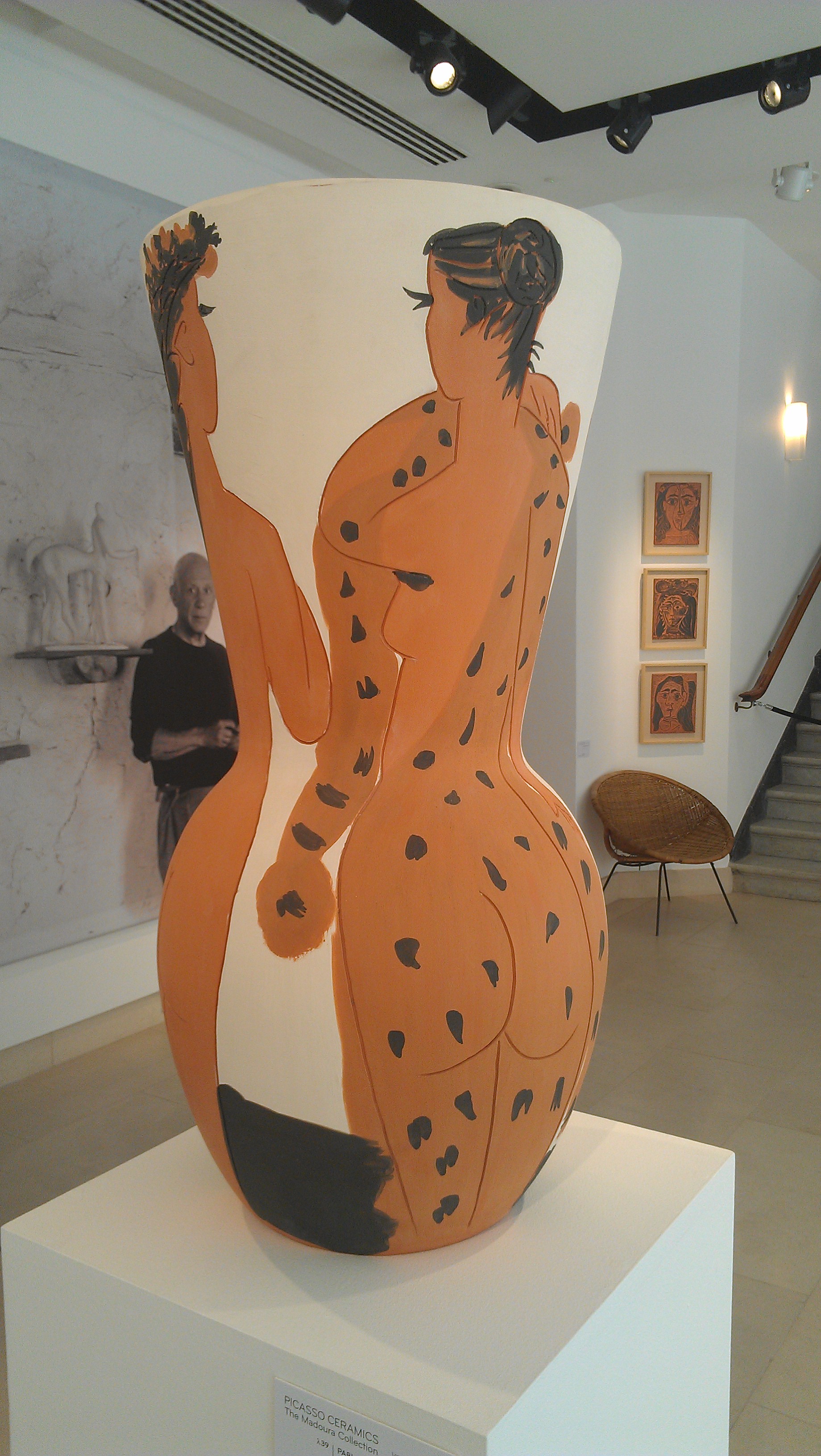
Looking like it had been made yesterday, this Grand Vase was the Madoura Sale’s top lot, selling for the equivalent of $1,146,143
Christie’s sale rooms in South Kensington were a perfect venue — one of the priciest neighborhoods in the world and the kind of place where the street traffic is comprised of billionaires. Right there in the window were scads of these charming, wacky Picasso pots and plates, which probably a lot of billionaires and their sisters and their cousins and their aunts had never seen before. These are the sort of folks who usually only bother with the big evening sales where even “restaurant Picassos” start at a couple million bucks. (“You know, Restaurant Picassos,” as Steve Wynn once educated me. “They’re not good enough for my museum so I put them in the restaurant.”) Here was an opportunity to pick up a genuine Picasso with the best provenance imaginable in such pristine condition that it looked like it had been made yesterday for estimates that began at a mere 1,000 pounds or even less. Stocking stuffers!
People who attended the previews reported that these were the archive copies of the Madoura pottery, the “bon à tirer” pieces, the very prototypes approved by Picasso so that editions could be recreated and sold inexpensively (originally) to the tourists. Strangely the Christie’s catalogue itself did not mention any of this, other than to identify the sale as “the Madoura Collection” and specify the edition size. In other words you might have bought the story but as in any auction you weren’t buying actual documentation beyond what was printed in the lot description. 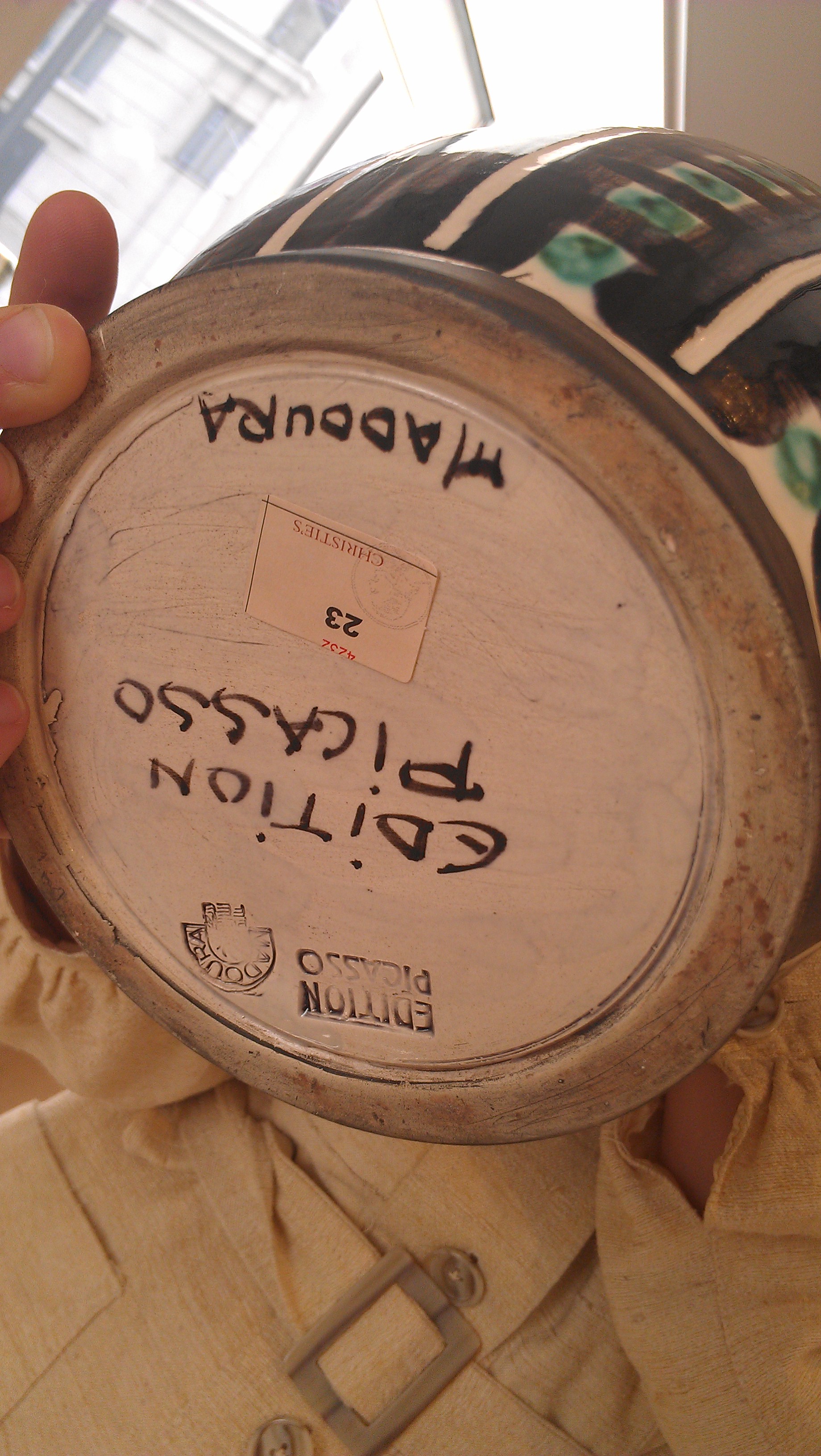 Many of the ceramics were marked “Exemplaire Editeur,” which led to a lot of grumbling among cynics and old-time dealers who had been buying ceramics directly from Madoura — in some cases since the 1960s — and had never heard of anything marked “Exemplaire Editeur.” Nothing about Exemplaire Editeurs had been mentioned in the catalogue raisonne. How many of these things were there and when were they really made?
The same people also complained that the person who Christie’s (and Sotheby’s) trusted to judge the authenticity of Picasso ceramics was the same person who consigned the pieces, a rather serious conflict of interest! No matter. It wasn’t the cynics who were going to buy at the Madoura sale, any more than they would have shelled out a thousand dollars for a $50 cookie jar at the Andy Warhol Estate sale or God only knows how much for Jackie Kennedy’s dental floss. The once-in-a-lifetime Madoura sale was geared toward once-in-a-lifetime buyers — this was their last chance to buy directly from the source. And buy they did. The two-day Madoura Collection sale was a huge success, taking in over £8,000,000 ($12,500,000), four times its total presale estimate, and was 100 percent sold by lot and by value.
It is interesting to note that not all of the ceramics in the Madoura sale were Exemplaires Editeur. Some were ordinary numbered and unnumbered production pieces. Others bore strange numbering like 113/157/200. A “Grand Vase” that sold for £265,250 was marked H.C 1/3. H.C. is an abbreviation for Hors Commerce, which basically meant not for sale. There is no mention of H.C. Picasso ceramics in the catalogue raisonne. These ceramics skyrocketed past their estimates like everything else.
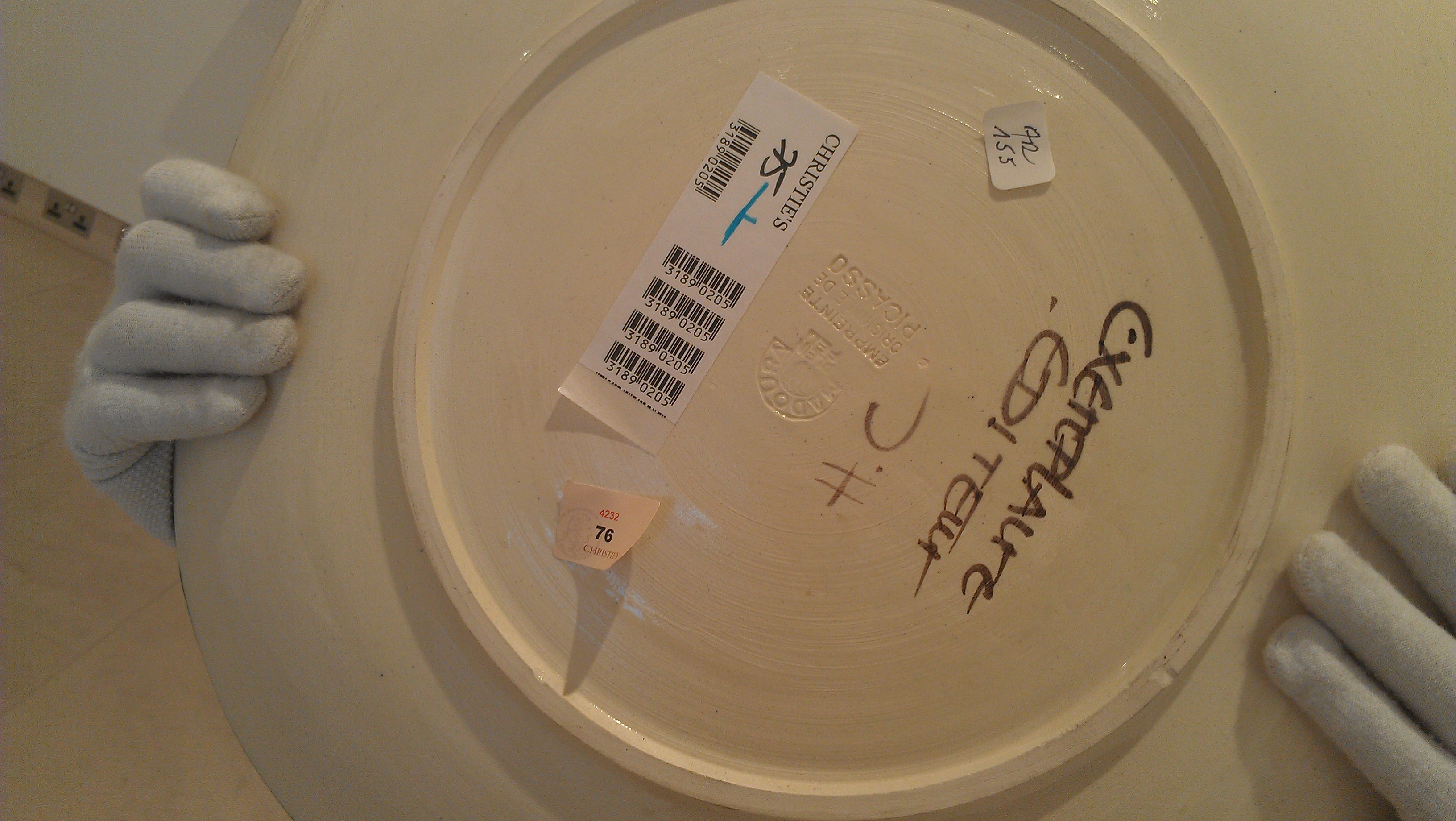 When the purchasers go to sell their copies, will the market reward them for coming from the historic Madoura Sale (presuming the buyers have kept their receipts)? Or will they find their ceramics valued just like all the hundreds of identical others in the editions?
And what about Taureau, AR 255, Picasso’s Bull that ran away in value? Will it continue to bring a huge premium over its bovine brethren?
In fact a year later the price of Taureau was down by more than half, an example from the edition selling at Christie’s New York for $68,750. A few months later Christie’s South Kensington did better, getting the equivalent of over $91,000 for one (rumor has it that they specifically targeted Chinese internet buyers who had no idea that genuine Picassos could be had so cheap). Not bad, but of course not in the same league as that Exemplaire Editeur Taureau that garnered $151,263 at the Madoura sale. How much, I wonder, is that once-in-a-lifetime ceramic worth today?
In fact, buried at the bottom of the definitions and abbreviations page of Alain Ramié’s catalogue raisonne is the note that there are three “publisher’s copies” for each piece. So perhaps there will be two more “once-in-a-lifetime” Madoura sales in the future. But an Exemplaire Editeur Taureau may not be in both: I appraised one purchased directly from Madoura in 2005.
Value Mysteries: The Case of the Runaway Picasso Bull
Working at the Madoura Pottery in the village of Vallauris in the South of France Pablo Picasso hand-decorated over four thousand ceramics between 1947 and his death in 1973. Over 600 of these were selected to be replicated in editions of 25 to 500 by the artisans at the Pottery and sold inexpensively to the tourists. For the last thirty some years they have been bought and sold at auctions and in galleries around the world. Studying these sales can bring fascinating insights into markets in general and the art world in particular.
Market inefficiency drives price volatility and, as with many markets, there are three factors that create inefficiency for Picasso ceramics: lack of knowledge, thin trading and what some people might call manipulation but which in reality is simply the interaction of small groups of people who think they are smarter than everyone else seeking to make money by exploiting the first two factors.
Ironically, until recently the highest prices for Edition Picasso ceramics were achieved in the 1980s when the Japanese appeared to be on the verge of taking over the world. At the beginning of the decade it was the Japanese who knew something that everyone else didn’t: that ceramics had always been the true fine art in Japan, a culture where oil painting had not traditionally existed. Tremendous wealth was flowing toward Japan and the Japanese wanted to experience the best that the Old World had to offer in luxury products, fashion, food, entertainment and of course art. Well-heeled Japanese who weren’t rich enough to buy important European paintings could pay twice the asking price for a Picasso plate and feel they had gotten a tremendous bargain. Prices soared. By mid-decade Sotheby’s and Christie’s, which for years had turned up their noses at Picasso ceramics as mere tourist curiosities, began to include them in sales. Prices went even higher. Yet few people understood what these items were, where they were made, who made them and how many were created.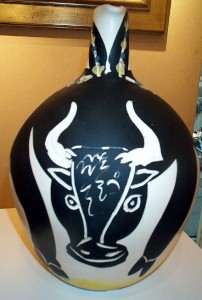
Because Picasso ceramics were low-priced vacation “souvenirs,” there was little published information available. Not even the book written by the owner of the Madoura Pottery, Georges Ramié (which was only available in French for several years), offered much hard data. Georges Ramié’s “Ceramiques de Picasso” pictured various of Picasso’s unique prototypes without explaining that there were perhaps hundreds of “authentic replicas” of the pictured pieces. This inevitably led to confusion among buyers and sellers alike as to whether ceramics were originals or edition pieces (in fact the vast majority of ceramics decorated personally by Picasso were never for sale and are still owned by members of the Picasso family and museums).
When this Bull appeared at auction it was probably the first time that anyone in the prestigious sale rooms had ever seen anything like it. But novelty wasn’t the only reason that this Bull sold at Sotheby’s London on October 18, 1990 for 44,000 British Pounds, then the equivalent of $87, 824. Knowing that the Japanese were voraciously pursuing Picassos a dealer may have made the top bid for this ceramic, figuring he could sell it to some rich fool in Tokyo. It only takes two bidders to achieve a record auction price and unknowingly the buyer might have been bidding against the one Japanese collector who would have paid a top retail price for this ceramic. Or perhaps there was a second dealer who thought he too was smarter than everyone else, was willing to take risks and believed there was no limit to the Japanese mania for Picasso ceramics. We’ll never know. What we do know is  that one month later, on November 19, 1990 another Picasso ceramic Bull just like the first sold for $39,600 at Christie’s in New York City.
A 55% decline in one month would be considered a crash in any market (the great Stock Market Crash in 1929 was a mere 12.82%). Certainly one factor in the price decline was lack of information, but that was about to change — sort of. In 1989 Alain Ramié, the son of Georges, published “Picasso – Catalogue of the Edited Ceramic Works.” I say “sort” of because both Georges and Alain Ramié’s books were popularly referred to as the Ramié Catalogue and to this day they are confused with one another. Each gave numbers to the pictures of Ceramics they included but the only Ramié numbers that now mean anything to dealers, collectors and auction houses are the numbers from Alain Ramié’s book. It is an authoritative catalogue raisonne compiled from the records of the Madoura Pottery and includes definitive measurements, descriptions, edition sizes and pictures. Sometimes (but not always) these numbers are referred to as AR numbers. Thus the professional shorthand for this Bull is R 255 or Ramié 255 or AR 255.
Around the time of the record 1990 sale anyone with access to the Alain Ramié catalogue would have known that the Bull was one of an edition of 100. In fact that’s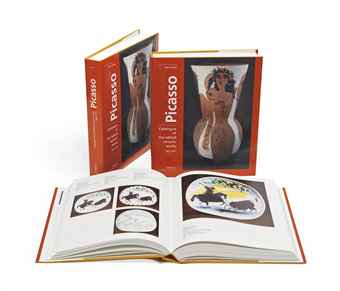 how Sotheby’s identified it in the auction catalogue, but clearly the bidders weren’t aware of or discounted this information. In fact edition size is a problematic fact. After all, it’s not like there are actually 100 of these ceramics available for sale at the time of any given auction — there is only one. It might be years or even decades before another appears for sale (then again, it could be weeks). Of course there’s nothing like a record sale to alert all of the other owners of a similar item that now may be a good time to sell — often gaggles of similar pieces suddenly appear out of the woodwork at the next sale once a record has been achieved.
In the stock market there are millions of shares, and the “spread” between the bid and ask prices can be a fraction of a penny. However, for thinly traded items the spread can be enormous. In hot markets this may work to the seller’s advantage: you might have multiple bids on your million dollar Miami Beach condo in 2007. But if the buyers suddenly disappear like they did for Florida real estate in 2009 you may have one offer and it might be for $400,000. This is what happened to the artworld when the Japanese “Bubble Economy” burst. The music suddenly stopped, the Japanese buyers disappeared, seemingly from one day to the next. Just as with people holding Collateralized Mortgage Obligations in October 2008, anybody who hadn’t already found a “greater fool” to sell to was stuck.
If the underbidder felt bad about losing the Bull at Sotheby’s October 1990 sale, he probably felt a lot better after the Christie’s sale the next month. And the buyer who bought the Ramié 255 Bull at a 55% discount (perhaps the same underbidder?) may have thought he was a genius. He would have been mistaken. The following year, on November 4, 1991, a Bull sold for $24,200, again at Christie’s in New York, nearly 40% less than the “bargain” November 1990 price. (Of course any dealer with a Bull of his own had immediately raised the price of the one in his shop to at least the $87,000 after the October 1990 Christie’s sale and many never adjusted their price downward — but this will be another post.)
Nearly twenty years later the Picasso Edition Ceramic Bull AR 255 was still changing hands at about the same price it brought in 1991 (one sold at Sotheby’s New York on October 29, 2010 for $25,000).
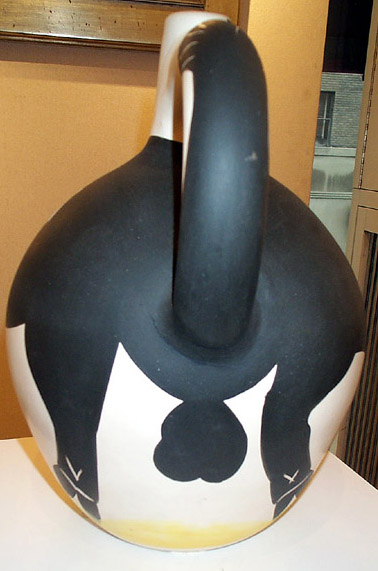 You would think that the market is more efficient these days, wouldn’t you? That lack of information is no longer an issue, that edition sizes have been discounted in the prices, and that mature markets like the long-standing one for Picasso ceramics can’t suffer from small groups of people who think they are smarter than everyone else seeking to make money by exploiting the first two factors.
How then would you explain the Edition Picasso Ceramic Bull that sold on June 25, 2012, just a year and half after a two-decade string of $25,000 – 35,000 sales, for 97,250 British pounds at Christie’s South Kensington, then equal to $151,263?
I’ll try in my next post.
A Conspiracy of Paper
“A Conspiracy of Paper” was mystery writer David Liss’s first novel, published in February 2000. It’s a meticulously researched story of a Jewish boxer in 18th century England who gets involved in stock market manipulations that have eerie parallels to what goes on in financial markets today.
I bought the book when it first came out because I like the period and am interested in the stock market. Also, I must confess, I was jealous. I was an active mystery writer at that time, and frankly I wanted to know what kind of book a big-deal publisher like Random House would throw its weight behind. “A Conspiracy of Paper” came out the gate with a bang-up review in the Sunday New York Times and ended with an Edgar for Best First Mystery Novel of the year. And in fact it was a great read. At least I consoled myself with the thought that I  had purchased a first edition (I felt it only right to buy fellow writer’s books, hoping that some of them might follow the golden rule, too), and it would probably be worth something one day. Back then first novels by writers who were hot brought big prices at the many bookstores across America that specialized in mysteries. A mystery writer friend of mine who was practically living out of her car was kicking herself for not having saved a few copies of her first novel which was then selling for almost as much as the advances I received from St. Martins Press.
Today, sadly, there are few if any mystery bookstores left, and if you want to read “A Conspiracy of Paper” you can for $9.99 download it for your Kindle. But we’re remodeling our small New York apartment and there simply isn’t room for all the books so today was the day that I decided to cash in on my investment.
In terms of dollars, selling your books is orders of magnitude less consequential than selling your stocks or your art, but in certain ways it can offer clearer insight into how markets function. Bookstores and book dealers don’t just make the market for books — they physically OWN the market. Unless you own a bookstore, too, books are virtually unsellable except maybe through Ebay (which for low priced items is more trouble than it’s worth). Luckily in New York City we have the Strand, one of the largest independent bookstores in the world and one that actively purchases books — but strictly on their terms. The Strand is not only prepared but happy to deal with walk-in sellers. Computers allow them to scan the bar code and have instant information about how much they can offer.
Some people might characterize these offers as a conspiracies not of paper, but of spare change. Therein lies the reality of all markets: it is demand that drives prices, not supply. You may have an extremely rare volume, but it doesn’t matter what you think it is “worth.” Yours may be from a tiny edition. The author might be loved by critics and readers alike. You may have seen one in a store for a hundred dollars. None of this matters. The only real question is how many people would buy it if they knew that yours was available for sale? (Perhaps that’s why signed first editions of my mysteries, tiny editions all, linger on Abebooks.com for less than $30.00, but that’s another story.)
If you take your books to the Strand, they won’t even consider anything that isn’t in perfect condition because you probably purchased your books from Barnes and Noble, not Sotheby’s. You don’t have a book collection, you have a lot of used books — and as with used cars or used furniture, a used book has to look pretty good if it’s going to appeal to anybody. The Strand will save you the trouble of shlepping home less than perfect editions — they put them out on the $1 sale tables — but they won’t give you a nickel for a wheelbarrow of them. For books in pristine condition they might pay a few dollars, take it or leave it. Even very nice art books will probably bring less than $10. Again, if you don’t like their offer you can go become a book dealer yourself. Go ahead, try your to sell first edition John Updike on Ebay. According to the Strand, nobody really collects Updike, regardless of how great the New York Times thought his books were — and the press runs were huge so there’s plenty of supply out there. There’s no demand for John Grisham, or most other best-selling authors, either — and the supply is even larger for this stuff. You may point out that booksellers on Abebooks are asking hundreds of dollars for that rare classic the Strand is offering you two bucks for. They will point out that they’ve had six upstairs since 1992, none have ever sold. Why do they need to buy another one at any price?
And those fancy art books? A gallery owner friend of mine bought a few boxes of Chagall catalogues raisonnes when they came out decades ago. Art dealers and appraisers need to buy these essential references so there is a legitimate demand — you can find them one Abebooks for hundreds of dollars. But how many art appraisers are there and how many don’t already have copies? Thirty bucks was all the Strand would offer, and they certainly didn’t want all twenty, the most they might take was one or two. It could take years to sell them and, after all, they already had a few copies.
And David Liss? If you go to Advanced Book Exchange you can find a signed first edition of “A Conspiracy of Paper” in perfect condition for $120. Unfortunately you can also find perfect signed firsts for $10, to say nothing of all the unsigned copies. Publishers support their books to make sales in the primary market, not the secondary one. Random House sent out hundreds of promotional copies, had a national advertising campaign so they could sell enough of that big first printing of Liss’s first novel to make a profit. Everybody thought the author was going somewhere, so plenty of people saved their copies. The Strand already has a ton of them and hasn’t sold one for years. That’s why they didn’t want mine at any price. And I wasn’t going to shlep it home and wait for collecting first mystery novels to come back into fashion.
It will probably be on the $1 table for a long time to come.
Pablo Picasso Ceramic Editions from the Madoura Pottery
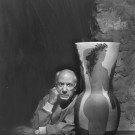
In the summer of 1946 Pablo Picasso visited the ancient city of Vallauris in the South of France. The name Vallauris comes from the Latin “Vallis Auris” – Valley of gold, but the gold here was the rich clay of the area. The town became a pottery center in Roman times, producing the amphorae that wine traditionally was stored in.
Two thousand years later Vallauris was still a pottery center, though the sixty-odd workshops of the town were in depressed economic straights after the Second World War. Picasso, who was soon to move to the South of France, admired some of the local ceramic production in Vallauris and amused himself by decorating a few plates. When he returned a year later and was shown the fired results, he was enchanted. Georges and Suzanne Ramié, owners of the Madoura workshop seized the opportunity to invite him to make himself at home at Madoura, putting all of their artisans at his disposal, even giving him an outbuilding to store his production.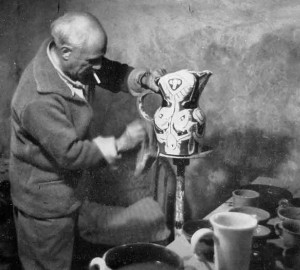
It was a dangerous offer to a man like Picasso, who happily took over the pottery’s entire output. Clearly Madoura couldn’t survive as the personal ceramics studio for Picasso, so it was early on agreed that the Ramiés could produce editions after Picasso’s originals. These “Authentic Replicas” would be sold inexpensively to the tourists, which worked to everyone’s advantage. Picasso could explore this wonderful medium; the tourists could bring home a whole new category of souvenirs from their French vacation; and the local economy would get a much needed boost. Even better for Picasso whose financial success as an artist was the cause of grumbling in the Communist Party which he had recently joined — Picasso could now demonstrate that he was helping labor employment, plus he was making affordable art for the people!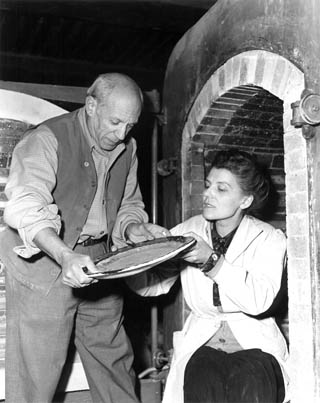
Ultimately Picasso personally decorated over 4,000 ceramics at Madoura, the vast majority of which he kept for himself and which are now in museum collections or still belong to the Picasso family. The artist was also directly involved in the replication by the Madoura artisans of over 600 of his ceramics in editions of between 25 and 500. These were sold at Madoura from 1947 until Picasso’s death in 1973 and what remained continued to be sold until the individual editions sold out. Each ceramic was given an individual reference number in Alain Ramié’s definitive Catalogue Raisonné which everyone now uses for easy identification. The most interesting forms ceased to be available within a few years of their introduction, but Madoura was still marketing leftovers until 2012 when what were said to be the pottery’s “Bon à tirer” collection was sold at Christie’s South Kensington for record prices.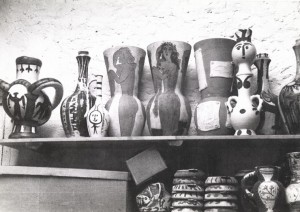
Almost as soon as they became available Picasso ceramics were adored by the public (especially those tourists bringing back Picasso souvenirs). The art establishment, however, was initially convinced Picasso had lost his marbles: the great creator of Cubism was now playing with clay! However, with the 1998 blockbuster exhibition, PICASSO: PAINTER AND SCULPTOR IN CLAY, presented by the Royal Academy of Art and the Metropolitan Museum of Art, Picasso ceramics were acknowledged as some of the artist’s most innovative work. Today items that people’s grandparents paid less than $10 for can sell for tens of thousands. The market in fact is more heated — and prices more erratic — than ever before.
With the total number of Edition Picasso Ceramics approaching 120,000 in number, common sense would suggest that the smallest — and therefore the rarest — editions would command the highest prices. However, some ceramics that were made in editions of 25 have sold for much less than fairly common examples from editions of 500. The reasons why might surprise you.
To understand value and quality in this area takes experience and knowledge. I’ve assembled a lot of both as Director for over twenty years of the Jane Kahan Gallery, one of the first and still one of the most important galleries in the world to specialize in this area. In forthcoming posts I’ll share some of what I’ve learned.
Appraisals, Relativity and Value
Albert Einstein’s Relativity Theory changed the paradigm by which we view the world. Before Einstein people believed in absolute value. After Einstein nothing had an absolute value except the speed of light. If theoretical spaceships had to shrink and time itself had to slow down to make the equations work out, then so be it. Everything was relative. And then quantum theory threw another curve ball by revealing that everything was in the eye of the beholder. Just by looking at something you changed it.
Many people think that appraisals of objects somehow get around Einstein, quantum physics, the Uncertainty Principle and the whole works. They like to think that at least as of the date of the appraisal report, an appraiser can record the absolute value of an object. Unfortunately this is not true. There is no absolute value of a work of art or piece of antique furniture or even money itself, which fluctuates in relation to other currencies, other stores of value and how you measure it.
Take gold for instance. The largest gold coin in the world was produced by the Perth Mint in Australia — one metric tonne of gold, which equals 35,274 ounces. You can find a lot of references to this artifact on the internet and calculations of its “value” (for instance gold at $1300 per ounce makes this coin “worth” more than $45,000,000 US dollars). Presumably the Perth mint will tell you what they want for it if you contact them directly, but I’d be surprised if they’d take the daily bullion cost. This big chunk of change must have cost a lot to produce; there’s bound to be a premium. How much is only one question. Another might be what’s the tab to get it from Perth, Australia, to your apartment in Brooklyn? How about the cost of a new security system? What does it cost to shore up the floor?
Whatever the premium is for a one tonne gold coin I’ll bet it wouldn’t come anywhere close to the premium on this little baby to the right.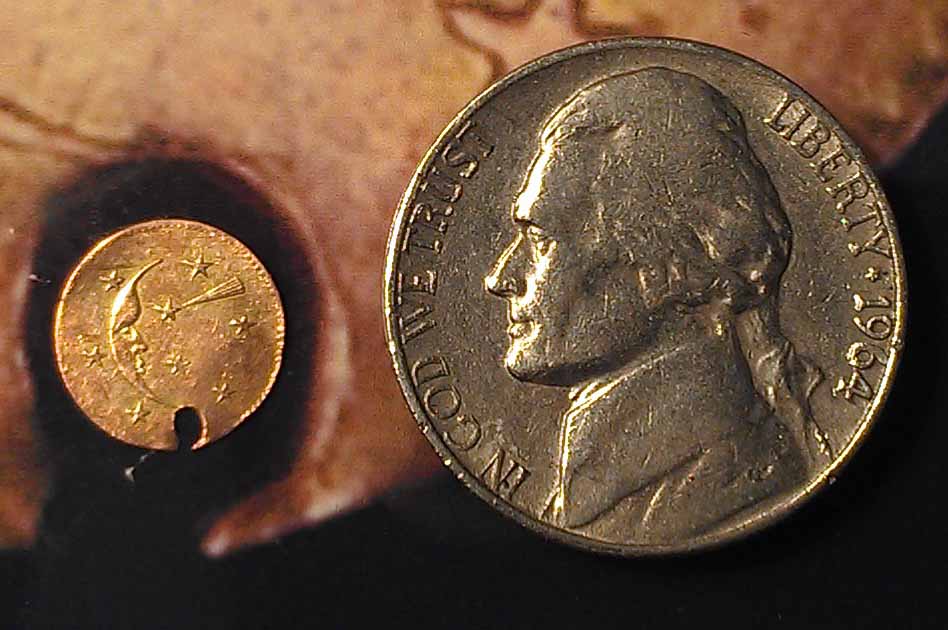 Not the big one — the little fella. This item is what numismatists call a California Gold Token, which was never even legal tender. It also has a hole in it, which usually kills a coin’s value for collectors.
The last time I found a California Gold Token with the Moon and Shooting Star, similarly holed, for sale the price was $799.99. Tokens like these are as thin as a parking ticket and weigh typically about one gram — .035 oz. Most were only 10 karat gold to boot. Even a non-mathematician can see that this bad boy is worth quite a bit more than its weight in gold. By at least one measure (premium above the bullion value of its gold) it is worth astronomically more than the one tonne coin.
But there doesn’t seem to be one of these for sale anywhere in the world right now, so even if you had $45,000,000 you can’t buy it. It’s literally priceless. And even on the day that it was priced at $799.99, its value was relative — worth about a minute’s worth of work for the highest paid CEO in America, Elon Musk, or almost two years’ annual income for the average household in the Democratic Republic of Congo.
Now imagine if Jeff Koons made a ten foot high version of this California token in mirror-polished stainless steel. I don’t know what it would be “worth,” but at Sotheby’s or Christie’s it would probably bring a higher price than the solid gold version. At least this year.
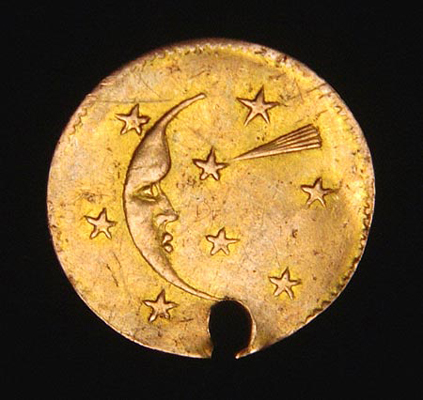
What is an Appraisal and Who Needs It?
When people have a piece of art they want to sell they often think that their first step should be to get an “appraisal” so they won’t be taken advantage of.
But what is an appraisal? When your friend who owns an antique shop says, “This is worth about three thousand bucks,” is that an appraisal? How about when an imperious looking chap wearing a bespoke suit and a British accent looks at your painting on THE ANTIQUES ROADSHOW and declares that it would bring $40,000 – $50,000 at auction? Did you get an appraisal?
The dictionary might say both of these are examples of appraisals, but according to the Appraisal Foundation which was authorized by Congress as the source of appraisal standards and appraiser qualifications, to be credible an appraisal must conform to rules that the Appraisal Foundation refines and publishes every two years in a big fat book entitled the Uniform Standards of Professional Appraisal Practice (USPAP). USPAP compliant appraisal reports can run dozens of pages even for single paintings in order to conform to the standards. To jump through the required hoops takes a lot of hours on the part of the appraiser, so USPAP compliant appraisals are expensive propositions. USPAP says that even oral appraisals must conform to all the myriad standards and be documented in a work file, so it is unlikely that any oral appraisal is USPAP compliant. Members of the professional appraisal associations (the Appraisers Association of America, the American Society of Appraisers and the International Society of Appraisers) all REQUIRE their members to perform only USPAP compliant appraisals.
A person needs a pet grooming license in New York City to shampoo your poodle. To come into your house and do an “appraisal” of your silverware, he doesn’t even need a business card that identifies him as an appraiser. Anybody can give you an “appraisal.” For that matter anyone can issue a “Certificate of Authenticity” for your Picasso, which will be just as credible as the issuing party. The whole point of USPAP and appraisal organizations is to make sure that the public can have confidence in appraisals done by unbiased professionals experienced in the business of valuation – not the business of grooming poodles or selling your property to make themselves a profit.
Bottom line, a credible appraisal is usually a lengthy document conforming to USPAP standards written by a member of a professional appraisal group. If you’re dealing with the IRS for a charitable contribution or for estate tax purposes, chances are you need such a document. Your insurance company may also require it to protect your expensive art collection. Perhaps a credible appraisal is necessary in a court situation — a divorce or a lawsuit.
But if you just want to get some idea of what your art is worth so you can sell it, you very well may not need and probably shouldn’t have to pay for a professional, USPAP compliant appraisal report. So ask your dealer friend for his opinion, run it past an auction house if you like, but be aware that the oral “appraisal” you receive may not be worth the paper it’s written on.
Stephen Hawking Is Not So Smart

The physicist Stephen Hawking said in a famous quote, “I regard the brain as a computer which will stop working when its components fail. There is no heaven or afterlife for broken down computers; that is a fairy story for people afraid of the dark.”
I find this an extremely odd statement, especially from a scientist. It completely ignores what powers the computer, namely electricity. Yes, collections of computer components will not go to heaven. But if a computer dies, does electricity cease to exist?
Whatever “life” is, it has more in comm0n with electricity than with circuitry. When the human body is no longer animated by life, a person dies as surely as the computer on which someone has cut the power. But electricity still exists even when the computer breaks down. When a person dies, isn’t it only logical that life still exists?
Maybe the fairy story is that we are just a collection of organic components.
What makes something valuable?
What makes something valuable?
A long line of discussion usually follows, but at the end it becomes clear that what makes something valuable is the same thing that makes the universe visible: a self-aware mind that can perceive it.
When a tree falls in a forest and there is nobody there to hear it, does it make a sound? Many people in our 21st century materialistic culture will say, yes, it does. But if these people didn’t exist — indeed if no people at all existed, no conscious entities anywhere in our universe, would the universe exist?
Our universe is limited to our perceptions. Flies have a much different view of reality than we do, and in that sense at least they are creating their own reality. But quantum physics indicates that what we perceive as a chair or a cloud or a block of gold are all in fact particles or maybe vibrating strings winking in and out of existence. If we weren’t here, then in a very real sense our universe would not be here either.
Value is the same thing in a parallel way. If we decide that gold is valuable, then it is. If we decide it is worth $200o per ounce that is what it is worth (at least in dollars) though it is exactly the same thing that was worth $500 per ounce a few years ago. The hyper-inflated currency of Weimar Germany was worthless because the German people perceived that it was backed by nothing. When Germany replaced the worthless Papiermarks with new Retenmarks, which it was announced were backed by the sacred soil of Germany, suddenly people perceived that the new currency had value. However, no one was able to take the paper bills to a bank and exchange it for a wheelbarrow of German dirt.
It is the perception, the thought that creates value. This website is about thought.
Appraising Damaged Fine Art Ceramics

Picasso, Chagall, Miro, Leger, Matisse and other important 20th century artists created ceramic works. It could be a serious mistake for appraisers to use the same percentages to assess loss of value to such fine art pieces as some have suggested for damaged decorative art ceramics and porcelain.
Picasso personally decorated over 4,000 ceramics at the Madoura pottery in the town of Vallauris in the South of France from 1947 to 1972. Most never entered the market. However, editions after 633 of Picasso’s designs were recreated by the artisans at Madoura under the artist’s supervision. These “Edition Picasso” ceramics were at first sold inexpensively to tourists, but such pieces became highly collectible over the years. Edition sizes were anywhere from 25 to 500, bringing the total production to almost 120,000 pieces.
It is thus not uncommon for a personal property appraiser to find Edition Picasso ceramics in an otherwise modest home or estate. Such ceramics, which might have been purchased for less than a hundred dollars in the 1950s or 1960s, can be worth tens of thousands today. Large pieces, which are much rarer than the plates, fish, owls and ashtrays that most tourists brought home, can sell in six figures.
The Jane Kahan Gallery has been dealing in fine art ceramics, especially Edition Picasso pieces, since 1973. We have found that this is not a market that focuses on condition. You do not see Dr. No-type collectors at auctions with black lights and fluoroscopes. Repairs and restorations – as long as they are undetectable to the unaided eye – are rarely discussed in galleries or auction houses, though presumably condition reports would be available if requested. Condition is simply not relevant in the same way it might be with stamps or color field paintings or prints where it is of prime importance. If a piece looks damaged or fiddled with, it’s difficult to sell, either at auction or in galleries. If a ceramic looks perfect, however, then professional buyers (who constitute most of the auction market clientele) treat it as good regardless of what may lurk beneath the surface.
 In this litigious society appraisers must therefore be careful with their own opinions, biases and assumptions about condition issues as they relate to fine art ceramics. Regardless of how much an appraiser may believe that condition should affect value, each market has its own realities, which no value formula or guidelines can repeal.
The fact is that perfection was not something that Picasso, nor many other artists, cared about. Picasso cared about the art, he didn’t care about the artifact – a distinction that appraisers reverse to their peril. Picasso never permitted any of his ceramics to be discarded, no matter what their condition issues. There was even a special “mechanic” at Madoura to whom he entrusted the repairs of items that had had firing accidents. We have had at our gallery such a piece, with staples on the back to hold a crack together. This ceramic is pictured in a 1948 magazine with the crack clearly visible. An appraiser inexperienced in the market for fine art ceramics might think this plate is less valuable than a “perfect” piece. Picasso did not think so, nor do many collectors. Nor do we (though we might if it weren’t as attractive and desirable a subject).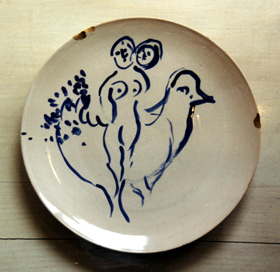
In 1951 Chagall created a dinner service as a wedding gift for his daughter. The family used this service at table. Like Picasso’s ceramics, these plates, saucers, cups and platters were soft earthenware. They chipped. A few such pieces entered the marketplace. The chips are as identifiable as fingerprints and make for a compelling provenance. Do they lessen value? We don’t think so. Repairing such damage might even be seen as compromising its integrity.
An appraiser might assume that condition is more important with Edition Picasso ceramics because they were made in quantities, like prints. This is not necessarily the case. However, when an expensive vase falls off the shelf during an earthquake and shatters into pieces, few would argue that there has been a loss. Assessing this loss can present major challenges and traps for appraisers, especially those inexperienced in this sophisticated market.
Consider this parable into which I have incorporated some auction sales and condition issues of a real Edition Picasso ceramic.
Late in 2003, Helene, a fictitious St. Louis appraiser, is called in by a Dr. No (not the same Dr. No who is so scrupulous about condition) to evaluate a large Edition Picasso ceramic vase that accidentally has been broken into pieces. Rather than waiting until the ceramic is repaired and then consulting with experts in this market to determine its post-restoration value, Helene applies percentages suggested in an industry handbook for catastrophic damage to “modern ceramics.” She declares in her loss/damage appraisal that the vase is a total loss, value zero.
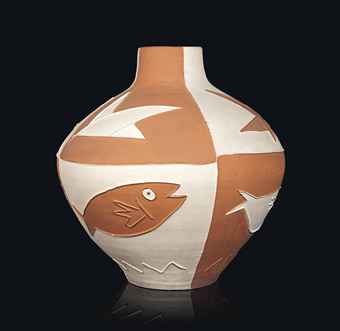 The ceramic in question is Oiseaux et poissons, a large and relatively rare vase, number 291 in Alain Ramié’s definitive catalogue raisonne of the Edition Picasso ceramics. A vase from the same edition of 25 had sold at Christie’s London in October of 2002 for $46,590, so Helene puts down this number as the amount of the loss. (The ceramic would probably have been $65,000 or more in a gallery, but Dr. No didn’t have replacement value insurance.)
The insurance company takes possession of the shards and has the vase skillfully restored. It then sends it to Sotheby’s in New York, where it goes into a April 2004 sale and sells for $30,000. Already one can see that, by any definition, the “value” of the ceramic is significantly more than zero. In fact Sotheby’s gave it a presale estimate of $40,000 to $60,000, so it is clear that Sotheby’s didn’t seem to care overly that the piece has been repaired (though the words “skillfully restored throughout” are placed into the catalogue entry).
The buyer promptly sends the ceramic to Christie’s London, where it is estimated at ₤20,000 to 30,000 (roughly equivalent to the $40,000 to 60,000 Sotheby’s estimate) and made the cover lot for an October 2004 sale. This time no off-putting mention of restoration is made in the catalogue, but the ceramic does not sell. Note that when Sotheby’s mentioned condition in the catalogue, the piece sold. This time no mention was made, and the piece did not sell.
Condition information is not generally recorded in on-line databases, so potential buyers looking up the auction records for this ceramic wouldn’t have known about the condition of the piece unless they asked for a report from Christies. Few professional buyers of Picasso ceramics are concerned enough to do this, as I have said before. Someone checking the auction databases, however, would have noticed that the last sale of this ceramic was for $30,000, so perhaps the estimate might just have seemed too high for savvy buyers.
In any case Christie’s puts the piece in the April 2005 auction and lowers the estimate to ₤15,000 to 20,000. This seems to do the trick, because the totally restored ceramic sells for ₤31,200 (then $58,646.) to a French dealer, Monsieur Yes (whom I have made up entirely out of whole cloth, as I have the rest of this story, except for the auction
records for this ceramic and its condition issues, which are real). Monsieur Yes has decades of experience with Picasso ceramics. Condition problems are irrelevant to him unless there is a visible problem, which is not the case here (and if there were a visible problem, he would have it repaired). He takes the ceramic back to Paris and subsequently sells it to an American tourist for the equivalent of $125,000 (they get very good retail prices in Paris). He does not disclose that there is restoration because, not having asked for a condition report, he does not know. And even if he did know, in his experience this is not relevant to the value of the ceramic.
The buyer, Mrs. Maybe, proudly ships her prize back home to St. Louis, and early in 2006 she engages Helene the Appraiser to assess the replacement value of her belongings for insurance purposes. Edition Picasso ceramics are numbered, and Helene cannot help but notice that the number of Mrs. Maybe’s Oiseaux et poissons is the same as Dr. No’s. It is the same ceramic.
What dollar value should Helene assign in her appraisal? Two years ago Helene herself had declared this piece worthless. Its fair market auction value of record is $58,646 from the Christie’s sale. Its retail replacement value is the $125,000 for which Mrs. Maybe recently purchased it in Paris – in fact another vase of this type probably could not be found at that point for any price. Similar to Schroedinger’s Cat from quantum physics which found itself in the peculiar position of being both alive and dead at the same time, Mrs. Maybe’s ceramic appears to be simultaneously both worthless and overpriced.
Helene feels ethically bound to disclose the issue of condition of this vase to Mrs. Maybe, but she should think very carefully before she does so. Monsieur Yes does art fairs in New York, Los Angeles and Miami, and he can’t afford to have integrity impugned. He may very well sue if Helene tells Mrs. Maybe that he has sold her a worthless vase for $125,000.
Good luck with your appraisal, Helene.
Copyright @ by Charles Mathes
Mathes Missive From Moscow #1 – The Cast of Characters

Greetings, Fellow Traveler,
As you may know, my gallery is exhibiting this year for the first time at the Moscow World Fine Art Fair.
Such an endeavor might sound exciting to you. Quarterbacking for New York Giants probably sounds exciting to a lot of people. But if you’re the one who is holding the football as a bunch of guys the size of refrigerators charge toward you at full speed, different emotions may well up. The folks who ride in metal boxes atop rockets into outer space, or play leads in Broadway shows, or make billion dollar bets on oil futures probably feel more scared shitless than excited, too.
Being a writer, I like to think that I can get some perspective and process certain unpleasant emotions by putting things down on paper. It may not actually help, but it gives me the illusion of doing something constructive. And at least there will be a record of what happened in case I am never seen again. I am more scared right now than excited  for reasons that will never become fully apparent. As an art dealer I have to keep everything confidential. The art business runs on secrecy. I’ll discuss this in more detail later (but unfortunately I will not be able to tell you the actual details).
Perhaps you have noticed by now a certain sentence structure polish and lack of hysteria that doesn’t quite jibe with the juicy terrors I have been implying are in store. This is because I am composing this ahead of time in New York and plan to send it before we leave on the afternoon of Monday, May 19th, 2008. We will arrive in Moscow at 10:00 a.m. on Tuesday (Moscow is 8 hours ahead of the Eastern U.S.) The Special Invitational Charity Preview to the opening night Gala Opening Night takes place on Monday, May 26 (we are invited, but we would have to buy a table for 10,000 Euros if we wanted to come to the sit down dinner with Mme Medvedev), so we have a week to explore Moscow and set up our booth before the oligarchs descend upon us with their billions. The fair closes on Monday, June 2nd.
Who exactly is the “we” to which I am referring? Allow me to introduce the cast of characters. There are three of us, not including a special cameo guest appearance, which will be revealed in Moscow. Me, you know. At least you thought you did until you wade a bit deeper into these narratives and discover the horrifying extent of my neuroses (you may also not be aware that I was once a member of the National Rifle Association).
 The true heroine of this adventure is our fearless gallerist, Jane.
Every business must have an engine, and Jane is ours (it was her inspiration to go to Moscow). She’s an explosion of creativity, exuberance, experience, daring, shrewdness, knowledge, vision and a perhaps just the teeniest bit of lunacy. The problem with explosions is that they tend to blow things up, which is where I come in. An explosion by itself isn’t necessarily the best thing to have around, but if you figure out how to put an internal combustion engine around it, you can drive to Schenectady. I try to figure out how we can channel some of Jane’s creatively exploding limitless energy. I must have succeeded a little bit since 1) the East Coast is not a smoldering ruin, and 2) we are about to invade Russia — a formidable exercise in logistics (but one that didn’t work out so well for either Napoleon or Hitler). And you wonder why I’m a little nervous?
In recent years Jane has found her true calling as a photographer of small living creatures. These are mostly dogs, but Jane has also stopped traffic to digitally capture cats, horses, donkeys, ducks, geese, pigeons, wolves and assorted others (even some humans). Hopefully, she will be bringing her camera to Russia.
But, how — you may ask — do we propose to sell artwork in a country where we don’t even speak the language? And who will protect us if we get into trouble? This leads us to the third member of our little team: Julia.
The lighting was a little low here in the Turkish restaurant where she was performing her belly dancing act that night, but you may still be able to tell that Julia is in very good physical shape. Besides being an expert in all manner of gypsy exotic dancing (don’t get any wrong ideas, those are knives in her hands),  Julia is also a personal trainer. Jane signed up with her at the JCC and Julia was such a good personal trainer that it nearly killed her. Julia is also a world-class simultaneous translator (she was born in Ryazan, Russia and went to University in Moscow, majoring in English which she now speaks fluently). If her passion weren’t dance, she would probably be a supreme court justice or a nuclear physicist — she’s that smart (though she eats like a bird). Julia will be coming to Moscow as our assistant, translator and tour guide. (She actually looks much less menacing without her mask and knives, which presumably she will not attempt to bring in her carry-on bag; you will have to wait for the next Missive to see her unmasked.)
So, thank you very much for listening, and this ends our introduction. If you want to find out more about the art fair the way the organizers wish for it to be perceived, go to www.moscow-faf.com A more interesting story (and one with a happy ending, I hope) will take place here. Next stop – Russia.
Nostrovia!
Charles
Copyright © by Charles Mathes
Mathes Missive From Moscow #2 – Tuesday: Arrival

Greetings from Moscow.
I stumbled down to breakfast this morning, not really sure what day it was (it turns out to be Wednesday). Hopefully this will be my worst mistake today — breakfast that is. I knew they had some expensive buffet, but I chose (wisely, I thought) the continental. I still hadn’t figured out the money conversion, so it wasn’t until I got back to my room and looked it up on line did I discover that the 680 rubles i just paid for coffee, croissant and orange juice (18% gratuity included) actually comes to over $28!
We arrived in Moscow yesterday some time between 1:00 and 2:00 pm after a predictable four hour flight delay. I’m not sure of the time, because after the kind of sleep you get on airplanes I was in pretty sorry shape and there was then the predictable problems of getting through customs and finding the car we had hired to take us in from the airport. It was encouraging to find in the airport area beyond passport control two young ladies (whom a cynic might describe as being of the Bialystock-and-Bloom persuasion) in a little booth advertising the Moscow World Fine Art Fair (there were other little booths advertising Lowenbrau and other available delights of the city – Moscow is pretty littered with little booth advertising; billboards of every persuasion decorate the city).
Ultimately were we able to locate the car we had hired, and even though Mikhail doubted we would be able to fit our luggage in as well as ourselves, we were soon on our way into the city. That’s Julia with Mikhail in the picture above, by the way, without her mask and knives, egging him on. I did notice that Mikhail kept a baseball bat on the floor next to him in the car.
It might be a good idea here to explain why we were so loaded down — not that packing for two weeks in a strange climate and a lot of fancy events is so easy. Russia has these interesting … shall we say slightly paranoid?… ideas of what can be shipped in for an art fair. The art presented no problem — except for the cost, which was insane. (A note about fair and  shipping costs here, for those who are curious. A good rule of thumb is start with the highest amount you think might be reasonable, and then double it. You then have some idea — provided you take the same number in Euros rather than dollars. You can look up the exchange for Euros yourself, I can’t bear to) . What can’t be shipped into Russia with your art are books, catalogues or advertising. Naturally, we have all kinds of art references that we need. Also we just published a beautiful brochure explaining the modern fine art tapestries that we specialize in (and which Julia translated into Russian). So we had to carry probably fifty pounds worth of printed material in our hand luggage. Nor do the Russian authorities allow tools to be shipped in either, so we have our hammers, staple guns and the like, in our suitcases!
Now, you may have ideas about what to do when you arrive, jet-lagged by the 8 hour time difference and a fitful night on an airplane. Jane, being well-experienced in travel, has other ideas. The essential first thing is to establish communications (Napoleon, being a general, too, probably had similar ideas). So after checking into the hotel (a very nice Sheraton, even though they are doubling our rates for the first two nights because the soccer championships are in town and won’t give us any discounts, or even an upgrade), off we went down Tverskaya Street in search of a phone store. Jane had told me to bring an old phone; we were going to buy a Russian sim card for it, and thus be able to talk to one another without phone through New York. This shows how smart Jane is — I had had the foresight to call TMobile and discovered that service to Russia is $5 per minute. Even if you don’t answer when it rings, you get charged $5.
I’m not exactly sure why it took two hours to get these phone cards , but by this point I hadn’t eaten anything since the cereal and fruit on the plane — I don’t know if was at three o’clock in the morning or noon. I was seriously into what Arlene calls “the zone.” I am a bit of problem when I am in the zone, hunger drives me insane apparently. Julia was also in the zone, but she was merely weak. Jane didn’t seem seriously affected and kept trying to explain to the Russian clerk at the phone store exactly what she wanted in a phone card (Julia attempting to translate, simultaneously, as her eyeballs rotated back and forth in her skull). The fact that I immediately blew the fuses to every light in the room and shorted out the “laptop safe” upon arrival says something about our energy field.
By the time we got out of the store with our phone cards, I was gibbering in some alien tongue, Julia appeared to be sleepwalking. Jane tried her best to steer us to an appropriate restaurant. After rejecting twenty six, we stumbled into some kind of cafeteria, which I didn’t like the looks of at all (having gone to high school with a cafeteria and being naturally prejudiced against them). Also the food looked suspiciously Russian. But what did I know, being in the Zone? In fact everything was delicious and quite reasonably priced — for this unreasonably priced city.
I was feeling slightly more human by the time we got back to the hotel and went through the ordeal of trying to insert sim cards into our telephones for an unsuccessful hour. Today we will go back to the phone store and see if they can get the phones to work (the sim cards worked fine — the phones just woke up saying “RESTRICTED.”
 I bought an internet card before going upstairs (you don’t even want to know what this costs — and it will last only 24 hours – no discounts given if you need two weeks). The password seemed to be in Russian, so I couldn’t get on line before going to bed last night at nearly 9:00 pm. When I woke up my watch said 9:30, but it was still dark outside, so I went back to sleep. The next time I woke up, my watch said 9:15. It took me quite some time to figure what this all meant — by then I had paid $28 for a croissant and coffee. Maybe we can find some kind of Starbuckski affair near the hotel. I will keep you posted.
A final note — there are two thin English language newspapers and from them you really begin to understand how foreign a place this is. I sat next to a diplomat on the plane who explained to me how things worked in Moscow. The mayor apparently is intent on progress, so building regularly mysteriously burn down and miraculously reconstruction begins the next day. His wife apparently owns the company that supplies all the cement for this. The Manege — the 19th century riding academy where the Art Fair will take place — was one of these mysterious urban renewal miracles. Apparently facts on the ground rule development. If you want to do something, you act and then nobody can stop you in retrospect. The laws governing constructions were apparently all passed by this mayor, and even judges can’t figure out how to get around them.
One story yesterday that really caught my eye: “Institute Denies It Director Was Killed by Poison.” This was some big scientific institute, the director of which is a close friend of Vladimir Putin. His brother is a billionaire. The institute developed the Soviet Atomic Bomb and last year received a billion dollars to develop nanotechnology. So the story was that an envelope containing white powder, addressed to the director, was opened by his deputy. Five days later she fell sick and died of multiple organ failure. Russia’s chief public health officer declared the powder was harmless. Prosecutors have declined to open an investigation. A colleague of the deceased commented, “It was just an unlucky coincidence.”
Here are some more sights in Moscow — forgive me for dwelling on the familiar (besides Mamma Mia, Indiana Jones and a Karaoke Club, there’s also a Kentucky Fried Chicken place in there somewhere); i was in the zone
Mathes Missive From Moscow #3 – Wednesday: First Real Day
Greetings, Fellow Travelers,
I don’t know about you, but I’m not much interested in hearing about the standard tourist bits from people’s trips. What fascinates me is the differences in how people actually live. Like what’s the deal with those funny German toilets? 
Of course, one of the first things one has to cope with in a strange land is strange money. Rubles are pretty strange, partly because the ratio to dollars is so weird that it takes a while to figure out what things cost. Like breakfast yesterday. I had scouted out a little hot chocolate shop in which to eat this morning where I could get some kind of pastry for the equivalent of a few dollars. Unhappily nobody cooperated with my quest for an umbrella yesterday. Jane said I didn’t need an umbrella because all she needed was her rain hat (Jane’s logic works this way). Probably the only optimistic Russian in captivity, Julia said, “Maybe it will not rain.” Of course she brought along an umbrella from the friend she is staying with.
 Anyhow, it is pouring this morning so I am eating the complimentary fruit left in my room and have made myself a pot of coffee, which is just as well because this quiet time gives me a chance to write this missive and settle my brain. I congratulated myself too soon about sleeping twelve hours yesterday, because last night I didn’t sleep much at all. I am hoping that my brain will soon average the times out and I will be able to have more regular nights in the future.
I just noticed that I had an umbrella here, after all. Apparently I stole Julia’s last night.
But I was speaking about money. We’ve gotten some money from ATM machines, which seem to work the same as ATM machines in the US. One thing the Russians have and we don’t however, are other machines into which you put a ten or twenty dollar (or Euro) bill (or presumably a stack of hundreds), which can identify and count your cash and dispense the equivalent in Rubles. If you trust it to, and if, of course, you can read the directions in Cyrillic. Another strange thing — at least strange to a New Yorker — is the unwillingness of many, many places to accept credit cards. For instance, we had to pay cash to the phone store, where we have become regulars. This is not some minor kiosk, it is the equivalent of an ATT or Verizon outlet. (Notice the young man sitting the corner, by the way. There are young men sitting in the corners of most stores, restaurants and hotels, presumably to deter trouble. Most are much bigger, beefier and meaner-looking than this fellow. There are also young women with Asian features [Julia says they are all from Turkmenistan, and other such old Soviet republics] who continually mop. It is a sexist country, but clean. I don’t know about how safe.)
Also strange is the fact that we have seen virtually no traffic lights. The bumper-to-bumper traffic on the grand boulevards is unimpeded by crossing pedestrians, who have to go through underground passages to get across the street. These underground passages are chocked full of guys who look like thugs and hooligans. So are the streets. Happily not all Russians are so menacing — since apparently many of the aforementioned throng are soccer fans from England here for the finals — and clogging the hotels to such an extent that they can all double their room prices.
So, after another two hours rearranging phone service (we ultimately had to buy Russian phones – cash only), off we went in search of lunch. By this time it was nearly three o’clock. Actually maybe it only seemed like two hours in the phone shop. Anyway, it calmed Jane down to know that we can all communicate (even though the buttons and menus on the phones are in Cyrillic). We even got a phone for our mystery visitor, who will not appear until next Tuesday.
 Before we were able to settle on a restaurant, however, Julia coaxed Jane into purchasing tickets for the evening performance of the Georgian National Dance Troup. More about this later (the ticket booth — the Moscow equivalent of
  Ticketron — would not take credit cards, cash only). Up above is a nice picture of Julia and Jane. Julia has hair down, as my father used to say, to her pipick. I’m sure this is very useful if you are a masked gypsy belly dancer. Jane has a backpack, which Jane insists is very useful despite it looking like a good place to stash a bomb (see below).
The restaurant we finally chose — Julia knew it from her last trip — was probably as representative of the new Moscow as any: it was decorated like a giant space ship, and featured what looked like a giant Egyptian mummy in a space suit. You can see it here just behind Jane and me. Julia took this picture — she likes to hold the camera diagonally. Maybe because she is Russian. Or maybe it’s because she is a dancer. Her hair may also be throwing her off balance.
Russian wait staff are very creative, even though they appear totally disinterested. None of us got food at the same time, several orders came back wrong and by the time we escaped, several hours had passed. Very amusing. The food was tasty, however. And they did take credit cards. The check came with a stick of Wrigley’s Spearmint Gum (label in English, perhaps a relic from the Cold War).
So by this time there was just enough time to go back to the phone shop yet again (we had to leave the phones there for them to program), and dash off to the theatre, which we did by subway. The Moscow subway is suitably famous, quite grand and perhaps the only reasonably priced thing in the city. It would have helped if the clerk had given Julia better directions, since we got off a stop too soon — but making the 7:00 pm curtain was going to be a stretch anyway. Russia is presently having certain… problems… with Georgia, so the security around the theatre was pretty intense. As in — the entire Red Army. Jane was directed by armed guards to check her backpack. Ever the spitfire, she actually tried to talk them out of this. Too bad (or perhaps lucky) for her, they didn’t understand a word of English.
 I didn’t quite understand what all the fuss was about, but it quickly became apparent that this wasn’t some nice little folk dance troupe, it was a major Big Deal. Observe the coat room of the State Kremlin Palace theatre where the Georgian dancers were performing. This joint makes Lincoln Center seem cozy. The show was spectacular, with guys leaping through the air clashing swords and women gliding across the stage in their long gowns as if they were on wheels (reminds of Arlene, who in her childhood was subjected to nuns in long habits and didn’t realize for many years that they actually legs).
Anyway, it was a grand evening, which we ended with Planet Sushi (quite good, in fact) and the subway home. Below are some more pix of the day. Off now to meet Jane, who has promised to program all our telephones, but says she has just a few more questions for the girl at the phone shop. 


Mathes Missive From Moscow #4 – Thursday: First Sight of the Venue
Greetings, Americanskis,
It’s becoming pretty clear that keeping up the pace on these missives is going to present a problem, in that I’ve been leaving the room early in the morning and not getting back until late at night — not much room for both thoughtful composition and sleep.
But here’s the news until I break down. Speaking of news, how about this story in the English-Language Russian newspaper? Says something about the new Russia in an even more direct way than the definitely-not-poisoned Institute Director. “Corporate Raiders are ‘Scourge’ of Economy,” reads the headline and then goes on to reveal that the term “corporate raider” has a different meaning here: “In Russia, raiders use their links to corrupt government or law enforcement officials to seize businesses illegally.” Note the last irrelevant word here; if nobody can do anything about this, what do you need laws for? “The raiders often include former intelligence personnel, security service or police officers, lawyers or people with close ties to well-placed individuals. Through their control over judges, prosecutors and bureaucrats at all levels, they are  able to order searches and inspections of businesses, gather background information about the owner, and falsify whatever documents are needed to take over.”
Apparently this is a huge problem and even more so outside of Moscow where businesspeople know even less about how to defend themselves from such tactics (perhaps this is why Mikhail, our driver from the first day, had that baseball bat on the floor of his car). But of course, this is why bringing to Russia a billion dollars worth of art and jewelry (the total from last year according to the Moscow Fine Art Fair pr) is so much fun.
Well, anyway, enough of small talk. I’m not going to bore you with with rain or my poor choices in today’s lunch (but don’t chose shishkabob in the mall) or the details of the bad cold I am still trying to recover from. Nor will I go into all of Jane’s phone adventures of the day. Let’s cut directly to the chase — or rather the Manege. This was a 19th century indoor riding academy. As I think I mentioned, it was mysteriously gutted by fire a few years ago, but miraculously workmen showed up the next day with detailed plans for a new reconstruction — presumably including underground parking. The Manege is where the art fair will take place, and it is the art fair, after all, that we are here for and about which these missives are really to be about. The Manege is directly across the street from the Kremlin, and it’s hard to get a feel for how big and grand it is. Perhaps these pictures of the exterior will be a good place to start.
Some interior shots of the Manege will be equally sobering. This place is enormous, and right now — as you will see below — its vast interior has been filled with the rough shapes of booth construction. Hard to believe that in a few days this will be the most elegant art fair in the world. 

Some of the crews setting up the fair are French, but the Russian crews are for the most part the ones that built the booths (the French art handlers cost four or five times what the Russians ones do – I think because the French dealers can’t speak Russian so are ripe to be taken advantage of. But we have Julia, who can speak Russian so we are going to go with the locals.)
Unlike all of the other art fairs we’ve done, the booths here are constrained into very regular boxes — some of the very formal Parisian fairs operate like this; the Russians always liked things Classical and symmetric — hence the columns and arches — which leads me to my funny story of the day.
Too bad I can’t show a picture of Jane working out the ground plan and elevations of our booth — it would be pretty funny with all that smoke coming out of her head. Jane is a positive genius for booth design, but it doesn’t come easy. She does it the old fashioned way — with a pencil and reams of that old fashioned graph paper with little 


 boxes, each representing one foot (or some other measurement that will drive her insane). It takes hours upon hours for her to work out exact placement of everything we will bring — and I mean down to the inch. Her planning for this fair was the most difficult she had ever attempted, with Jane having to convert feet to inches to centimeters to square yards to who knows what? Not only steam came out of her ears — I believe there was a significant quantity of radioactive waste. But she survived and the result is a brilliant floor plan — which I hope you will see realized in photos herein over the next few days. Unless we self-destruct first and run howling off over the steppes, always a real possibility.
The funny part today was when we arrived and found that the booth didn’t look quite right — the entire center section seemed to be a foot off, which would throw everything out of whack. Tapestries that had been calculated to the millimeter wouldn’t have enough room to fit; paintings suddenly had more space than they were supposed to. Jane got the French supervisor to get down on his hands and knees and measure each wall. Two walls that were supposed to jut out a foot apart from one another were somehow perfectly in line. How had this happened?
It took a while, but the culprit was ultimately revealed — it was the Russian technicians who built the walls. They had looked at Jane’s plan with two walls not quite aligned and figured she had made a mistake — what she had meant to make was a nice, even, perfectly matched doorway — not the irregular opening that was the keystone to the entire booth. Why would anyone make walls that were not symmetrical? So they considerately corrected the situation for her! Luckily there is enough time for them to move and rebuild the walls, or somebody might have had to die. By the time Jane had finished throttling people, it was time again to eat (which we do as often as possible). Shunning all fast food choices at the mall, we ended up for the second time at Planet Sushi. Hard to believe that you can get great sushi in Moscow, but there it was and there you are.

 Jane refused to go back to the subway, so we had a leisurely stumble in the rain up Tverskaya. Julia, ever looking out for our interest, summoned a friend to meet us at a coffee shop where we all ate again. i had chicken soup and a bloody mary and tried not to cough (it doesn’t help that everyone in every restaurant is smoking cigarettes). In the drizzle on the final leg back to the hotel (there are no taxis in Moscow for all practical purposes, alas) we passed this funny non-descript little building that you see in various views, including with me and the two umbrellas I have borrowed from the hotel. The last is me and Julia inside this building. Only the few of you involved in the theatre will care, but this is Stansislavski’s Moscow Art Theatre! Note that it’s still light here after 10 pm.
No day would be complete with a final forage for breakfast. Here’s a joint called Yeliseyevsky. Built three or four years before the 1917 revolution when everybody here was cuckoo for Rococo. Fantastic looking food here, let me tell you, and the wackiest rococo stage set I have ever seen. Best croissant in town! why did i ever order that shishkabob in the mall when great food is everywhere in this city?
Seems I forgot to sign off on the last message. So Good Night and Good Luck from Moscow — I will now collapse into a heap.
Mathes Missive From Moscow #5 – Friday: False Start
Hello dere from Russia,
Today, Jane somehow got into her head, was the day that we would supervise the uncrating of our artwork and begin to arrange the booth, maybe even hang some tapestries. This impression had something to do with someone saying something about our needing to be around for customs inspection at 10:00, so we dutifully got our Armenian driver Marat (the only words of English he seems to know are “Armenia! Armenia!” which he shouts happily every few minutes) to take us and our suitcases full of tools and books  over to the Manege. Today the fare was 400 rubles rather the the 600 we paid yesterday. Unfortunately stern faced storm troopers (I call these the Nyet Police and they are everywhere in Moscow) wouldn’t allow us Marat to drop us of anywhere near the building so we had to schlep through the rain.
Inside nothing at all had changed, except for the presence of dozens of security men. Maybe hundreds. Each was dressed in black, wore jackboots, stood at least 7 feet tall and apparently was instructed never to smile on pain of death. I considered taking pictures but didn’t think they would understand. I tried to persuade Julia to take pictures — perhaps wiggle her hair at them as a distraction.  She didn’t think this was a good idea either. So no pictures, but trust me, they all look like killers and they were everywhere, which is very funny considering what we usually get. At most American art fairs (especially in Los Angeles and Miami) security consists of a small team of short guys with pimples who look like their real jobs are at McDonalds and who won’t search your bag even if you have a bazooka sticking out of it (they have metal detectors everywhere here). I guess in America everybody knows how stupid it would be to steal art — just ask any dealer how difficult the stuff is to sell!
It soon became clear that we weren’t going to get anything done today. We could only hope that the art will eventually come and be cleared through customs — there is a special customs clearance right there at the Manege so the boxes don’t get opened (and perhaps looted) en route. So we stashed our three hundred pound bag of tools and books (which we had to hand carry on the plane because you’re not allowed to ship in books or tools and, yes, I may be slightly exaggerating about the weight but the damn thing is heavy if you have to carry it yourself) with the French construction crew and explored the building, wondering what to do for the rest of the day. If I didn’t convey how big this joint is, take a look at the basement — same size as our floor at ground level, and complete with its own balcony. Here every jeweler from Harry Winston to Bulgari will display their  trinkets (hey, do you think maybe all those security guards are for them? All kidding aside, here, I think, there is a real possibility that a clever squad of 20 heavily armed men could storm the fair and steal several hundred million dollars worth of jewelry — this probably isn’t a possibility in America. you get the sense that it could be here.)
We quickly developed our strategy for the day: when in doubt, eat. We figured we would get a crumpet on the way to the famous Pushkin Museum, which we have a special interest in — more about this later. Unfortunately there are not crumpets on every street corner in Moscow the way there are in New York. And it had begun to rain. Luckily I had the umbrella I had borrowed from the hotel yesterday (the second umbrella was actually for Jane, who made me return it: “Charles, why in the world would I ever carry an umbrella; I have my rain hat!”
Here is Julia trying to argue with Jane about the value of umbrellas and losing (I learned better years ago.) Dialogue accompanying this picture (taken verbatim from life) should read: “Julia, do you honestly believe that your umbrella will keep you drier than my hat?”
Anyway, we set off at a fast clip for the Pushkin. About twenty minute later we reached an impasse. What is wrong with this picture to the left? Only if you walk around in cities regularly will you notice that there are no traffic lights and no place to cross the street — in this case the usual eight lane highway (cars do not stop for pedestrians — in fact pedestrians do not stop either; people bump into you all over the place; some crumb even goosed Julia on the street our first day and was gone before any of us could deck him). We had been walking for twenty minutes and there had been no place to cross the street. The majestic architecture of Moscow was partly designed by the Soviets to glorify the masses, so grand boulevards were de rigeur. Of course there are underground tunnels that will allow you to cross, but in the center of the city these tunnels basically correspond to subway stops. In other words, you have to walk to the next subway stop to get across the street. Forty minutes later, having retraced our steps and marched a few miles through the rain, Jane wanted to just call a cab and go home — forget about the Pushkin. But of course you cannot call a cab. This is why everybody travels by subway, which Jane still did not want to do. As fearless as she is, Jane doesn’t like going down the long, steep (nearly horizontal) escalators deep into the ground, and then walking the endless tunnels and climbing the millions of steps that comprise this glorious system. Vertigo. Bad knees. Faintness from hunger.
It was still before noon but we had be walking for hours (it seemed) by the time Julia delivered us to a street that had restaurants; unfortunately none were open, except one that looked to me like a beer garden called 3/9.
“It’s amazing, I’m not wet at all,” said Jane, happily, wringing out her vest.
 The restaurant’s name actually refers to quite a charming tradition in Russian fairy tales. Ours begin with “Once Upon A Time.” Russian children hear “In the 39th Kingdom, in the 39th State…” The dishes were all named (I think) after fairy tales. Warily I ordered “Kurachka-Ryaba” — some fairy tale about a chicken. The dish turned out to be delicious as did everything else, including the service (once Julia made the waitress understand that we were okay — just crazy Americans.) Here’s an idea of what Russian restaurants look like:
Suitably revived, we set out to find a subway — by this point Jane decided that walking who knows how many more miles to the Pushkin was less onerous than taking the subway. And at least the worst of the rain had subsided. Julia, however, found that her pants were still wet. “I think I sat on my hair, “she confided.
If you haven’t heard about how grand the Moscow subway is, you should look it up. Here are some pictures of our experience (the only problem is that you have to go down that three mile escalator and then walk two miles of underground passages to get to the train. But at least it’s dry.
 The reason why we had headed for the Pushkin — a trek that Jane at several points was ready to abandon, for very good reasons — was professional. Out gallery deals in modern tapestries and we had learned that the painting on which a very important Fernand Leger tapestry of ours was based belonged to the Pushkin. By the time we got to the Museum we were pretty worn down, and they wouldn’t even let us see the painting as a professional courtesy, though Julia tried to make the case with a female Nyet Policeman and Jane flashed her press pass (julia did get in for 30 rubles as a native, while we had to pay 300 as tourists).
But the journey was not in vain, for as we climbed up the grand stairway (there was no elevator for Jane’s knees) to the top of the building, we saw through the center t o the great  gallery, our painting. Leger’s Constructeurs a L’Aloe. To our amazement we also found two Leger tapestries across from it — including one, a copy of which we have in New York and were going to bring to Russia until we substituted something else at the last minute.
Having this kind of connection to important art in a Russian museum is exactly the kind of thing that will give us credibility an d help us sell to this audience. At least that’s what we like to think. Our plan now is to hang is small repro of the other tapestry and have Julia translate something to the effect of “We didn’t bring this tapestry to Russia because we knew you could see another copy at the Pushkin. The only difference is that theirs is number 3 (of 6) and ours is number 4. We then proceeded to track down one of the curators in the textile department and give her passes to show. This is the exactly the sort of personal relationship we like to cultivate and our next stop was another.
Marat our Armenian driver had been called to rescue us from the rain, but alas, he was apparently at some other Pushkin (Pushkin train station? Pushkin Boulevard?). Luckily a “real” cab was sitting there and we jumped right in and had him drive us to Bloomberg News, Moscow branch. Of course there was no meter and he gave us the price only after he sped away from the curb. We were so happy not to have to take the subway again, we didn’t care.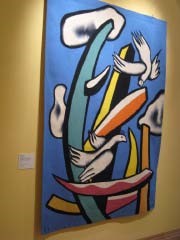
John, the Russian art reporter for Bloomberg, had actually tracked us down and asked for an interview. This kind of thing really is our pleasure, and he turned out to be a lovely fellow and very smart (note pix of Julia eating the candy he started us with), born in Brooklyn, family moved to Belgium, graduated from Cornell. The Bloomberg offices were modernity itself, and we are quite partial to all things Bloomberg from the get go, being New Yorkers (Mayor Bloomberg actually lives a few blocks from our gallery). here are some pictures. What we said is confidential (because I can’t remember anything about it) but we did talk for about two and a half hours. If they don’t throw you out after ten minutes, by my book it was a success!

 By this time it was after seven — time for dinner! No cabs to be found, we braved the subway again for Julia, who led us to an Uzbekistan restaurant the name of which resembles something like Cafe Babai — in case you’re in Moscow and have a hankering for Uzbeki cuisine. After my bad experience with shiskabob at the mall, I was a little wary — but I had been wrong about several Russian restaurants and let Julia help me order. I stayed away from the horsemeat sausage, the fragrant sheep ribs and the slightly roasted lamb baby tongues with potatoes and pickles, though they sounded delicious, and went with Navruz — spring salad with cucumbers, tomatoes, radish, herbs and what Julia says is Russian comfort food — Kavurma Lagman: noddles, lamb, fresh vegetables and spices.
It is easy to make fun of strange places and strange cuisine (Uzbekistan is not far from Boratville), but in reality the Uzbeki food was wonderful — fresh, beautifully prepared, delicious. The service was gracious. The people here were really and truly enjoying themselves in an atmosphere that one rarely finds in the United States. Look over our should in the picture below at the table in corner. A bunch of guys sat there for hours, talking, laughing, taking tokes of a Hookah on one end of the table and a bottle of Chivas Regal on the other. These people truly know how to live. Poor Jane looks tired, doesn’t she? You should see me!
 The check came under a little Uzbek hat with a stick of Wrigleys Spearmint Gum (sugar free). Julia persuaded us that it is a tradition to be photographed in these hats. I have the photographs of Jane, and will use it as a last resort if she tries anything foolish (the one of myself I will destroy). But here’s the one of Julia, who had to take subway back (it was after 11:00 pm)
 Tomorrow we have to begin the art fair in earnest — and hang the booth. I’m actually writing this tomorrow — Saturday night, and we have survived, but barely. Jane and I left the hotel at 10:00 am and didn’t get out for dinner until nearly 10:00 pm (Marat found us, thankfully, so we didn’t have to walk). We went back to the Uzbeki restaurant (what, we’re going to go looking for a new place after a 12 hour day)? It’s now after 2;00 in the morning. I’ll consolidate Saturday and Sunday into the next email — if we survive.
Jane and Cafe Babai wish you a good evening. Charles
Mathes Missive From Moscow #6 – Saturday: Set Up Part One
Greetings from Moscow,
It’s not surprising that normal people have no idea what an art fair is, or what the art business is about. Most people have no real idea what it means to be a dentist, or a real estate broker, or a roofer, either. Within every specialty there are all kinds of characters, all kinds of stories, all kinds of craziness. Art is a “glamour” business, however, like fashion, entertainment, music and publishing. Glamour businesses basically are those that have acquired that special aura of sexy exclusivity which allows them to get away with exploiting idealistic young people at slave wages and making a select few at the top of the pyramid rich beyond their sickest dreams. This is why the artworld often comes across as snobby and intimidating; many dealers deliberately cultivate the mystique that their lives, opinions and wares are somehow on a higher level than other people’s — if you want to buy something, buddy, you’ll have to prove to us that your money is as worthy as the more important money we usually pocket.
 I suppose that what I’ve just said are secrets. I told you at the outset that the art world is built on secrets, and that I couldn’t reveal any. But snobbery, intimidation and exploitation are not any secrets of ours, so you can have them. We make our money the old-fashioned way. Exactly what that old-fashioned way is, of course, I cannot say (it is a secret). But you’re welcome to follow us around and glean what you can. Let’s begin on Saturday at 10:00 am., our first real day of set-up for the Moscow Art Fair. I have just enjoyed a hearty five hours of sleep, having finished the last missive at 2:30 in the morning.
Marat picks us up at 10:00 am and drops us at the Manege. We meet Natalia, the Russian customs agent. She has a list of the items that we have declared are in the boxes we have shipped to Russia and which are now being opened. As each box is opened, Natalia compares the name of the item on the label (each label is printed with all the information and a small picture) with the name and picture on her list –Julia translates. Jane, holding our copy of the same list, checks off that item as having arrived (usually our registrar or other employee does this, but here in Moscow there is nobody but Jane and me). The two different shippers that we have used to get the artwork from New York to Geneva, and from Geneva to Moscow have lists of their own. Actually everybody’s list is a little different depending upon their own specific needs. It took our idealistic young staff working at slave wages several weeks to create all this paperwork (actually they’re well paid for the art business – they would just be making a hell of a lot more if they had listened to their mothers and gone to law school).
As the shippers open each crate, remove the cardboard boxes within and then unwrap each scrupulously wrapped item with each box (hey, this stuff has to make it in one piece across several thousand miles) Jane, Natalia and Julia get on with their work. Since this will take four hours, let’s take this opportunity to look at what the Manege looks like at this point.
 Our booth!
Since the French art handlers are more expensive to hire in Russia than are white shoe lawyers in New York, our plan is to have the Russian art handlers, who are vastly cheaper, hang everything with help and direction from us. The way this usually works is for the handlers to hold up painting and tapestries in the approximate places on Jane’s plan. Jane and I then judge when the height and placement are correct. Good handlers can even help suggest alternatives if our intended placement doesn’t work. Then the handlers put in nails or screws or velcro and hang the art. When the Russians show up, however, they don’t seem to have any idea of what we want them to do. They don’t even have tools.
We have tried to anticipate any situation and have brought an abbreviated collection of tools in our luggage, just in case: staple gun, hammer, picture hooks (we simply could not carry a real toolchest as we do to other fairs). However, the Russians will not even take responsibility to use these tools, though they will be happy to move anything we want. After half an hour, we have hung one small painting and are trying to figure out the logistics of hanging something larger. Our staple gun somehow was D.O.A. We may not have enough hooks. The Russian handlers are looking very unhappy.
The following is a good lesson in why people have problems overseas — the inability to communicate, as well as cultural differences even when you can make yourself understood, can add up to disaster. Many Americans in this situation would start thinking the Russians were pretty stupid. Julia at this point explained to me that the problem was that they weren’t stupid at all. They were highly trained and very educated. Standing around, unable to contribute anything, they felt frustrated. They didn’t want to waste their time or ours, but basically there was nothing really for them to do until we were ready to have them hold up a painting to check a height level — pretty stupid work for two smart guys. These were the folks who had gotten all these hundreds of boxes into the Manege, distributed, opened, sealed, stored away. The Russian technicians had also built all the structures.
I had Julia explain that they were doing a very important job — they were like firemen. Firemen also have to around and do nothing, but when the bell rings they are available to save the day. (By the way, in case you were wondering what I do at the gallery — I am the chief fireman). One of the Russians wasn’t impressed with this argument and went off to get a replacement. He returned with a young guy from Ghana who spoke English (English apparently is the native language of Ghanians. There are many Africans working here and studying in universities. I thanked the Russian worker and said that thanks to Julia, I understood how he felt. In fact, I said, it was noble. He responded by making an unhappy face, clasping the shoulder of the Ghanian and giving him a big hug, then making a little speech in Russian and storming off.
 The Ghahian was very charming, but the whole idea of our hanging the show with Russian help was hopeless. These were not art handlers at all as we had been told: they were moving men and construction workers. We were going to have to hire the French handlers, whatever the cost. But it was already after three o’clock and we were faint from hunger. Time for lunch at Planet Sushi, again. It was still raining — it had been raining since our arrival — and there are no other comfortable restaurants anywhere within walking distance (Jane draws the line at eating at McDonalds or Sbarro. Sbarros are all over the place here for some reason.) Planet Sushi is staffed by young women with Asian features, dressed in kimonos, but they are not Japanese. They resemble Koreans or Mongolians more than they do Japanese or Chinese, but they are in fact from the Southern Russian republics near Afghanistan: Tajikistan, Turkmenistan and the others. Note the ubiquitous guard at the front door — even restaurants all have guards. There is also a ubiquitous cleaner — usually a woman from the same geographic area. An expert in judging bathtub rings, Jane confided to me that one is likely to end the day here significantly less spotless than one begins, so I guess these cleaners are as necessary as the guards.
It was at Planet Sushi that Julia explained to me that by saying he was noble, the Russian worker thought I was making a distinction between him and the Ghanian. The Russian had given his colleague a hug to show that he was not “noble” (he had apparently thought I was making a class distinction, that he and the Ghanian were equals — and his speech was to tell me so in no uncertain terms. By noble I had meant admirable — as a writer (and a dope) I often say things in too obscure a fashion, Arlene tells me. Boy, was that ever the case here. But I’m glad it happened now to open my eyes — in just a few days we were going to have to sell complex, expensive art in a situation where the subtlest nuance of language, even language perfectly translated by Julia, could plunge us into an abyss of cultural misunderstandings. Yikes!
Meanwhile Julia herself is feeling frustrated because Jane doesn’t really want to hear her suggestions or discuss the finer points of art. On several occasions Jane gets to the pre-meltdown stage, and I have to take Julia for a walk so Jane can be alone to think about what to do with the booth. When you are very competent and very nervous you want to do everything yourself so you can be sure it will be exactly as you want it. It is part of my job to recognize such situations with Jane and clear the area so that she doesn’t have to be r ude. Jane really doesn’t like to be rude to anyone. Even morons.
After lunch we returned to the Manege. The French art handlers soon appeared with tools and smiles. Both handlers were named Christoph, so blonde Christoph is called TinTin. They were altogether the best art handlers we have ever had — worth their weight in gold (literally, I’m afraid). Together, and with occasional help from their colleagues (it took four men to hang the monumental Chagall tapestry that is the centerpiece of our booth, as well as one of the most important pieces in the entire fair). Here follows a visual diary of the day from the time the French crew took over. How we ever got the idea we could have done this ourselves with a few Russians and a few tools is mind-boggling. The French handler’s tools are pictured above left.
Scenes from the setup — note how it took four of the most competent art handlers in the world to get the Chagall tapestry up (we hang these tapestries by putting a piece of velcro on the wall — the sticky backing reinforced with staples. Each tapestry has the matching velco sewn to the back and you just pop them right onto the wall). 
It was nearing ten pm before we finally had most of the booth hung and felt confident enough to leave for the night. Julia said that there were many restaurants from different former republics by the rail station close to the hotel. We could walk around and see what looked good.
For some reason, Jane was not ready to walk around in the pouring rain, looking for a restaurant at 10:00 pm after a twelve hour day (she’s much like Arlene in this regard). She wished us well, but she was going to Cafe Babai. I can’t say I disagreed. Julia was disappointed, although she acknowledged that the food was very good at Cafe Babai. Perhaps we could try a new restaurant tomorrow after the Gypsy Dance Concert, she said cheerfully. Julia has been mentioning the Gypsy Dance Concert for several days now, suggesting that we will find it even more interesting than the Georgia National Dance Company. Julia, of course, happens to be a Gypsy Dancer. In fact she is delivering a paper on Gypsy Dance in Greece next month and has been staying up all night working on it.
“Yes, maybe we can try a new restaurant tomorrow,” I say, humoring her. Jane smiled. After working together for so many years, Jane and I can communicate entirely by eyeball and mental telepathy. This particular smile said, “Have fun at the Gypsy Dance Concert, but I’m not going anywhere tomorrow except maybe into a bubble bath.”
Julia spoke to Marat earlier in the day and told him we would need to be picked up after seven. Luckily he is still waiting outside the Manege in the rain.
I know I said I would consolidate the two days of setup into one email, but this installment is getting pretty long, so stay tuned for Part II.
< #5 MISSIVE MISSIVE #6 Pt. 2 >
Mathes Missive From Moscow #6 – Sunday: Set Up Part Two
Greetings, again, and now it is Sunday,
Although with the help of the miraculous French art team we had hung nearly everything in the booth yesterday, we were still far from finished when Marat picked us up on Sunday morning and drove through the rain to the Manege.
First, we had to get Christophe and Tintin to place the few remaining odds and ends. The biggest challenge of the day was the lighting, one of the most important aspects of our entire exhibition. Without proper light, a great booth is a wretched one. Our lighting situation today was perilous. Last night at 9:30 as we were about to leave a guy came by, staring at our ceiling.
“You have the wrong lights,” he said.
“That’s very nice,” said Jane, packing her knapsack. We often get people (actually we call them morons), who come up to you while you’re racing against the clock on some vital tasks and think it might be a nice time to say hello have a chat. It isn’t.
“Yes, they are all wrong,” the man said again.
We tried to ignore him, but he kept muttering in a French accent about lights (he was actually Russian).
 “Excuse me,” said Jane, in exasperation, “Are you a lighting person? I don’t want to be rude but we’ve had a very long day and perhaps we can have a nice discussion about lights tomorrow.”
“Yes, I am a lighting person,” he said modestly.
“Are you a lighting person with the fair?” said Jane smiling politely, but giving me the familiar look that she wanted to kill this person.
Well, it turned out that not only was he a lighting person with the fair, he was THE lighting person, the guy who was responsible for all the lights of all the booths. And in fact we did have all the wrong lights. Jane had ordered them when she was in Paris from the French transport company. Unfortunately the French have nothing to do with the lights, there was no catalogue to look at, and Jane had just ordered what they seemed to suggest were the right fixtures.
The modest Russian lighting man — his name was Nicola — now explained why we had the wrong fixtures. Jane had to spend half an hour with him, but by the time we left on Saturday night for Cafe Babai, modest Nicola understood exactly what we required, and was going to change all the lights. Jane also saw that she needed numerous additional fixtures; we are very particular about how each item is lit. Besides his modesty, Nicola seemed supremely intelligent and experienced. In his totally laid-back way (he made Californians look tense), he said he would meet us in the booth at noon and focus everything to our satisfaction (meaning that you have to place the beam of the light exactly where you want it on the painting or tapestry — and perhaps add one or more additional fixtures so that the work is completely lit. Sometimes you want even lighting, sometimes separate “hot” spots where beams are focused, thus giving a more dramatic effect. A person looking at an artwork usually is totally unaware of the lighting considerations, but it can make all the difference in how good a painting looks). We were very impressed with Nicola and felt in good hands. Even the wrong lights were much better than the bulbs in cans we usually got at fairs; these were real, focusable theatrical lighting fixtures.
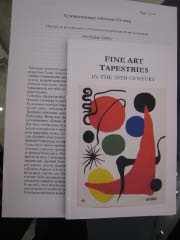 So Jane and I were at the Manege shortly after ten on Sunday morning again, always figuring to err on the side of caution. We let Julia sleep late – her mission for the day was to have copies made of the Russian translation she had made of a fifty page brochure we had created to explain modern tapestries. We figured it would be easier to print Julia’s translations of this brochure in Moscow, rather than schlep a hundred or more copies in our suitcases, which already had weighed two tons, what with all our books, handtools and clothes for two weeks. True to his word, Nicola had replaced all the lights with the proper fixtures. Expecting him to arrive at noon to focus the beams and add whatever extra fixtures were necessary, we spent several hours finalizing the booth with the French handlers, and fine-tuned. We also put up the labels, which it turned out wouldn’t stick to the walls because the walls are sheathed in linen. The Russians solved this with staplers.
Nicola, however, didn’t appear at noon. Nor at two. Nor at four. Every time Jane chased him down and he promised to come right over, he was apparently promising the same thing to every other exhibitor in the fair. We had hoped to be finished early and to be able to go back to the hotel and rest or let Julia show us around the Kremlin, across the street (in the rain), but basically we sat around doing nothing for most of the afternoon. Julia showed up with the translated brochures shortly after five.
“I really think that you will enjoy the Gypsy Dance Concert tonight,” she said with a big smile.
Happily we didn’t need to make up any excuses about why we couldn’t go (curtain was a 6:15 and we still had several hours worth of work). We told Julia to buy herself a ticket on the gallery and have a great time.
By the time Jane finally physically dragged Nicola to the booth it was after six. He started focusing lights, but every few minutes he calmly took a phone call (from another irate exhibitor.) Exhibitors stood around our booth like vultures, ready to spirit him away if we dropped our guard for a second. Jane kept yelling up to him on the ladder, “Can I see your phone a minute, please?” Nicola just continued to take calls, and never gave her the phone. Somehow he understood that if he did, Jane wouldn’t give it back until the job was done. It took several more hours but we finally got it all finished except for one additional fixture and a power outlet at our desk so we could use our computers, which Nicola promised to put in overnight (at one point in the evening he had to go get additional fixtures — Jane went with him so he wouldn’t get away; two dealers followed, ready to steal him if Jane looked away for even an instant).
Here is a visual diary of the day, including some general pictures of the rest of the building:

A little before 8:00 pm Julia called . We had just finished — finally. It was intermission at the Gypsy dance concert. She wanted to see how were doing and to check about what time she should come tomorrow. After we hung up, Jane and I hobbled to door where we looked out into the rain and suddenly wondered how the hell we were going to get home. A French dealer whom we knew was standing in the crowd at the door, smoking cigarettes (inside the Manege is one of the few places in the city where smoking isn’t allowed) with a Russian colleague.
“Are there any cabs around here?” Jane asked. The Frenchman and the Russian laughed. Fat chance. It looked like we were going to have to walk. Luckily I had an umbrella. Jane and I sized one another up, wondering which of us would have to carry the other if worse came to worst.
“Just out of curiosity, how much should a cab cost from here back to the Sheraton Palace?” Jane asked the Russian, an older fellow with that mildly cynical, you-would-be-cynical-too-if-you-had-seen-all-i’ve-seen smile that many older Russians have.
“Hundred fifty rubles, two hundred tops,” said the Russian with a Russian shrug. “But you will not find one.”
We walked toward the subway, but just as we got to the main street we saw Marat, opening the door of his car and smiling. We had bargained Marat down to 400 roubles for a one-way trip. A bargain.
“Armenia! Armenia!” said Marat.
“It’s a miracle!” Jane exclaimed.
“Julia,” said Marat, holding a mimed telephone to his ear.
It wasn’t a miracle. Our Julia, the genius, had called him during intermission. Marat turned on the radio and the sounds of Julio Iglesias filled the car.
“Julio!” screamed Jane. I hadn’t even known he was still alive, but there are billboards of Julio up all over town. He’s singing somewhere around here pretty soon, and Jane is a 
 big fan. Her eyes rolled back into her head. Jane was already in heaven, but there was no mystery where else we wanted to go.
“Cafe Babai?” asked Marat,
“Cafe Babai,” Jane and I both answered together. What a great place!
Tomorrow — the Gala Charity Preview.
Mathes Missive From Moscow #7 – Monday: Gala Preview
Greetings from Moscow,
Though I’ve been working on French for nearly fifty years, I don’t speak any foreign languages. However, I learned a lot about communication back in my theatre conservatory days. We did this one exercise in acting class that I particularly remember: you sat across from your partner and said the first word that popped into your mind.
“Mouth.”
“Mouth,” she responded.
You kept repeating this word and let the scene develop as it would. What happened was that you could express all kinds of things and they didn’t have anything to do with what words you were using. At first the conversation was pretty random and meaningless, but after a few minutes you got a lot of control when you used your face and body instead of the word:
“Mouth?” {“want to get a cup of coffee with me after class?”}
“Mouth.” {“Okay, I guess”}
“Mouth?” {“Maybe want to come back to my place afterwards?”}
“Mouth.” {“Maybe in your dreams, Charles.}
I tell you this because I don’t want you to think that we would be entirely helpless here in Moscow without Julia. In fact if we weren’t doing some pretty sophisticated selling, we could have a great time even though we don’t speak the language. (Jane has amazing linguistic talent. She is fluent in French and Hungarian and can make herself  understood in Spanish, Italian and a few other languages. She’s been studying the Cyrillic alphabet and since we’ve been her she’s reading street signs and comparing notes with Marat — who by the way doesn’t even speak Russian, according to Julia, though that’s what she’s been speaking with him. Apparently Julia’s Russian is closer to his Armenian than is our English or Jane’s phonetic Russian.)
But this morning is an illustration of the limitations you have when you don’t speak the language. There’s a restaurant next door to the hotel that the concierge told us was very nice and which we thought to have lunch in today before going to the Manege. Marat was picking us up at 1:15, so Jane and I went over to the restaurant at noon. The door was locked. We hovered for a few moments, trying to figure out why the sign seemed to say open at 11:00 but the door was locked, when two guys in suits and a young fellow in a t-shirt saw us standing outside, came over and unlocked the door.
“Open?” we asked (Mouth?)
They nodded and ushered us to one of the tables, which were all empty. We were alone in the restaurant.
“English?” we asked (Mouth?)
“Little,” said one guy (Mouth.)
Then they all disappeared. Jane and I sat at stared at one another. There wasn’t much happening so I went to take her picture — we’re all dressed up for the opening tonight.
“Stop, stop,” she ordered. “From now on no pictures until I put on lipstick.”
We’re from New York, so we expect when you go to a restaurant for someone to come over with a menu pretty quickly, but nobody was doing this. Maybe the place didn’t open until 11:00 this evening and they had just let us in to wait. Finally Jane caught the eye of the boy in the t-shirt.
 “Are you open? Can we get lunch? Can we get a menu?” (Mouth?)
“Lunch? Menu?” he replied uncertainly. (Mouth?)
“Lunch. We want to eat lunch,” said Jane. (M-o-u-t-h.)
“Lunch,” nodded the boy (Mouth) and departed. He returned with a tall glass of something that looked like it might be either tea or Jack Daniels. Jane blanched. She is not a Jack Daniels person.
“Apple,” he said to her relief. It was apple juice. Jane and I sat for a few minutes and stared at one another. Nothing happened.
“This is ridiculous,” said Jane, perhaps not earth’s most patient individual. “I don’t think they understood. I’m going to go over and get somebody to give us a menu.”
“I think they did understand,” I said. “We asked for lunch. I think they’re going to bring us lunch.”
Sure enough, I was right because the boy soon returned and placed lovely salads in front of us. We supposed that this is just how they did things over here. When we were finished he took away the plates and returned with a very nice soup. This was followed by a cold-meat-and-potato-stew-type thing on a plate. Not what Jane would have ordered, but a safe enough choice if you just serve one dish – lunch. I wasn’t hungry anyway, being very nervous about the day.
Somewhere during the meat course a group of six arrived and sat down at the next table. Within a few minutes the boy brought them a menu. Then lovely glass pots of tea and all kinds of interesting dishes.
“Why did they get a menu and we didn’t?” Jane asked the boy. (Mouth?)
“Menu. Twenty minutes.” (Mouth.) “Lunch.”
“Maybe you have to wait twenty minutes if you want a menu,” I ventured.
“They weren’t waiting here twenty minutes,” said Jane. “Why did they get a menu and we didn’t?” (Mouth.)
Finally she couldn’t stand it any more. When she discovered that one of the party spoke English she asked what was going on. Happily the man (an Austrian — this is one international town) explained or we would have never known. Apparently they have a very nice menu. One of the choices is a special business lunch, for people in a rush. You’re in and out in twenty minutes.
I can’t remember if I’ve already told you, but Julia the professional translator says that anytime you say two words in an unfamiliar language without correct sentence structure linking them, the person with whom you are talking may assume a much different link that you intend.
Having thus learned a valuable lesson in exactly this regard, off we went to the Manege, where naturally the promised additional lighting fixture and electrical outlet at the  desk had not appeared in our booth. Jane tracked Nicola down and demanded action.
“You made me stay two hours yesterday,” said Nicola in laid-back fashion. “I am very busy.” He promised to see to our problems right away. Apparently everybody in the fair is angry with Nicola. Things are looking a lot better in Manege, but there are still boxes everywhere. At least our booth is correctly lit.
Julia arrives. There is a press conference for Russian journalists at 3 o’clock. Nobody has told us what this entails but it turns out that they have a table set up upstairs. Russians are asking questions of the Swiss organizers which is translated into French by somebody at the table. The Swiss answer the question in English, and there is a simultaneous translator (probably not as good as Julia) in a booth who is furiously speaking the answers in Russian into a mic rophone. None of the Russians, however, have the earpieces in their ears to hear the translation.
We’re in our best clothes. Jane, not knowing what to expect has three different layers so she can be more formal or less, depending on how the event tonight develops — nobody has explained anything to us about how it’s all going to work. She doesn’t have pockets (which she needs for the three telephones and various other sundries she needs) but she has cleverly figured out how to turn her fanny pack around to her back so that it is not visible when she puts on her jacket (I hope this isn’t an art secret). Jane never wears skirts, but she is wearing one tonight and having a lot of fun, spinning around, watching her it float up around her in the air. There is a hole at the heel of her tights that she’s wondering what to do about. Maybe Julia can buy her another pair.
“Hold still,” I tell Jane in mid-spin. “I can’t get a picture.”
“And you never will,” she giggles.
As we’re sitting around, hoping that some of the Russian press trickles down to the floor of the Manege so that we can answer their questions, we suddenly begin to wonder why nobody has taken the protective plastic wrapping from the carpet and cleaned up the booth, which is filthy from four days of people trekking through from out of the rain. It is also littered with nails, wrapping papers, bent staples and other debris. Usually (at least in the dozen other fairs we’ve done) the fair’s cleaning crew have tidied everything up by now and vacuumed the booths. The gala preview is just hours away.
Not one to wait around if there’s action to take, Jane puts on her jacket and goes to find out who’s in charge of booth cleaning so that we don’t have to wait any longer or get interrupted by vacuum cleaners when we’re trying to speak (through Julia) to Russian journalists . She comes back to the booth after a few minutes wearing an expression that in our fifteen years together I have never seen on her face.
It turns out that nobody is ever going to come to remove the plastic from the carpet, or vacuum and clean the booth. The French are art handlers and this is not their job. The Russian technician s are movers, and this is not their job. There are women in red aprons who are sweeping up everywhere (including the men’s room, don’t ask), but they are not allowed to go into the booths. Nobody wants to take responsibility of breaking anything. No, the physical aspect of the booth, Jane has been told, is our responsibility. Oh, and so are vacuum cleaners, which presumably we were expected to bring to Russia in our hand luggage.
It would have been nice to have known this yesterday when we were sitting around for four hours in our dunga rees doing nothing but waiting for Nicola. Jane erupts, but the best she can accomplish is to get the Russians (who always say that the French are idiots, which is funny because the French say the same thing about the Russians) to take up the plastic from the floor. Here are some scenes for your approval — it is only when plastic comes up that Jane realizes we have made a mistake choosing such a light color carpet. It is filthy in various places where the plastic was torn.
“I don’t understand why we never had this kind of problem at other fairs,” she murmurs, accepting responsibility. Because at other fairs they give everyone gray-colored carpet for a reason, Jane. I am the one who finally steals a vacuum cleaner from the booth across the way. Jane has taught me well.
It is now time to track down Nicola in earnest and try to get the missing fixture and the power cord for the desk. As Jane goes off to do this, I give an interview (through Julia) to Radio Svoboda (or something). I am still a bit damp from vacuuming and hope it doesn’t show when I am later interviewed, on camera, for TV 5 in St. Petersburg. God only (plus Julia and ten million Russians) knows what I said.
At some point in the afternoon I turn to Julia and inquire if Jane is being too demanding — Jane is very a very powerful personality and for some people can perhaps be difficult to take full strength for long periods if they are not used to her.
“No, I have no problems with her,” Julia answers, a powerful personality herself in her quiet way. “I even think I am falling in love with her. She presents such an unusual palette.”
“What do you mean?” I ask.
“Jane has so many different aspects of herself that she reveals,” interprets our interpreter. “One minute she is screaming at the lighting man, and the next she is twirling around in her dress like a little girl. She is very different than anyone I have known.”
Finally, at 6:00 pm, the Gala opening preview begins. We are in our booths for the cocktail portion of the evening. At 9:00 the Black Tie people who have paid 1000 Euros for a seat can have dinner for charity with Madame Medvedev, the wife of the new president. After paying all the shipping, booth and art handling charges, we certainly can’t afford it. It’s not really our crowd anyway. We’re all dying of thirst — you can get free Macallan scotch, but nobody has water (by the way, did i tell you that nobody here drinks the tap water? They boil it for tea or drink bottled). Here are some scenes from the gala.

 The private dinner commences at 9:00 pm and we are free to go to a dinner of own. Tonight, Julia has decreed it will be Georgian — a totally wacky Baroque-funhouse-looking building that we passed in the rain one day on our travels.
Apparently Georgian food is similar to the Uzbek we liked so much at Cafe Babai (and which Jane would be happy to return to every night). Marat is pleased. This is a good place, as far as he is concerned. The interior of the restaurant was as wacky as the outside — a strange cavernous grotto, complete with a small stream with carp swimming through it and a water wheel. The food is fabulous, and the big hit is the crazy cheese flats breads.
“Pizza!” Jane declares as the first is brought out. The waiter corrects her. This is certainly not pizza, except that it is flat and comes in a pan. The cheese is put into the inside and percolates up through the top surface. It and the other flatbreads (one with an egg on top that you dip into with pieces of bread you tear off the ends) are out of this world. The Georgian diet is full of cheese and fresh meats. They are the ones who live in the mountains to be 120 years old and also eat yoghurt.
No matter what we do we seem not be able to make it back to the hotel before midnight, and tonight is no exception. We pay Marat extra to take Julia back to the apartment of her friend where she is crashing. 

 Natalie and her boyfriend have been away for the weekend, off at an American Civil War re-enactment (go figure) somewhere outside of the city. It’s actually pre-Civil War as nearly as I can gather, Richmond 1860, but everybody still gets to have some fights with Indians — the Russians are big in martial arts. Julia is sleeping with Natalie’s two cats in the cold apartment and wondered if it was a good idea to have left the window open. She better not catch my cold, which has been gone for a week, only the hacking cough remains.
Stay tuned for the real opening night tomorrow. In the meanwhile, John our friend from Bloomberg dropped by the booth tonight and mentioned that his article will hit the web on Wednesday if the editor approves. He’s going to lead his story with a mention of us. Bloomberg items are picked up by television and print outlets across America, so if you see any stories, please let me know.
Good Night.
< #6 (Pt 2) MISSIVE MISSIVE #8 >
Mathes Missive From Moscow #8 – Tuesday: Opening Night

Greetings, again, from Moscow,
Now that it’s finally stopped raining, I decided to explore Tverskaya — the avenue of our hotel (and the most expensive street in the world after Fifth Avenue and the Champs Elysee according to Jane, even though it looks like a dump) in the other direction. We’ve been going crazy trying to figure out how to eat something for breakfast without breaking the bank. Jane discovered if you sit in the cafe area outside the hotel’s restaurant you can order a la carte, and the croissants and coffee are not nearly as insanely expensive. Just down the street, however, I discover a great little coffee shop/internet cafe, where I had two almond croissants and an espresso at a reasonable (for Moscow) price and began to feel like a human being. Then I walked around a huge traffic circle that included a train station in the vast construction site that is the city. Here are some scenes:
 At 1:15 Marat picked us up and set off for the Savoy Hotel, where Jane’s daughter, Terri — our mystery guest of the week — will be staying. Jane has assembled a little package for Terri, including her badge for the fair, directions to the Manege, and of course the telephone that Jane has procured for her daughter and programmed all our numbers into.
All mother-daughter relationships are complicated, and Jane and Terri have had their share of ups and downs. Still, it is evident in the way that Jane is always bragging about her daughter that she loves her very much. Terri, who does marketing for a New York hedge fund and is flying in from Prague, was some kind of infant prodigy — brilliant, beautiful and with world-class social instincts from the cradle. Jane’s stories of what is was like to raise a precocious daughter in New York City will be familiar to every mother, though perhaps a bit more intense. “When Terri was nine,” Jane will say, with a perfect mixture of horror and pride, “she snuck out of her room, rappelled down the side of the building, highjacked a police car; we only knew she was missing when we turned on the eleven o’clock news and saw her sitting on the lap of the second baseman of the New York Yankees at Studio 54.” Or “When when she was thirteen I’m coming home from Zabars and see Terri driving off in a limousine she had charged on my credit card. As she sped off up West End Avenue she called out that she was just taking it to school, but we finally found her in St. Tropez!”
Terri is still beautiful, a world-class athlete who, Jane says, runs five miles every morning, a fixture at New York social events. Getting the M.B.A. at Columbia University really helped straighten her out a lot.
After we dropped off the package for Terri, Marat drove us half way around the city on the way back to the Manege (because, as you now know, there’s hardly any place a car is allowed to turn), happily pointing out the sights along with way. Kremlin. Zum and Gum department stores. Lubyanka Prison, headquarters of the old KGB. Who knows what else — Jane doesn’t speak Armenian very well yet, though she’s told Marat all about Terri and about her eleven-year-old granddaughter, Gabriela, the soccer star. It turns out that Marat was apparently a soccer player himself in his youth; I’m not sure what professional team (my Armenian is not so hot either), but apparently he played for the USSR team in the championships against Yugoslavia (or someplace similar, who knows?). 
As we enter the Manege we have to pass a gauntlet of Russian eye candy that the organizers have dressed the doorway with. The girls are all tall, thin and beautiful. Jane is outraged with their legs, which are all like matchsticks (they wear towering high heels to maximize the effect). “It’s because they see women just as objects here – it’s ridiculous for women to have to make themselves into unnatural shapes just so they can serve as decoration, but they all buy into it! They don’t know any better.” Because you’ve watched from the start as we’ve built our booth, I think now you might like to see how it turned out. Remember, this is pretty much what Jane envisioned in her head months ago and set down on the graph paper with little squares. It shows, I think, how good she really is.
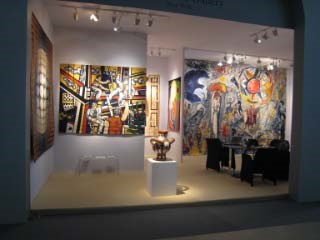
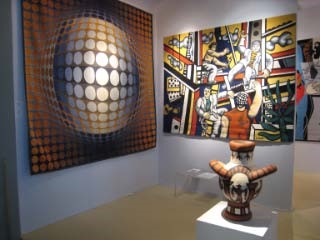
 Yesterday was the press conference for the Russian media. Today it is the English-speaking press that has been brought in at 3:00 pm. The actual opening won’t be until 6:00 pm.
The fair organizers obviously have their weaknesses, but now their real strength is revealed. In New York City you have dozens of art fairs competing with literally thousands of important events of every size, shape and color. To get the city’s attention is virtually impossible unless you are the New York Mets and have just won the World Series. The Moscow World Fine Art Fair, however, is the biggest event in fine arts of the entire year in probably a thousand square mile area. There are journalists here from all over the world, but we are now amazed to learn that the fair organizers have actually junketed over fifteen or twenty writers from American art magazines. I give interviews to German, English and American journalists. Jane likes me to give these interviews because she thinks I am a better speaker than she (she’s a little shy, too, believe it or not), but I make her speak with Art & Auction, while I’m talking with Art & Antiques. She does brilliantly. Somewhere along the line I give an on-camera interview with Reuters — which could be picked up by any of the 500 television stations they sell to.
It’s all really quite amazing. We had sent out press releases to these very same magazines ourselves over the past few months, but such publications get hundreds of releases. When they fly you over to help you get the story, that’s different. We will have more publicity in American because we came to Russia, probably, than we’ve been able to attract in a decade by all our best efforts.
Somewhere before five Terri shows up. As you will from the photos below, she is perfect in every way. That’s John from Bloomberg in one of the pictures. Terri is ready to help and we try to put her to work. When she learns that we wrote to the director the Pushkin’s tapestry department to see if he might like to have one of the tapestries on loan before the fair (we never received an answer, though we had had Julia translate the letter into Russian), Terri wonders why Jane didn’t just call him up when we arrived. This is what Larry Gagosian would have done in a minute, says Terri. Gagosian is probably the biggest art dealer in America. Terri worked for him when she was just out of college. She’s right, we suppose. It’s hard for Jane to explain why we didn’t. She’s feeling uncomfortable, physically as well as psychologically — it’s been a stressful week. She can’t turn her head more than a few degrees in either direction for some reason. Julia says it is from carrying her heavy bag with all the fair materials all day for the past week. Julia herself has a headache.
The crowds (about 8,000 people are expected tonight, though there could be a few thousand more) begin coming at 6:00 pm, and I’m afraid I don’t have any pictures because I was too busy trying to deal with all the people, all the questions, all the complexities that make up a Night At The Art Fair (sounds like the title of a Marx Brothers movie, doesn’t it? Like A Night At The Circus. A lot like, maybe.)
Toward the end of the evening Julia and I get into a little tiff. She thinks I could have explained certain aspects of the relationship between the artists and these tapestries which are after their images. I try to defend myself, but this is not the time to have an argument. Besides, she’s here to be a translator, not a critic. Selling at a venue like this is a kind of performance. You can’t tell an actor that he should have spoken his last few lines better as he is waiting in wings to go onstage again. Julia will not let it go. I learned the other day that this whole week she’s felt much like the Russian construction worker — that she had much to contribute, but didn’t feel fully utilized. We keeping beating dead horses, and I start criticizing her for not being supportive. Terri tries not to pay attention, but it is clear she thinks this is peculiar.
Julia’s ear is stopped up for some reason. Her headache is getting worse. Jane can’t turn her head. I’m feeling all deflated, even though the guy that Julia and I were arguing about will probably come back — I just wanted him to read the complete explanation of tapestry in the brochure Julia translated. Julia thought I should have made the points better in our personal exchange. Am I beating a dead horse again?
People finally start leaving, and we escape, too, at about 9:30.
 Tonight Julia has decreed that we will continue to explore the former republics, turning now to the Ukraine. We are supposed to go to Taras Bulba (as in the old Yul Brynner/Tony Curtis movie), but when we arrive there are no tables available. Terri doesn’t like the look of the place, being used to three star Michelin restaurants. She doesn’t understand what we see in peasant food. The management of Taras Bulba suggests another Ukrainian place. Marat sets out to find it, but we soon get lost — or rather, not lost, but simply thwarted. Every street he tries to turn down is blocked off. There’s no way to keep up with all the street realities, the city is changing too quickly.
A few days ago, Julia told me a story about how she used to get terrible earaches when she was eight year old. She became afraid to tell her family that her ears hurt because then invariably they would say, “Juuuuuuulia. Why have you made yourself sick?” So she would keep quiet until she started to cry, and only then would her trouble be revealed. Now her ear is hurting in earnest. It is all stuffed up, and it just won’t open. She tells me that she is becoming frightened. I try to get her to pull the plug on the evening, but she won’t hear of it. She is starting to cough.
We arrive at the suggested alternative Ukrainian restaurant. None of us like the look of it, but it is getting very late now and we have to eat. Jane keeps bombarding Terri with tales of how much fun we’ve been having at ethnic restaurants. Terri looks skeptically at the menu. She keeps to an extremely healthful diet in between workouts.
“I don’t think there’s anything here I can eat,” she says, wrinkling her perfect nose.
 Jane keeps on trying to get her to understand how wonderful ethnic food can be, but Terri has to make that faithful choice: Whom is she going to believe? Her mother? Or her eyes?
“I mean, look at this menu,” she says with surprising tenderness, trying to keep her perfect smile from disintegrating. “Smoked Lard. Rolled Lard. Lard with spices.”
“What, ” I venture in amazement. “You don’t like lard?”
We all finally find things to order, but it isn’t easy. Terri pushes away her salad — it is too salty. Jane keeps chattering happily about how good all of other restaurants were this week, but she cannot turn her head. Julia keeps opening and closing her mouth, trying to open up her ear, but not succeeding. She tries to conceal it, but she is looking very scared. She is worried about going back to the cold apartment.
As we are leaving I pull Jane aside and tell her that Julia is in real distress and that we can’t let her go back to Natalia’s. Jane was so focused on trying to show Terri a good time that she didn’t realize the situation was so bad. She does now, in an instant.
“You’re coming back to the hotel with us,” Jane tells Julia. Julia tries to protest for a moment, but she is too frightened and uncomfortable to make pretences. She accepts with noticeable relief. Terri does her best to be conciliatory, but she is tired and just wants to go back to her hotel and go to bed. We drop her off, then head back to the Sheraton. It is after midnight when Marat drops us off and departs for the night. At the front desk, however, Jane is told that there are absolutely no other rooms available.  There are no hotel rooms available anywhere in the city.
“You’re going to stay with me in my room,” Jane tells Julia. “There’s a big double bed in the room and a deep bathtub. You’ll be fine.”
“Yes, thank you,” said Julia. It never occurred to her that Jane would get her a separate room of her own. Of course this had been Jane’s intention, though it would have cost a fortune.
“Are you all right?” I ask. “I’m sorry if we argued earlier. I’m horrified if I’ve given you my cold.”
“No,” says Julia. “I have had a problem for a long time, but I just don’t understand why my ear is plugged up and I cannot open it. I don’t want to have an earache.” She stiffens her lip.
“I will do traditional Russian treatments. I will take hot and cold baths and give myself a vodka compress. I will be better soon.”
Jane and Julia head to their room, and I to mine. It is hard to determine who among us is the most worried.
Mathes Missive from Moscow #9 – Wednesday: First Public Day

Greetings from Moscow, where our last installment ended with Julia tied to the railroad tracks and old Eighty Nine barreling toward her at high speed.
“How’s Julia?” I ask as I anxiously slip into the restaurant booth next to Jane’s at around noon. I had wanted to call all morning but wouldn’t have wanted to wake Julia if she were still sleeping. In fact she still is.
“She’s okay,” said Jane, who looked tired. “We didn’t get to bed until two thirty in the morning.”
 The fair runs most days from 2 in the afternoon until 9 or 9:30 at night (the fair organizers apparently are not sure, since printed hours differ). After taking out a croissant this morning from my little coffee place at eight (as well as the folder the check came in, thinking it an advertisement), I had written for most of the morning, returned the stolen folder (“Sorry, stupid American,” I tell the waitress, who looked happy to see it), then headed to the overpriced coffee shop at the Sheraton Palace for lunch. Yesterday I had actually forgotten about lunch for probably the first time in my life. I had had to get by on a raspberry tart, the most substantial offering from the cafe next to our fair booth. It was no time to go restaurant shopping now.
But at least Julia would live. She had gone immediately to the bathtub and started a regimen of baths — first a hot one, then a cold one — to get her blood circulating. She had been there for two and a half hours.
“I didn’t want to disturb her,” Jane explained. “I had to put on my clothes and go down to the lobby to pee!”
Jane has already ordered, but I can see she is “out of her plate” as Arlene (and the French) would say, though she insists Julia is no trouble — the bed is very large. And she can turn her head a little better than last night. We are the only people in the restaurant. The lunch is very good, but my seared tuna salad comes before Jane’s soup. And then my egg-wrapped pork arrives before her tilapia.
“Excuse me,” Jane says, flagging down the waitress, clearly in need of some trouble to make in order to put herself to rights. “Is it the restaurant’s policy to serve men first, instead of women?”
“Please?” says the waitress with a smile (Mouth?).
“I’m not criticizing, you understand,” says Jane, “but I was here first and you served his meal before mine. Is there an assumption that a man should be taken care of first because he’s here to do business, while it doesn’t matter to keep a woman waiting?”
“Sorry?” (Mouth?)
“Maybe she doesn’t understand?” I said.
“No, no, it’s okay,” said Jane, satisfied, letting the girl escape. “It’s just that somebody has to start questioning how things are done here, put new ideas into their minds.”
I suppose if anybody can turn around an entire foreign culture, it would be Jane.
 From two until six are what the Fair calls “Public Hours,” and have paid admissions, as opposed to the nights, when only people who have been given VIP passes by galleries can get in. Today is much less crowded than the opening last night, and that’s fine with us. Julia is going to come when she’s ready. Jane and I are relieved to see that while Julia is vital for some encounters, it is easier to deal with many clients without her. Julia is so kind and polite that instinctively she wants to treat everything each person says as important. Though she understands that we must focus on those who might actually buy something, extricating yourself in a polite fashion from people who glom onto you at a fair is an art that takes years of experience to develop.
Jane and I in fact have years of experience doing fairs, and not being able to speak the language turns out to be a wonderful way to handle certain types. We always bend over backwards not to be rude to anyone. Even when we have to throw somebody out of the booth, we try to do it in the nicest possible way. But some people are impossible. There’s always some artist who wants to show you his work or entrepreneur who wants to sell you something, and who somehow just cannot be persuaded that this is not the right time or place. Several of these characters show up today. What a pleasure that we can just shrug politely at them as they try tell us how important they are, “Sorry, no speak Russian. Why don’t you go over and bother that nice French dealer over there?”
We are in fact very impressed with the caliber of the fair patrons, and many speak English or French. Our best clients of the day, however, are an American couple, old clients of ours, who live also here in Russia and who want to send some of their important Russian friends to see us. It’s nice to see friendly faces.
Terri shows up, looking rested. She’s gotten more sleep than she has in a week (must have been the lard with garlic which we all sampled on black bread last night), has worked out and has brought us sandwiches from one of the department stores, Zum or Gum, she’s not sure which. She sets about making herself useful.
 Through no fault of her own Terri has been introduced into this narrative in an unsympathetic role. I mean, here we have three characters straight from Characterville — Julia, Jane and me. And now poor flawless Terri shows up. How could she not come across (especially in the hands of someone like me who can’t resist shooting fish in a barrel) as the villainous interloper who is crashing our intimate little party? But Terri is a real person, not a caricature. The fact that she is here is more important to her mother than Terri can imagine. Plus Terri offers us a lot of good suggestions from her different world. She really does belong to the high-powered contemporary art scene, knows all the real players, understands how things are done in the places that matter. Is it Terri’s fault that she’s embarrassed by her mother? Don’t mothers exist partly to embarrass their children?
“If you want to be a dealer like Larry Gagosian and have that kind of success, you have to start thinking in a different way,” Terri tells Jane, and of course she is right. What she doesn’t seem to understand is that her mother doesn’t want to be a dealer like Larry Gagosian.
There aren’t real crowds today, though a steady stream of people come through the booth. We’re pleased to see Marat, our Armenian driver, to whom Julia has given a pass. He’s a real member of our team and is concerned about Julia. Nor is he the gonif he might appear. He came to Moscow to give his daughters a chance to get a better education.
“You see who a man is,” says Jane, “when he wants to educate his children, but especially if they are girls.”
Marat had invested all of his savings in a little grocery store. He was doing well until he became the victim of what is apparently the Russian version of urban renewal. The government appeared one day and condemned the building his store was in. Not only was he thrown out, all of his inventory somehow disappeared. So now he is driving a cab.
 It is well after four when Julia finally appears, looking no worse for wear. What a relief!
“I can see you’re feeling a lot better,” I say.
“Not really,” she replies sadly. “This is my problem. Even when I am a wreck I still look very nice.”
“Poor Julia!” The sympathy seems to perk her up.
Julia’s ear is still blocked, but she is confident that with baths and vodka compresses she can make herself better. We discuss the merits of other traditional remedies including mustard plasters, on which Arlene is very high. Jane looks on, baffled.
The big event of the day, of course, is reading John from Bloomberg’s story about the Fair, which hit the web first thing today. John had told us that he was leading with our gallery, and we had hoped it would be more than one sentence. In fact, he has generously given us a several paragraphs and featured a visual of our most important Chagall tapestry, maybe because we are the only purely American gallery at the fair. We’re walking on air.
The show seems to wind to a close shortly after 9:00 pm, and we head for the doors. Tonight we’re going to try a restaurant that Marat had pointed out on our wild goose chase last night to Lardville. Putin and Medvedev, the new president, eat at this place, according to Marat. It is a kitschy palace called “Sun of the Desert,” themed, according to Julia on the first Russian movie western. Julia tries to recount the plot, but it is hopeless.
We order according to our usual fashion – numerous appetizers and breads for the table and main dishes, which we will all share. The wine is a Chilean from the Maipo valley, a Rothschild venture, and a successful one. Julia has a traditional grog in addition to her wine. The conversation is easier tonight and interesting. The food is more like what  we have been used to (in fact we order mostly from the Uzbek section of the menu — no need to tell veterans of Cafe Babai that this is great cuisine). Everything is fresh and flavorful. Even Terri is impressed. We’re not so impressed with the belly dancers, who spin through the room periodically, having seen Julia in action.
“I’m the happiest creature on the face of the earth,” says Jane, nibbling on a herring.
Terri rolls her eyes. The problems between mothers and daughters are certainly not lost on Julia, whom Jane seems to think of as a spiritual daughter.
“Why do you think I live in New York and my mother lives in Ryazan?” says Julia. In fact her mother is coming to the fair tomorrow.
The conversation turns serious. Julia has mentioned several times that she is wondering if still makes sense for her to stay in America and is seriously considering moving back to Russia. Jane has been trying like crazy to make the case that she should stay in New York. Terri sees Julia’s point. The two of them are getting along surprisingly nicely.
“If you want the past, stay in the US,” says Terri. “If you want the future, it may be here in Russia.”
Jane disagrees vehemently, but it’s really hard to argue with the excitement, energy and sense of new possibilities that we have all experienced for ourselves here in Moscow.
The check comes with sticks of Wrigleys Doublemint Gum for one and all.

=
Mathes Missive from Moscow #10 – Thursday: VIP Night Owls
Good morning from Moscow,
The rhythm of the day here is much different than in the U.S. or, Jane says, in Europe. Since we arrived we’ve been working until about 10:00 pm, but it’s still quite light outside at that hour and many other people are going to dinner. We rarely get back to our rooms at the Sheraton before midnight, whereupon I work on these missives until after two. Now that the regular hours of the fair have commenced (2:00 pm until about 9:30 pm, as opposed to 10:00 am to 10:00 pm when we were setting up), I can write in the morning from the time I get up at 7:30 until noon. At that point we have to eat and get ready to leave for the fair. Marat picks us up at 1:15. I generally polish the previous day’s missive each night, polish it again the next morning (what, you thought maybe they popped out full-blown like Athena from the head of Zeus?) and then start another. In this way, I can generally stay a day ahead. We now have an internet connection at the fair, so I don’t have to purchase an internet card at the hotel ($28 for 24 hours WIFI — no discount for longer amounts of time). This is why you haven’t been hearing about the usual tourist spots. When in this schedule is there time for us to tour the Kremlin?
As I write this Missive #10, which will cover Thursday’s events, it is now Friday morning. I have just finished polishing Missive #9, which actually was what happened Wednesday. Got it?
Anyway, we can almost slip into a routine on Thursday, except that this is the “VIP Night Owls” night, when the Fair will be open from the usual 2:00 pm until 11:00 o’clock in the evening. The rational for this seems to be to accommodate some kind of round table discussion tonight from 7:00 pm to 9:00 pm by the auction houses, which have set up booths at the front of the Manege. As in America, people here don’t like to go somewhere just before closing. In New York the fairs stay open until at least seven or seven thirty, so that folks will come at 6:00 pm after work. Here the organizers seem to think of the dealers rather as animals in the zoo, to be paraded out and left on display for the convenience of the public for any length of time. And if it will lead to a sale, that’s really fine by us (the fact that there’s nowhere in the Manege where a person can get something simple to eat or even a bottle of water — Julia says that nobody drinks from the tap — is something else)..
 Of course, I’m not going to tell you about our sales, one way or another.
There are many reasons for this — most of which are secret, as you know. When people (and especially other dealers or journalists) ask how we’ve done we always say that we’ve met a lot of interesting people. This is actually always true. Some of these encounters may lead to sales, though the time frame is sometimes measured in years. You can seem to do badly at a fair, but in the long run it may turn out brilliantly. Conversely, some successes can be costly in ways that are not immediately apparent. You can sell hundred million dollars worth of stuff (well, maybe Larry Gagosian can), but what does it mean if the stuff cost you ninety five million dollars and you’ve incurred ten million dollars worth of expenses? Moscow is an incredible gamble for us, and we’ve known from the outset that it will probably take years to understand what it has really meant for the gallery. Jane has more than just courage to have brought us here. She has vision. (Early on, I suggested that in addition to her other sterling qualities Jane perhaps also possessed “perhaps just the teensiest bit of lunacy.” I’ve shared all of these missives with her from the outset. That was the only thing she’s objected to. “I am insulted,” she said, “why only a little bit of lunacy, why not a whole lot? I don’t like to do things half way.”)
Anyway, after another lunch at the hotel coffee shop (Jane did not feel the need to torment any waitresses today), Marat drove us over to Manege and for half an hour Jane and I finally were able to do what both of us enjoy the most at work: staring off into space.
Here are some views of the wood-paneled booth is our neighbor, Steinitz, one of the biggest Parisian antique dealers — remember all of his crates blocking the aisle outside our booth at the setup? There’s probably 20 million dollars worth of stuff there (the million dollar price tag on the paneling includes shipment and installation). The chandeliers must have been a whole lot of fun to pack and ship, don’t you think?
Julia, still looking very nice but still not feeling very well, shows up with her mother and a passel of cousins from her home town of Ryazan, which she says is about a three hour trip from Moscow. They have taken the train in, then the subway to the Manege — another twenty minutes or so. They will go back later today, but don’t seem to have minded the commute. Julia’s mother, though, knew there was something wrong from the moment she saw her from fifty feet away:
“Juuuuuuulia! Have you made yourself sick?”
Julia’s mother is an electrical engineer. Julia actually majored in physics in her education, which she says have been very valuable in her work as a personal trainer, simultaneous translator and gypsy dancer. Julia’s mother seems like quite a different type of person than Julia. Mother and daughter relationships are very complicated. 
Terri comes by after three with sandwiches again (it was Zum, not Gum, where she bought them – both are department stores of the Harrods persuasion). She has slept better. Her hotel, the Savoy, is much closer to the Manege than ours and quite elegant. However, on her first night here the people in the next room were entertaining loudly and kept her awake until five in the morning> At breakfast there had been a man smoking a gigantic cigar right next to her.
Today Terri is again full of helpful suggestions, wondering why we weren’t being more pro-active and pointing out that Larry Gagosian would have millions of people working the floor if he were here. It is nice to see Jane and Terri having some mother-daughter time together; a few hours of quality bickering is always refreshing at events like these. 
Julia’s family finally departs for the long commute home. Terri tries to help her mother see a better way of doing things (and fails). In between speaking to clients, I try to figure out a way of getting some pictures of the crazy shoes women here are wearing. We are talking heels as high as nine inches, I am certain.
“Fashion has become decorative arts and comedy,” Jane declares. “It used to be pure torture.”
I think the pendulum is swinging back again. But how can I take pictures of women’s feet without getting slugged (or worse)? Julia again to the rescue. Some girls from the one of the jewelry booths downstairs wander through and Julia somehow manages to find the words (in Russian) that will make a shoe pose inoffensive. These heels aren’t nearly as high as many, but you get the idea (they insisted that I take another shot to show how well the legs went with the shoes). The shoes at the end, of course, are Julia’s.

 Finally it is eleven o’clock, pretty late to go looking for a new ethnic restaurant. We return to our old standby, Planet Sushi, which is open 24 hours. It is the perfect place and even Terri is pleased, though she has to send back the yellowtail (it is suspiciously yellow and smells fishy). “Are you sick?”Terri asks Jane, who tries to place a piece of caterpillar roll on her daughter’s plate. Julia and I share an identical cough (though Julia insists that this has been coming on her for a long time). Typhoid Charlie strikes again!
It’s half past midnight by the time we’re ready to leave, and we have to play hide and seek to find Marat. He was waiting outside the Manege. When we came looking for him, he was at Planet Sushi looking for us.
“Armenia, Armenia,” he says happily when we finally rendezvous. Jane has begun to call him “our magic carpet.”
Mathes Missive from Moscow #11 – Friday: Just Another Day at the Fair
Good morning, Americans,
Here were are in Moscow, the 14th dirtiest city in the world (even New Delhi is cleaner), where a few nights ago according the newspaper police arrested a man leading a stolen horse through the city on a drunken rampage (probably it was the man who was drinking, not the horse), where the official inflation rate is approaching 15 percent (so you know it must be higher) and where our merry little band is ready for another day and another dollar (coming in for a change, one hopes, as opposed to going out).
We are beginning to settle into a routine, inasmuch as one can establish a routine in a situation like this. But any bit of structure helps when you need to focus all of your energy for an unpredictable day. You don’t want to worry about where to eat lunch after you write for four hours then have to dash off and deal with oligarchs all day. The only thing different I attempt this morning is to replace my bottle of evil-tasting cough syrup at the pharmacy down the street. You can tell they’re pharmacies because the signs say something like Anteka — maybe these are very old-fashioned medicines? Antiques? (The cough syrup is Greek, but probably not ancient.) Jane, in dog withdrawal, has been looking for small creatures to photograph and finally finds a stray. You don’t see strays in any other major European capital. Here the only dogs you see are strays.
Jane spends most of the afternoon trying to call Terri on the Russian telephone she has procured for her daughter. Recall all those happy hours we spent at the phone shop? Jane is very high on phones (c ounting her own Russian telephone, she herself is now carrying four). But Terri doesn’t answer. Nor does she answer her American telephone. Jane finally resorts to sending emails. “Call Mom. Bring sandwiches.”
Julia still looks very nice and still isn’t feeling herself, despite another two hours of hot and cold baths last night in Jane’s room.
“I will have to find a Russian bathhouse where they beat you,” she declares.
I have this vague recollection of my brother Gary telling me how they used to do something like this to you at the Schvitz in Cleveland, the traditional Jewish version of what Julia has in mind. Hard to fit Julia in with the images I have of old farts kibitzing in the steam, while guys whack them on the back with bundles of twigs.
“They beat you with brooms?”
“Exactly.”
Poor Julia!
It’s a slow day and a relatively uneventful one (anything that actually did happen, art-wise, would of course be a secret). Here are some scenes of what the rest of the fair looks like.

 During the afternoon several friends of Julia’s come by — she has given out many passes — and she has a good time showing them around the floor. At some point a Russian comes in with a question we can’t understand, and we need Julia. Jane calls her on my Russian telephone (Jane’s own Russian phone has now stopped working) but of course Julia has left her phone in the booth. Just as well; she had forgotten to charge it anyway.
Jane has been insisting that sharing her hotel room with Julia is no trouble (“She’s just like a daughter, there are towels on the floor all over the place”), but at the same time has been working overtime trying to get Julia a room of her own in the hotel. Finally the hotel manager has been able to accomplish this, but only for over the weekend. The room rate is excellent, and he even gives us all a good discount for the weekend and free breakfasts — but on Monday all bets will be off again. Moscow is 100% full.
 Terri shows up at last, close to six o’clock. She has brought strawberries this time. From Zum. The berries are smaller and not as red as the ones you can get in any American supermarket, but like most of the food we’ve had here, they somehow taste better. In fact Terri says they are the best strawberries she has ever eaten. Terri’s American telephone doesn’t work because she has brought the wrong charger. Jane demands to see her daughter’s Russian telephone and eventually figures out that Terri has somehow turned it off. This is why Jane’s telephone didn’t work either – she had turned hers off, too. (My phone works great, but I have no one to call.)
After a few more invigorating hours of mother-daughter combat, staring off into space, and secret art doings (we did meet some interesting people, however), it is nine o’clock and a voice over the loudspeaker announces that the fair is now over for the night. Apparently they have decided upon a closing time. Immediately guards spread out and order everyone (including us) to leave.
Oh, did I mention that at eight o’clock this Friday night, the French technical person came by our booth with a bill for the electrics? Just the kind of thing you want to deal with over the weekend. And it is so a la carte as to boggle the mind. They’re even charging for the wooden struts (I think there are something like 59 of them) that are stretched across the top of the booth, above the fabric ceiling, to which the lighting tracks are attached. It’s like being billed for every spoon, fork, plate and napkin you’ve used in a restaurant — to say nothing about the number of flakes of pepper and grains of salt! Oh, and unless you have spent the funds on a new car, the bill must be paid in full by Monday. Your art will be held hostage until the funds clear.
Marat cannot meet us tonight — he has to pick up his aunt from the airport. Julia and I want to walk to the Cafe Pushkin, where we will be having dinner with John from Bloomberg, but Jane and Terri prefer to be driven. Julia, who once got stopped by the police for trying to hitchhike through Queens (“We don’t do that kind of thing here, honey,”) flags down a gypsy cab, plenty of which cruise the Moscow streets (if you think you can just stick out your hand and hail a regular cab here the way we do in New York, you’re going to be sadly disappointed). The driver is from Kazakhstan or some such place and takes us to Pushkin something-or-other, but not Cafe Pushkin (maybe this is where Marat was the other day, when we were waiting at the Pushkin Museum.) We then spend the next half hour tooling around central Moscow trying to find the restaurant — it doesn’t help that if you guess the wrong street you can’t make a turn for six miles.
 Finally we arrive. Terri has selected Cafe Pushkin because the magazine for American Express Platinum Card holders has mentioned it as being one of THE places to go in Moscow. Terri goes to all the IN places. It is a beautiful old building and the 18th century Rococo interior inside looks sparkling, authentic, 100% old Russia. If John, who meets us at the bar, hadn’t told us it is all in fact 100% brand new, built within the last few years (at phenomenal expense) to look old, we would never have known.
It’s not hard to understand why John is so successful as an art writer here in Russia. He freelances for a number of different publications and from the stories of his we’ve seen — including the piece featuring us on Bloomberg — it’s clear that he’s a talented writer. But John seems to be something more. He’s a quiet, lovely guy with an open mind, a happy heart and apparently no axes to grind. We don’t understand why he’s been so nice to us — he now says that he’s even influenced the folks at Reuters where he used to work to give us more coverage — but it’s certainly a pleasure to have the chance to be nice to him. John has wonderful stories to tell, and — as if you couldn’t guess the secret of being a good writer — he is a very good listener.
 As we wait at the bar for a table, Terri, herself a good talker, zeroes in and starts chatting him up. Sitting in a Ukrainian restaurant in front of a plate of lard, Terri perhaps seemed a trifle ridiculous . Here in this glittering setting among Moscow’s beautiful people, everything about her suddenly makes perfect sense. This is her natural habitat. Not that Jane or I or Julia don’t like Cafe Pushkin. We can swim in these waters, too; we’re all good swimmers. But I for one prefer Cafe Babai. Interestingly enough, John from Bloomberg when we told him that we were coming here didn’t think of it as the best place in Moscow — sort of like the Tavern on the Green in Manhattan. “Definitely you have to go once if you haven’t been there, but there are probably a lot of better places if what you want is good food.”
Terri, though, could probably eat here every night. She warns me to take some caviar fast, or she’s going to appropriate it all (how could we come to Moscow and not have caviar? And who better to share it with than John?).
I let Julia help me select an entree as usual, but it would be hard to make a real mistake. The food, needless to say, is rather rich. 
It is nearing one thirty in the morning when we finally finish dinner. Marat is waiting outside, all dressed up from seeing his aunt, and happy to see us. We offer John a lift, but he prefers to walk. We had been told that Moscow was a dangerous city, but I guess it’s like New York — any of us wouldn’t be afraid to walk around at night in New York. We live there. We know where to go and where not to go.
As we drop Terri off at the Savoy, she announces that she has changed her plane reservation and is leaving tomorrow morning, not Sunday as planned. She wants to have a day to decompress in New York before going back to work. Terri and Julia had made plans to go to a design fair elsewhere in the city tomorrow morning, but I guess that’s out now. Jane was anticipating another happy day of butting heads (at one point Jane announces that if Terri rolls her eyes one more time, she’s going to get throttled). But Terri is Terri; she’s sampled all she needs to sample in Moscow and is ready to move on. Marat agrees to pick her up tomorrow at 6:30 a.m., even though he won’t get home tonight until very late indeed — what a mensch.
An instant later Terri waves goodbye and disappears into the grand lobby of her hotel. Our time together is over. Funny, I think we might actually miss her.
Mathes Missive from Moscow #12 – Saturday: Saturday Night Special

Hello, Tovarich (I actually used this expression on a Russian, who gave me a totally blank look, so either my pronunciation is off, he doesn’t watch American movies and know that this is supposed to mean comrade in Russian, or it’s politically incorrect to be a comrade nowadays– hey, do you think he just didn’t want to be my friend?),
This morning begins with the breakfast buffet at the Sheraton Palace, which the hotel manager has kindly comped us with over the weekend. Just what I needed — more food. At this point I’m beyond ready to get back to my dry seven-grain toast and tea at 3 Guys, the coffee shop up the street from our gallery in New York. But, hey, it’s a trip of a lifetime, what are you going to do? What I end up doing is freshly squeezed orange juice (such oranges!), coffee, fruit, bread, boiled buckwheat (had to try it, wasn’t bad), a red caviar blini, a made-to-order ham omelet (such eggs!), some herring, a piece of eel, several helpings of smoked salmon — some of the best I’ve ever tasted — and a sampling of smoked mackerel, which I generally don’t even like, but this was so terrific that I was ready to take as many pieces as I could fit into my pockets over to the Manege for lunch.
Back to healthy eating next week, Arlene, I promise.
We get to the Manege twenty minutes before the 2:00 opening time, so Julia and I set off on foot toward the Kremlin. The Kremlin is literally across the street from the Manege, and I know it would be crazy not to see at least a little of it while we are here. Jane doesn’t have the energy to join us, which is just as well because Julia’s fast pace would have killed her.
“Because of my Tatar heritage, I would have dragged your body back,” Julia later tells her, reassuringly. “By the heels.”
There is some kind of concert/promenade of ex-boarder guards, however, and all the entrances from Red Square to the walled in area of the Kremlin are closed (Julia finds it hysterical that I used to think that they called it Red Square because it was Communist; in fact it literally is red — the buildings are made of red bricks). So instead, we proceed at a brisk clip through the department store, GUM (as opposed to ZUM, across the street). At least I think this one is GUM. Whichever one it is, it turns out to be a va st, beautiful arcade complex filled with elegant boutiques and shops.
“Was this here during Soviet times?” I ask Julia, remembering all those tales of the deprived and starving people of the USSR that I heard growing up in the American Midwest during the height of the Cold War.
“Of course,” replies Julia. “One of my friends used to say that the difference between Americans and Russians was that you actually believed your government’s propaganda. We knew better. We were laughing our ears off at you.”
Thereafter ensued another day at the Moscow World Fine Art Fair, though anything that may have happened must remain a secret.
But complaints, by their very nature, are never secret, so here are a few choice ones for your enjoyment. You’d think that there’d be some place to get a quick bite at an event like this, in case a dealer didn’t want to leave his booth for two hours to go up to the elegant restaurant on the third floor for a three course lunch. Luckily there is: the small cafe next to our own booth, where you can wait half an hour for a table so you can have pastry and coffee — not the ideal lunch at 5:00 p.m. after you haven’t eaten anything since the two pounds of fish at 8:30 in the morning. Want a three-inch-tall bottle of Evian? That will be the equivalent of $6, please, if they haven ‘t run out. Too bad there is literally no other place in the entire building to get a drink of water (and remember, you can’t drink from the tap). When I said I was thinking of putting some mackerel in my pockets, I hope you understood that I was thinking SERIOUSLY.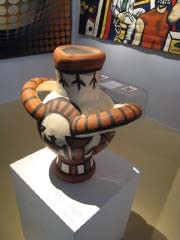
And now that you begin to see behind the curtain some of the little difficulties that we art dealers must suffer, allow me to mention that there are also no wastebaskets at the Manege. Where are you supposed to put the wrappings if you can persuade a hedge fund person from New York like Terri to bring you sandwiches or strawberries from GUM (or ZUM)? I’m afraid your only option is to take the trash down to the men’s room and hope one of the ubiquitous cleaning girls spirits it away on one of her every-other-minute circuits of the urinals (don’t ask). It’s come to the point where I have begun eyeing our big Picasso ceramic bird as a possible garbage receptacle (hey, maybe we could suggest that it’s authentic Picasso garbage and raise the price)!
At the end of another day of meeting interesting people, we were about to depart for dinner when Julia noticed doings in the booth next door, that of perhaps the biggest figure in the arts in Russia, Zurab Tsereteli — painter, sculptor, architect and President of the Russian Academy of Arts. Tsereteli’s fame is international. His sculpture, “To the Struggle Against World Terrorism” — a 40 foot teardrop suspended in the fissure of a 106-foot bronze rectangular tower was recently installed in Bayonne, New Jersey. Bill Clinton, Homeland Security Chief Michael Chertoff and Governor Jon Corzine of New Jersey (one of three governors I’ve seen breakfasting at 3 Guys over the past year) all spoke at the dedication. Tsereteli’s fame is such that even Olga, the Russian diplomat whom I sat next to on the airplane coming over to Moscow, actually mentioned this sculpture to me with something like — but not exactly — admiration (“We call it the ‘Crying Vagina'”).
Though Tsereteli is ringed by a large entourage, Julia somehow manages to drag Jane over and get the great man’s attention. The next thing I know, Jane has led him to our booth and is showing him our wonderful Chagall tapestry, “La Vie.” I’m only sorry I couldn’t get a shot of everyone with the tapestry in the background, but that’s where the film crews were standing with their  cameras.
The fellow on the left, by the way, is the world-weary Russian artist who told us the other night that a taxi from the Manege to the hotel should be about 200 Rubles. I don’t know his name but his work is being shown at the fair by an important French gallery. Everybody knows Tsereteli, and Tsereteli knows everybody that matters. Now Tsereteli knows us.
Marat has suggested that we dine tonight at a traditional Russian restaurant on Arbot Street that is big with politicians and the Russian mafia (a quality predictor that had proved quite accurate with Sun of the Desert) but we passed the place the other day in the rain and know that it’s closed. Julia decides that our best bet will be Godunov, another traditional Russian place with two advantages — it is close by so we can walk and see a little of the Kremlin after all. And it is supposed to have gypsy dancing, which Julia knows we enjoy so much.
How do you like this for a nice little walk over to dinner?

 That’s St. Basil’s Cathedral behind us in most of the shots, by the way. The long red wall is the Kremlin. The guy in the last shot offered to take pictures of the three of us. We very much would have liked to have such photos, but I thought it might be wiser for tourists not to give their cameras to a strange character in Red Square channeling Elvis.
“I prefer to think the best of my countrymen,” said Julia, but who nevertheless agreed.
Alas, no Gypsies appeared at Godunov, but the food was terrific, classic old Russia. Though the bear and moose dishes sounded delightful, I wanted to try something Russian that I’d had before so I could have some point of comparison. The Beef Stroganoff at Godunov’s came in its own loaf of brown bread and was significant better than the one my girlfriend made for me in 1966. Sorry, Rosie. The fish pie (pike, sturgeon and salmon) took 20 minutes to bake and we couldn’t finish it (Julia will take it home and keep it for lunch tomorrow), but it was delicious. And you can’t imagine what sour cream really tastes like unless you can taste it here.


 Do you get that we are foodies?
It was actually before midnight for a change when we left the restaurant. Marat was waiting with his car across the square outside. He was very impressed with our restaurant choice — it turns out that Godunov’s is even more popular with politicians and the Russian mafia than Marat’s initial suggestion.
Yes, definitely back to vegetables next week.
 Julia made me pose this way, I swear
Mathes Missive from Moscow #13 – Sunday: In Alexandrovsky Sad with Jane and Julia

Zdrastvuita (an approximation of how you say hello in Russian, according to Julia), from Moscow,
When I run into Jane this morning at the breakfast buffet she demands to know what I am going to take for lunch. You recall that yesterday I had been seriously eying the smoked mackerel, but I just don’t have the Jewish grandmother gene that enables one to load up and spirit away quantities of food from buffets. Jane has such a gene. Also, like all Jewish grandmothers, she travels with plastic bags specifically for this purpose (actually the purpose may also involve cleaning up after her two small dogs in  New York, but the point is that she is prepared for everything).
Under the stern gaze of the hotel staff (“they want you to take food with you,” insists Jane), I can’t bring myself to take more than a pear. Rolling her eyes in a manner that would make Terri proud, Jane spirits a croissant back to the table and slips it into a baggie.
“What else?” she whispers.
“Mackerel?”
Even Jane draws the line at this. Alas.
“Take that pear, Charles. At least take that pear.”
“Whatever,” I say, taking a line from Terri’s book. And the pear.
On the way over to the Manege this morning, we see a girl riding a horse down the sidewalk. Both appear sober. Nobody on the street seems particularly surprised — you can see how much Moscow is like New York in this respect. Jane once saw Mayor Koch leading an elephant up Broadway; nobody on the street blinked an eye. All kinds of animals walk our streets. Here, too, I guess.
Whereupon begins another day at the Art Fair, the details of which must remain secret (we do meet some interesting people).
I have to report that, fancy dinners every night notwithstanding, we are under a lot of pressure, pretty worn out and getting a little cranky. All three of us are strong individuals, have similar coughs (I apparently have infected Jane now, too) and are under a lot of pressure. And while many of the interesting people we are meeting are exactly like (and sometimes simply exactly) the cosmopolitan, sophisticated people we meet at art fairs in New York, Miami and Los Angeles, many Russians who have suddenly acquired and are ready to spend great wealth have no experience with the art world. We continually are asked if what we have brought is for sale, and when is our auction. A surprising number of people speak English or French (leaving Julia with less to do than she would prefer), but an equally surprising number will not even give their names; it’s difficult to know which situations will lead to results.
“If he’s such an oligarch,” says Jane after one such encounter, “why doesn’t he have any teeth?”
As a personal trainer in New York, Julia specializes in telling people what to do, getting her own way, and making grown men cry. Jane has the same specialties, which is perhaps why they get along so well. But several times over the past few days Julia has offered to be helpful beyond simple (as if it were simple) translation. She wonders if  Jane understands all the subtle nuances of cultural differences that present themselves in each encounter. Jane, who has been selling art since the 1960s, doesn’t really need advice on her sales approach at this point in life (especially in the middle of an art fair), and wonders if Julia understands the first thing about the realities and complexities of making sales at this level. Me, I’m wondering if they’re going to be serving food at the big party for exhibitors to which we’ve been invited tonight.
At five o’clock my breakfast has finally worn off and I am a grateful for my pear and for the croissant that Jane has spirited from the buffet. One of Julia’s many friends who have come to visit us has brought a vegetable pie (hours ago Julia polished off the remains of the fish pie from Godunov’s) of which we also partake. Then Julia and Jane gang up on me for not making away with more from breakfast.
“Did you grow up rich and didn’t have to learn to forage for food?” they demand.
I blame it all on my mother, who kept reading me the same Aesop fable over and over when I was a little boy. The one about the man who, as he is being led to the gallows asks to be allowed to whisper into his mother’s ear. Instead, he bites it off. “Why?” she cries.
“Because when I was a little boy and I stole that first piece of smoked mackerel,” he says — as I recall it, “you didn’t punish me, and so soon I was stealing horses, then knocking over banks, and finally murder, which has brought me to where I am today!”
I think I was about 45 years old before my little mother for the first time dared to start believing that I wouldn’t end up on the gallows. She still will not let me whisper into her ear.
So is it any surprise that I am horrified when Julia now says that since fish is smoked to preserve it, this is something we should perhaps take away in little baggies tomorrow, besides more fruit, rolls and pastry (for all I know she is thinking about the silverware, too). Who knew that Julia would have the Jewish grandmother gene!
 At nine o’clock the fair ends for the night, and we proceed to the minibuses that the Fair organizers have arranged to take us to the Exhibitors party at the prestigious Central Writers House, which I gather was some kind of exclusive private club for people like Nabakov during Soviet times and is still one of the fanciest venues in the city. Julia knows we will be particularly happy that there will be gypsy musicians and dancers tonight. (It is always best to hire gypsy musicians for gypsy dancers, Julia says, proudly telling a story she heard about how when regular musicians took a break, the gypsy dancers opened the door to the back alley and sold their instruments).
 Central Writers House turns out to be a spectacular multi-level palace, all wood-paneled, and complete with towering stained glass windows. There are lavish buffets of food everywhere, wine, women and song. Now we know another reason why the booth costs are astronomical; this bash is going to cost somebody a fortune, and that somebody is us! The din is incredible. The only places to sit are upstairs, which doubles as a cigar lounge (which like the premium scotches, the vodka and the gallons of Cognac are distributed freely). People crush happily into one another. As Jane later described the scene: “There was food but you couldn’t reach it. There was dancing but you couldn’t see it. There was air, but you couldn’t breathe it.”
Actually she did reach the food and went on and on about how marvelous the crabcakes were. They were chicken. You lose some of your sense of taste when you have a cold.
We’re always being pestered by artists who somehow think that even though our gallery is limited to handling people like Picasso and Chagall, what we really want to do is represent them, too. This is the first time I was ever so pestered by woman artist who was smoking a cigar. Apparently she had interpreted William Shakespeare sonnets in lithography and wanted to know what I thought.
I recited “Shall I compare thee to a summer’s day?” (my father would be pleased that my M.F.A. in Theatre has finally come in so handy) and escaped into the crowd as she chewed her cigar, trying to figure out what the hell I had said. Even Julia couldn’t translate!

Somewhere around midnight Jane runs into William, the charming young Frenchman who was so helpful to Jane in Paris when we learned that the deadline for shipping all of our art to Geneva was not April 15 as we had been told all along, but March 15 (it was then the first week of March). Thanks to William, whom Jane always describes as wonderful and helpful, she was able to spend two days furious designing the booth from wrong dimensions, order all the lighting fixtures (every one of which Nicola had to replace the night before the opening), and it was William who presented the bill for the lights on Friday, payable Monday (this morning he showed up and said our credit card had expired — luckily Jane had it, unexpired, in her backpack).
 Now William tells her that tomorrow, Monday night, after the fair ends, we will not be allowed to move out as planned. No, the move-out can only commence on Tuesday.
To give you some perspective on what this little piece of eleventh (twelfth, actually) hour information means, here’s what usually happens during a fair move-out. I’ve been doing these with Jane since 1994 at dozens of fairs in New York City, in Miami, in Los Angeles, in Seattle and other places. When the doors are closed for the last time to the public, work crews which have been assembling for the past few hours descend and start removing the art from the walls. Each piece must be checked off on a disposition list, packed up for transit, taken out to a waiting truck, and then checked again against the list to make sure that everything that left the hall made it onto the truck. Sometimes our registrar or another person on our staff checks the items against the disposition list, while a team of hired art handlers packs each piece up. Other times our hired art handlers take responsibility for all the checking, too. Usually a fair closes no later than seven o’clock on the last night. Depending on unpredictables — especially in union venues — the truck can be loaded and on the road as early as ten o’clock or as late as five or six the next morning (don’t expect a lot of sleep if you are doing any fairs at the Javits Convention Center in New York).
Over all the past months nobody at the fair has been able to tell us exactly what to expect during the move-out, despite our asking numerous times. In our planning we have tried to cover all possible situations. While we didn’t know whether it would be the French or Russian handlers who would be helping us pack, we had to assume that they would be as good as their American counterparts. Jane speaks French and Julia speaks Russian, so we will be able to tell them exactly what to do.
It is the handlers who actually do most (or, even all, as I said) the work, so our participation will be limited to checking the works against the disposition lists and making sure that nothing is left behind. The fair doesn’t conclude until 9:00 pm, so we know that it’s going to be a late night. To save an extra night in the hotel, I am checking out and flying back to New York on Tuesday. I can work all night if necessary, but I know that Jane will probably not want to stay too much past midnight. With any luck we will have a good grip on things by then, and either the handlers can finish up on Tuesday morning, some time between 1:00 am and 5:00 pm. Jane isn’t leaving until Wednesday, so she can instruct handlers in French if necessary all Tuesday. We’ve been told that the Russian handlers are not as good as the French (I’m hoping these are not the same guys who refused to hammer a nail into a wall, but Julia, Jane and I can take the paintings off the walls if necessary), so Julia is staying until Thursday, so that she can wrap things up in Russian if it comes to that.
Because we are in a strange country (make that ‘Strange’), international customs are involved, and shipping is more complex since crates are requir ed. We know things will be more complicated, but we have great confidence that everything will be okay. Make that ‘had great confidence.’ If nothing is going to start until Tuesday when I am already gone, will there be enough time for Jane to finish everything before she leaves. And how many other galleries are the French handlers handling? Are they going to keep us waiting until dinnertime? (It could happen, I suppose, but Jane will probably drag them over by their heels long before then.) At least we have established a nice relationship with Natalia, the customs person who with Jane checked each piece as it was uncrated against the shipped items list. We gave her passes to the show and she seemed very impressed.
We run into Oxana, the marvelous efficient manager of the Russian team, and ask what the move-out will be like.
“Chaos, I think,” she says happily.
What was it like last year?
“Chaos.”
I have made friends with a big bear of a Russian, whom I think I will call Ivan the Terrible. It’s just like in the movies — we collide at the bar and both try to get a vodka, then defer to the other. You, first, Alphonse. No, you, Gaston. Of course, he speaks no English. When we have both gotten our little glasses, we click, and drink – Tovarish (he’s actually the one who gives me the blank look at this expression)! Here’s to Vodka, the universal communication.
With Jane suitably dazed by her talk with William, hacking from cigar smoke and Charles’s cold, and stuffed to the gills with every fancy food imaginable that has been served throughout the night on the dark buffet tables against the backdrop of wall-to-wall intoxicated art dealers and gypsy music, I introduce her to Ivan the Terrible, who has found out that I have had only two tiny glasses of vodka to his four, so has brought me a tumblerful (well, not a tumbler, but certainly a bigger glass).
It turns out (now that Julia is corralled to translate), Ivan is a journalist. Hard to understand what else he was saying, even translated into English. He did kiss Jane’s hand several times and say he would come by the Manege tomorrow. If he does, I think she may kill me for making the introduction.
We get back to the hotel at 1:30 in the morning. A dandy time was had by all. 
Mathes Missive from Moscow #14 – Monday: The Last Day, The Last Missive

Greetings for the final time from Moscow,
Today, Monday, is the last day of the Moscow World Fine Art Fair. Fairs tend to end with whimpers rather than build to crescendos. While it’s possible that multiple oligarchs will descend upon the booth in the last five minutes with sacks of rubles on their shoulders, the majority of dealers at most fairs sell nothing. The odds of selling in Russia are supposed to be even longer. Numerous old-timers have told us nothing will happen until the Russians begin to know and trust us — which will take years. These same people have also marveled at a foreigner who came to Moscow a few years ago and miraculously left with one of the richest men in Russia as her devoted client. (What they don’t know is that the oligarch discovered that the woman was in fact his long-lost cousin — so much for miracles.)
In any event, I would like to tell you that we are optimists at heart — but I cannot, since this information would be confidential. 
But the omens do not bode well. The first thing I see when I look out my hotel window this morning are three unloved, unwanted stray dogs sleeping in the construction site across the street. Lucky I’m not Herman Melville; any symbolic comparison to Jane, Julia and me is strictly coincidental. I hope. It is also about to rain, which doesn’t thrill me — I have turned in my borrowed umbrella to the Sheraton. Even the breakfast buffet has lost its allure. How much fish does a person really want to eat at 8:00 o’clock? And instead of fresh squeezed orange juice this morning, I get canned. Definitely not a good sign if you’re superstitious (luckily I’m not, knock on wood).
Surprisingly, it is a busy day at the fair. Last days are often sparsely attended, but here the crowds still pack the aisles. Crowds, however, mean nothing. There is probably only one real buyer for every thousand browsers at events like these. Most folks view art fairs the way they do museums, sporting events, and zoos: as entertainment. I suppose things equal out, since we have to view the people who wander through as prey. We are fishermen. But catching a bunch of small fry will not begin to pay our expenses. Like every dealer here, we have brought only our best and most expensive items as bait. We are fishing for whales. All we need to catch is one.
The day proceeds as days at any art fair do. Secretly. At five o’clock wry, beautiful Oxana (have I mentioned how beautiful Russian women are?) drops by the booth to inquire if we have made arrangements for the move-out. We told her what William told us last night, that nothing would happen until Tuesday. “Sorry,” says Oxana cheerfully (chaos makes her cheerful), “not true.”
 Determined to figure out what’s going on, Jane tracks down sober, stern-looking Francoise (Swiss, you know), whom everyone says is in charge of the move-out (William, Oxana, and Francoise all belong to different groups identified by different letter arrangements: SOC, ACS, CIA, AT&T). Francoise has yet a third version of tonight’s events — totally different than either of the other’s (except the bit about the chaos).
At nine o’clock the guards usher the stragglers and last-minute hagglers out of the Manege. The house lights go on. Crates start appearing in the aisles. The fair is over.
How did we do? Unfortunately, you know I cannot tell you — even if we knew ourselves at this point (whether we do or not I can’t say, either). But you are welcome to assume the best, or the worst, depending upon your philosophical orientation in life.
As we pack up the materials that we carried into Russia and will carry out in our hand luggage, we finally understand that 1) we don’t have any choice but to trust the wonderful (and expensive) French art handlers (who are actually Swiss) to pack up our booth; 2) customs will come tonight, but they don’t need for us to be present to verify that everything that came out of the crates will go back into the crates — checking paperwork is their passion; 3) SERIOUS guards are everywhere throughout the building so nothing will disappear; 4) every crate will be weighed after it is packed and all discrepancies will be investigated; 5) we are paying a fortune for insurance and are covered if anything does happen to go wrong. So why do we want to stick around all night?
There really is only one sensible thing for us to do.
Marat and our magic carpet are waiting outside the Manege. It is quarter to eleven when we arrive at Cafe Babai; our favorite neighborhood Uzbek restaurant is open until midnight. The three of us share a last meal together (don’t miss the Wedding Plov, is my advice to you) and compare notes. At quarter to one we are still comparing, but the gracious Uzbeks apparently never even consider throwing us out — everyone we have encountered in this city is hospitable and gracious.
Jane has a full-blown cold, a sore throat (hey, I never had a sore throat — maybe what she has isn’t mine), and a slight fever, which she plans to enjoy over the following week. Tomorrow she will sleep late, then come back to Manege and check to see what happened last night. Was our booth properly disassembled? Did everything make it intact into the crates? Will we have problems with customs? Jane wants to believe everything will have been done perfectly (if it isn’t, look out below). On Wednesday she will fly to Switzerland — Art Basel, one of the most important art fairs in the world, is opening this week. Jane never misses it — not to exhibit, God forbid, but just to keep up on what’s going on. (Some would say that she is a tireless, dedicated, passionate art professional to run off to Basel after just spending two weeks working her tail off in Moscow; others would say there is perhaps just the teeniest bit of lunacy involved.)
Julia has decided not to go to Greece after all. The paper she was to deliver on Gypsy dance was due on May 31st. Julia had been staying up all night working on it at her friend’s unheated apartment at the beginning of the week, after frog-marching us through Moscow every day through the rain. This is why she got sick, she claims again, it wasn’t from me at all. With the paper unfinished and the trip to Greece unnecessary, Julia can now spend two weeks doing what she says will certainly cure her — swim in the Black Sea. It may be that she actually intends to swim ACROSS the Black Sea. If anyone can do this, it would be Julia. She must return to her friend’s cold apartment again tonight — there are no rooms available at the hotel. When I realize she doesn’t have any warm clothes, I lend her my sweater — I won’t need it, I’m going back to New York tomorrow.
Julia is still puzzling what she will do with the rest of her life. Over the past few days she has made several comments about how she believes she could be very effective in the art business, and that maybe she might have a gallery of her own one day. A lot easier said than done, but if someone can swim the Black Sea, maybe she could also make a success in the art business. The tasks are probably on a par.
 As for myself, tomorrow Marat will pick me up at the Sheraton Palace at 8:00 a.m. and drive me to the airport. He has to charge 500 rubles more than he charged Terry because the traffic as he returns to the center city will take hours to negotiate on a weekday morning.
“Stalin built roads, Brezhnev built roads,” he will tell me (with hands and “mouths”) during the drive. “Roads are what the people need – there is only this one road to the airport and it must bear all the traffic. Is it any wonder it’s so crowded? But Medvedev and Putin, all they build are more and more big buildings downtown, because that is where the money is . How’s your cough ?”
“Better, thanks. I gave it to Jane (‘Mouth’).”
“May God watch over you and give you a safe flight home,” says Marat at the airport as he helps me wheel my two suitcases to the curb. Actually he just points at the miniature reproductions of icons on his dashboard (the Armenian equivalent of fuzzy dice?), then holds his hand to his heart, then points to me. “You will call me when you come back, and I will be here to drive you again, yes?”
“Absolutely! ” I assure him (“Absolutely!”). We share a manly hug and pound one another on the back.
In the Moscow Times on Monday I will read about how bands of skinheads have been assaulting Jews and Armenians and anybody who isn’t an ethnic Russian. I know there is a dark side to Russia, and I am glad that I did not see it. I saw only happy, brilliant, playful, funny, likeable, gracious people. There is a dark side of America, too. I don’t want to see it, either.
On the nine and a half hour flight back to New York as I will write this last missive, I will look back over my time in Russia with Jane and Julia, with Terri, with Marat, with John from Bloomberg and marvel at my good fortune. It has indeed been a trip of a lifetime for us all.
I suppose I should be tired after two weeks of working from morning to night, eating too much too late, straining each minute of each day to do everything I can to maximize our chances of making a sale. To a gallery sales are survival. There has been not just a lot at stake here, there has been everything. But I’m not tired. In fact I’m invigorated and looking forward to the future, as in their own ways are all the characters in this little play, I’m sure.
My thoughts keep coming back to something Julia said a few days ago.
“The best rest is the change of activity.”
Julia had been quoting Lenin. Somehow that’s both fitting and accurate, I think. I do feel rested. And changed. And happy that I’ve been able to bring you along.
Do svidaniya! from Moscow. See you in New York.

P.S. By my count (and I’m counting this back in New York after after about 15 hours in transit, so I might be mistaken) there have been 15 Missives from Moscow (counting #6 1/2). If you didn’t receive one, please let me know and I’ll resend. When I wake up.
I Hate Cozies!
Like many mystery readers, what I like best in the whole world is to curl up in a comfy chair in front a fireplace with a book in which I can lose myself for hours and hours; a book that is fast-paced and fun, full of odd characters and unexpected events; a book that challenges me and takes me to places that I might not dare go in real life, but doesn’t leave me afterwards wanting to stick my head in an oven or feeling like I need a shower.
If you had to come up with one word that captured the essence of this kind of book, what would it be? Perhaps “cozy” might fit the bill, but to many publishers and booksellers the word “cozy” connotes a mystery filled with cats and little old ladies drinking tea. It also says “this kind of book has a very small audience.”
I was a panelist recently at an MWA event in New York where I live, and a member of the audience, apologizing for her naiveté, asked the question. “What is a cozy?”
The True Crime lady was happy to pipe up with something to the effect of “Oh, that’s where you have an amateur detective and she — it’s practically always a she — has some neighbor murdered and she takes it upon herself to INVESTIGATE because the police are always incredibly stupid and there’s no violence, but there are always lots of cats, and everyone sits around and drinks tea.”
Who the hell would want to read such a thing? Or write such a thing? Even Agatha Christie, who probably is the prototypical cozy author, never did.
The fact is that all of us, authors, editors and readers alike, are prisoners of mystery categories. And if it’s not a Private Detective, a Police Procedural, a Historical or a Noir, increasingly often it’s being lumped into the Cozy bin. I’ve seen everyone from Lawrence Block to Sujata Massey referred to as “cozies” and this is just crazy. The cozy catch-all is like the bed of Procrustes, a bandit of Greek myth who invited his victims to have a lie down. If they were too big to fit on the bed, he cut off their feet. If they were too short, he stretched them.
Naturally publishers and booksellers need some kind of categories in order to steer customers to the kind of books they might like. “Mystery” itself is a category. However, the deck is getting stacked against the sub-genre of cozies. It doesn’t matter if a writer has never included a cat or a cup of tea in his books (and I have nothing against cats or tea, believe me). The problem is that once he’s lumped into the Cozy category he’s increasingly likely to have his contract cancelled because publishers think “cozies” aren’t profitable — or worse, that they’re not important and macho enough for their big important house.
IF NOT COZIES, THEN WHAT?
I’ve made the case for the term “Maverick” — at least for my own work, which doesn’t really fit any of the current terminology. However, the real categories of all books, mysteries included, are still the ones I learned when I was studying playwriting: comedy, tragedy, melodrama and farce. Within these categories I — and every other writer — fits nicely. I happen to write comedy — not the funny, ha-ha kind, but the form in which the ground falls out from under you at the end and plunges the level of discourse in a celebration of life. I recognize that some mysteries are crafted as tragedies, and some as farce, but the vast majority today are simply melodramas.
Aristotle identified various elements that a good story has to have. You could go from the lowest — spectacle — up through words and music, to plot, then to character, and finally to thought. The vast majorities of mysteries today do not fit into any of these areas. They are, plain and simple, melodramas, the form that has always been the most popular with the masses. There is no catharsis of pity and fear here, and no celebration when order returns (as it does in comedy) from chaos. There is simply a thrill a minute. Pauline is tied to the railroad tracks. We gasp. She’s saved at the last minute. We breathe a sigh of relief. But then the villain carries her off again. The curve of the action takes place not in the story or the thought, but in the audience’s emotions.
Serial killer books are the logical conclusion of this form, a genre which is entirely about eliciting strong emotions in the reader. It is the addicts of this emotional fix — and of course the horror that is encountered has to be ratcheted up in each book until you have children being skinned alive and other excesses worthy of the end of the Roman Empire, which is where the genre is today in my opinion — it is these people who have invented the word “cozy” and made it a pejorative term. Who could possibly care about some little old lady solving crimes and drinking tea when there are children being abused, women being raped, good men being killed in the most horrible fashion imaginable ( — all in the name of selling books)?
The fact is, however, that redemption and the return of the moral center is more likely to come from a well-crafted classical comedy with integrity than from the final, last minute destruction of the most hideous serial killer imaginable. That’s why Classical Comedy is what I try to write. But try selling it as that!
Where to eat in Chinatown
My mystery novel, The Girl at the End of the Line, features a jaunt through New York City’s Chinatown and a dim sum lunch.
If, like Molly and Nell O’Hara, you’ve never experienced such a repast you’re in for a treat. There are plenty of places to try if you fin
d yourself in the Big Apple, but the restaurant in my book was loosely based on Jing Fong on 20 Elizabeth Street between Bayard and Canal.
Okay, it doesn’t look like much from the outside — in fact it looks distinctly forbidding, plus you have to ascend a daunting escalator. But inside on the second floor you will be rewarded with one of the largest and most exotic restaurants in New York.
A lot of sites

My New York by Charles Mathes
I’m the author of a series of stand-alone mysteries, each featuring a different young woman with a problem in her past. A hotel-inspector orphan searching for her family. The professional magician desperate to understand why her grandfather was murdered. A pair of antique-dealer sisters whose grandmother sank into poverty after a Broadway career. A professional stage fight director whose father lies in a coma.
The books appear to be connected only by the word “Girl” in the title, but in fact each novel includes the same pivotal character with whom all of my heroines interact. The character’s name is New York City. Like any pivotal character my New York is a catalyst that forces my heroines to change, to grow, to develop.
Perhaps this is because New York forced me to change. Everyone who comes to the City to forge a career has to put aside old concepts of how things are supposed to work and reinvent him or herself to survive in a town that is both without limits and without mercy.
The stereotype is that you have to move fast here or you’ll get trampled, talk fast or you won’t get in a word edgewise and think fast or you’ll be left without the shirt on your back or a penny to your name.
The reality is that the city lets you be anything you want to be (which is probably why so many misfits end up here), but always makes you keep things in perspective. It’s hard to think you’re such a big deal when buildings soar sixty stories on every corner, but it’s hard not to feel like a king or queen when you’re walking down Fifth Avenue and the sun is shining and the city is pulsating with the energy of a million people certain that they are in the nexus of the world.
Like most “real” New Yorkers I was born out of town – Cleveland, Ohio, to be exact. My first taste of the Big Apple came on a family vacation when I was just a kid. I was used to the suburbs and had never seen anything like Manhattan before. Our hotel was something out of a movie, as bustling and gigantic as an airport, full of little shops and high ceilings and bellboys running around in red uniforms. A cab took us to a nondescript building on a seemingly deserted street. We opened the door and found ourselves in a cavernous restaurant full of beautifully dressed sophisticates. I ordered Lobster Thermador and nobody batted an eye.
When we came out of a movie theatre on Broadway at eleven o’clock at night the streets were more crowded with people than downtown Cleveland was at rush hour. And such people! Ladies with faces thick with make-up and cynicism smiling out from dark corners at passersby; guys with sharkskin suits and pug noses lighting up Parliaments with gold cigarette lighters; a leathery old broad dressed like a fireworks display and bellowing to herself about how the Commies had taken over the government.
My father, the traveling salesman, told me that if you waited around long enough in Times Square, you would eventually run into everyone you had ever met. I gave a skeptical glance around and to my astonishment was hailed by a kid I recognized from summer camp in Indiana the summer before. I was hooked. New York was pure magic, a place of miracles!
In high school I found myself in the City again, this time with my high school choir. Carefully chaperoned, my friends and I did the usual tourist things – saw the show at Radio City Music Hall, went to the top of the Empire State Building, checked out the U.N. Then we went up to Harlem and sang a concert in the chapel of the Salvation Army and saw a different New York City, a city where tourists never went but one that just as alive and full of heart as anything downtown. I felt welcome and safe and happy. New York was an old friend.
As a college freshman I came back to New York by myself. Confident that I would have another great time, I checked into a “reasonably priced” hotel in midtown. The room was tiny and dark. Sirens wailed in filthy streets far below. I walked through Times Square again, this time without my friends or my family. I didn’t recognize a soul. Thousands of people rushed by, none of them caring whether I lived or died. I ate alone in a greasy diner, the only place I could afford, and was hustled out when they wanted the table for a larger party. The city was overwhelming, gigantic and anonymous. I never had felt so lonely in my life.
After that I had no desire to go back. Each time I thought about New York, it grew bigger and uglier and more dangerous in mind. It was the seventies. Johnny Carson assured us that if we ventured into Central Park we would get killed. Kitty Genovese’s screams didn’t bother the neighbors. Every subway car pictured in the movies was a graffiti-scribbled horror. New York was a gigantic back alley that ate up idealistic young people and spit them out, where cops answered domestic disturbance calls and got shot in face. New York was Hell.
Yet every Sunday through all the time I was in college, I would sit in a restaurant in St. Louis or Pittsburgh and read the New York Times. I wanted to be in the arts, and there was no getting away from the fact that if I wanted a “real” career, I would one day have to come back to New York. That’s just the way the country is set up. New York is the focal point, the main stage, the major leagues. Sure you could have a nice career as a “local” artist or actor or writer or musician, but you would never be in the same category as those folks who had made it in New York.
It isn’t fair, of course, but it’s true. New York is like the sun. The other cities in America – and increasingly the world – are mere planets, trapped for better or for worse in New York’s gravity, illuminated by its brilliance. This I think is why people outside of New York tend to see the city, either in memory or in imagination, as some kind of huge monolithic menace. They speak of New York this, New York that – as if the city really were a character, as if it had a mind and objectives of its own.
It doesn’t of course. It’s just a bunch of concrete and glass, steel and asphalt, flesh and blood. Its very mass and complexity, however, has the power to turn grown people into children when they see it for the first time, which I think is reason why my heroines all end up here at some point – not just because gravity pulls everyone here eventually, but because when a person sees New York for the first time, he or she invariably sees it as a child, with a child’s terrible sense of magic and wonder and awe. That’s what changes them. That’s what makes them grow. Frankly it’s something I want to experience again and again, something I want to share.
Eventually, of course, I came here to live. I had to. I sold my car and cashed in my stamp collection and made arrangements to stay with a friend I knew from college. All my bridges were burned. As my plane landed with LaGuardia I knew I had enough money to hold out for three months. If I couldn’t get a job in that time, I didn’t know what would become of me. I was scared to death.
As the taxi carried me and the three suitcases which held everything I owned in the world over the Triborough Bridge, the towers of the city suddenly flashed into sight, twinkling with sunlight and the dreams of million young people like me. It was majestic and awesome and magical. Gershwin seemed to well up out of nowhere, just like in a Woody Allen move.
Suddenly all the fear, bad memories and awful anticipation were gone. I was a child again. I knew I was home.
(This essay originally appeared in Mystery Scene Magazine)